
NCLT President Calls For Raising IBC Insolvency Threshold From ₹1 Crore
Shilpa Soman
24 Oct 2026 2:07 PM IST
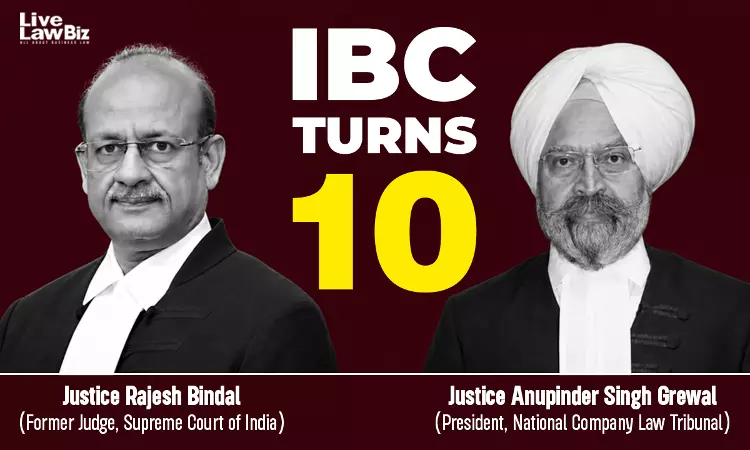
The President of the National Company Law Tribunal (NCLT), Justice Anupinder Singh Grewal, has called for raising the ₹1 crore threshold for initiating insolvency proceedings under the Insolvency and Bankruptcy Code (IBC), observing that some creditors are using the law primarily to recover debts rather than resolve insolvency.
Speaking at the 'IBC Turns 10' conference at the Chandigarh Judicial Academy on Saturday, Justice Grewal suggested increasing the threshold to ₹2 crore, ₹5 crore or ₹10 crore.
“Many cases that they file for the sake to recover their dues and not meant for resolution. So, they are just crossing the threshold of ₹1 crore... so I suggest that needs to be increased to ₹2 crores, ₹5 crores or ₹10 crores,” he said.
The threshold for initiating insolvency proceedings was initially fixed at ₹1 lakh when the IBC was enacted in 2016. It was increased to ₹1 crore in 2020.
Justice Grewal also highlighted the NCLT's work in resolving insolvency cases, stating that the Tribunal had approved 1,748 resolution plans under the IBC, involving approximately ₹4.90 lakh crore. The value of plans approved so far in the current financial year stood at approximately ₹17,000 crore.
He also stressed the need to explore mediation to resolve disputes. Acknowledging that timelines prescribed by the Supreme Court posed challenges to referring matters for mediation, he said the NCLT had begun calling parties for discussions during court proceedings to facilitate settlements.
“Mediation can play wonders,” he said, adding that the Tribunal had resolved 25 matters through mediation at the pre-CIRP stage.
Justice Grewal also highlighted the role of insolvency professionals in facilitating resolution, describing them as the foundation of the process. He said their work was essential to the effective implementation of the IBC and the wider goal of strengthening the country's economy.
“Insolvency professionals are the foundation of the resolution process. We have a limited role. We can look into the final aspect. But the resolution professional/insolvency professional play a vital role... This is a nation building. As said, ours is one of the fastest growing economies... So this is a very important profession and it should be seen as a service to the nation... As an insolvency professional, you have a very important role in building the economy of the nation,” he said.
Delivering the keynote address, former Supreme Court judge Justice Rajesh Bansal called for better use of default data collected by National E-Governance Services Limited (NeSL) to identify industries prone to recurring defaults and explore measures to prevent them.
Justice Bansal said collecting default data was not enough and stressed the need to analyse the information to understand which industries were witnessing recurring defaults.
“I have also read about a company, National e-Governance Services Limited. This company is collecting the data of the defaultment... But collection of data is one thing. Why can't we use this data for quality purposes? We should also see which kind of industry is going in default. What measures can be taken for that... whether we should encourage... we should use that data for that purpose also,” he said.
Justice Bansal also stressed the need to explore mediation and take timely action when signs of financial distress emerge. He noted that lenders, too, contributed to the problem by extending loans without adequate security or properly assessing the viability of projects.
Emphasising the need for collective efforts to implement the IBC, he said effective implementation would benefit the country's economy.
“As compared to any other law in the country, this Act has got the purpose for which it was enacted,” he said.
The conference, organised by the Society of Indian Lawyers in association with INSOL India and IWIRC India, marked ten years of the IBC, enacted in 2016. It brought together members of the judiciary, legal practitioners, insolvency professionals and students.
The programme features sessions on cross-border insolvency, including the UNCITRAL Model Law and the recognition of foreign proceedings, as well as mediation, out-of-court settlements and potential reforms to the insolvency framework.
Justice Jagmohan Bansal of the Punjab and Haryana High Court attended as Guest of Honour, alongside senior advocates and law firm partners.