
Interim Protection Granted By High Court Cannot Replace Claim Filing Under IBC: Madras High Court
Shilpa Soman
28 Nov 2026 3:52 PM IST
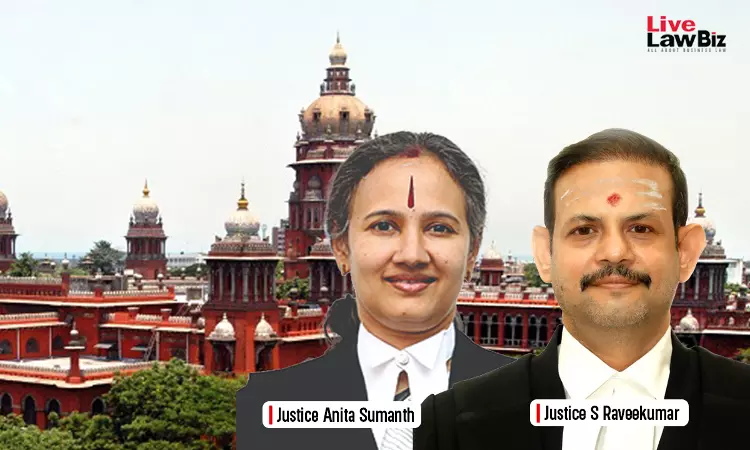
The Madras High Court on Friday held that an interim order directing a company to furnish a bank guarantee cannot substitute the requirement of filing a claim before the Resolution Professional under the Insolvency and Bankruptcy Code (IBC).
A Bench of Justices Dr. Anita Sumanth and S. Raveekumar in the matter of Ruchi Soya Industries observed:
“We are of the considered view that the defence that the interim protection granted by the writ Court would secure the interests of the Department in regard settlement of the outstanding demands, is wholly misconceived and has no basis in law. The nature of interim protection granted by the writ Court is, but limited, and cannot be equated to the CIRP provided for under the Code.”
Ruchi Soya (now Patanjali Foods Limited) had filed two bills of entry for clearance of consignment of edible grade palm oil.
During assessment, the Customs Department applied a notification dated September 17, 2015, which increased the Basic Customs Duty from 7.5% to 12.5%. The company challenged the reassessment, contending that the notification was made available in the public domain only on September 21, 2015, after the consignment had arrived.
Meanwhile, insolvency proceedings were initiated against the company and the NCLT approved its resolution plan on July 24, 2019. Ruchi Soya contended that the customs duty demand stood extinguished since the Customs Department had not submitted any claim before the Resolution Professional.
During the pendency of the writ petition, the High Court had directed the release of the imported goods against a bank guarantee furnished by the company.
The Single Judge directed Ruchi Soya to approach the NCLT for clarification on whether the customs duty demand was covered by the approved resolution plan. It also permitted the Customs Department to recover the duty after the stipulated period, subject to the NCLT's decision.
Aggrieved by these directions, the company filed an appeal before the Division Bench.
The Court noted that the Customs Department had admittedly not submitted any claim before the Resolution Professional, despite the commencement of the Corporate Insolvency Resolution Process.
It rejected the Department's contention that the bank guarantee furnished pursuant to the interim order protected its interests and dispensed with the requirement of filing a claim.
“ The order of interim protection thus has only the limited impact of balancing the rights of the parties pending the main litigation, and nothing more. Being an interim measure, it would certainly not substitute the procedure set out under the IB Code for settlement of outstanding claims.” it held
The Court observed that the IBC lays down a distinct framework for the submission and adjudication of creditors' claims during CIRP, as well as for determining the effect of an approved resolution plan.
Referring to Section 3(6) of the IBC which defines “claim”, the Bench observed:
"it is only upon institution of a claim by a creditor, that the process of adjudication of the claim would commence, securing and protecting the position of the creditor in the CIRP.”
The Court further observed that the IBC provides a specific mechanism for insolvency resolution and settlement of debts. It added that Section 238 gives the Code overriding effect over any inconsistent provisions in other laws.
Referring to the Supreme Court's ruling in Ghanashyam Mishra and Sons Pvt Ltd v. Edelweiss Asset Reconstruction Company Ltd, the Bench reiterated that once a resolution plan is approved by the NCLT, claims that are not part of the approved plan stand extinguished.
The Bench therefore held that there was no requirement for Ruchi Soya to approach the NCLT for further clarification on whether the customs duty demand had been included in the resolution plan.
Accordingly, the Court allowed the writ appeal.
For Appellant: Advocates Rajesh Rawal and V Pushpa
For Respondents: Advocate K.S Ramaswamy, Senior Standing Counsel