
Supreme Court Says Extended GST Limitation Cannot Be Invoked Mechanically, Quashes G.R. Infra Notice
Rajnandini Dutta
24 Aug 2026 4:59 PM IST
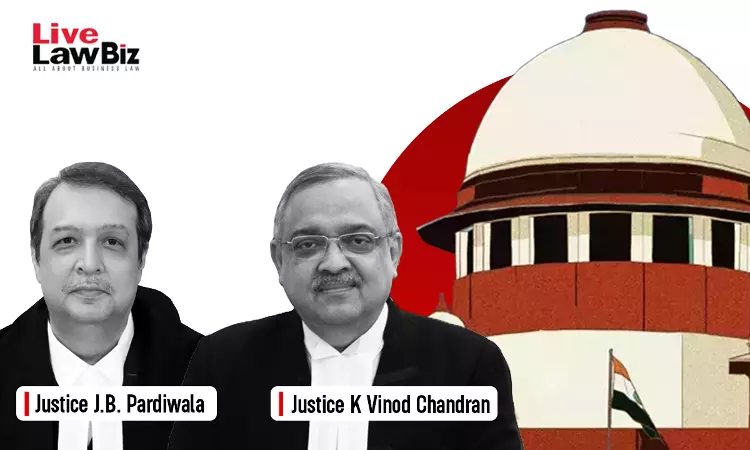
The Supreme Court on 19 August held that the extended limitation period under Section 74 of the Central Goods and Services Tax Act, 2017 cannot be invoked merely by mechanically using expressions such as “fraud”, “wilful misstatement” or “suppression of facts” in a show cause notice.
A Bench of Justices J.B. Pardiwala and K. Vinod Chandran allowed an appeal filed by G.R. Infra Projects Limited, Ratlam, observing that the show cause notice itself must specify the allegations and circumstances which led the assessing officer to infer fraud, concealment or suppression of facts. The judges held:
“What is required for the extended time to be applied are the allegations, which lead to the inference of a fraud or the concealment as attempted by the assessee resulting in suppression of facts, should emanate from the notice itself.”
G.R. Infra Projects Limited challenged the Madhya Pradesh High Court's order upholding a show cause notice issued under Section 74 of the CGST Act read with the Madhya Pradesh Goods and Services Tax Act for the assessment year 2018-19.
The State issued the show cause notice on 13 June 2025. G.R. Infra Projects contended that proceedings under Section 74 could be initiated only where fraud, wilful misstatement or suppression of facts was specifically alleged. In the absence of such allegations, it argued, the proceedings would fall under Section 73 and would be barred by limitation.
It also relied on its counter affidavit to explain the allegations of fraud and suppression of facts. The Supreme Court, however, refused to consider the counter affidavit for this purpose.
The Bench held that where a party challenges the validity of a notice or order, the notice or order itself must contain the requirements necessary to sustain it. A party cannot subsequently cure a deficiency in the notice through a counter affidavit filed before the Court.
On limitation, the it noted that the due date for filing the annual return for 2018-19 had ultimately been extended to 31 December 2020. Accordingly, the limitation for proceedings under Section 73 ordinarily expired on 31 December 2023.
The Court also took into account the exclusion of the limitation period granted during the COVID-19 pandemic and found that the extended period expired on 28 February 2025. Since the State issued the show cause notice only on 13 June 2025, the proceedings were barred by limitation under Section 73.
It then examined whether the Department could validly invoke Section 74 to overcome the limitation. It found that the notice contained only a “bland statement” of fraud or concealment of facts and did not explain how the assessing officer had inferred fraud or detected concealment.
Further, the judges held that authorities cannot mechanically use the expressions “fraud, willful misstatement or suppression of facts” without setting out the aspects which persuaded the assessing officer to conclude that such conduct had been adopted.
The Division Bench found no reason to sustain the show cause notice and set it aside along with the Madhya Pradesh High Court's order. It directed the State not to take any further proceedings pursuant to the notice.
Accordingly, the Supreme Court allowed the appeal.
Appearances: Jatin Harjai, Rohan Aggarwal, Nikshubha Sharma and Vatsalya Vigya, AOR, among others, appeared for the appellant. Rudraditya Khare, DAG, Mrinal Gopal Elker, AOR and Sai Shashank appeared for the State.