
Rajasthan High Court Sets Aside Unsigned GST Notice And ₹3.13 Lakh Demand Against Mayur Timber
Mehak Dhiman
1 Sept 2026 3:14 PM IST
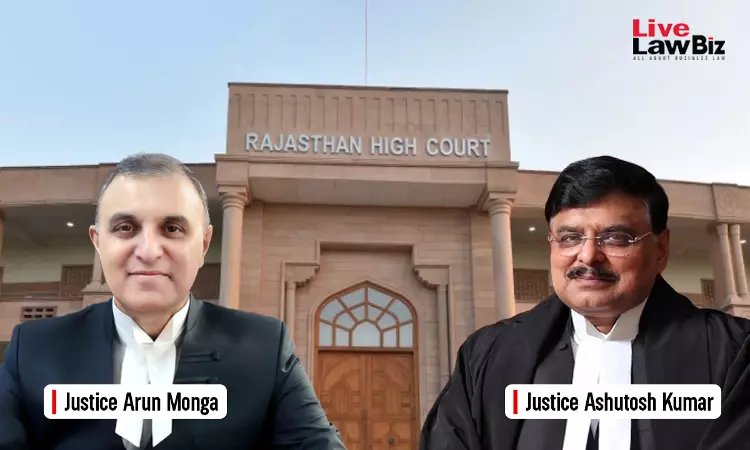
The Rajasthan High Court on 11 August set aside an unsigned Goods and Services Tax (GST) show-cause notice and consequential demand of over Rs. 3.13 lakh raised against Mayur Timber, along with interest of Rs. 4,26,002 and an equivalent penalty.
A Division Bench comprising Justices Arun Monga and Ashutosh Kumar held that mere generation of a document on the GST portal or allotment of a reference number cannot replace the mandatory requirement of authentication under Rule 26(3) of the Central Goods and Services Tax (CGST) Rules, 2017. It observed:
"The rule making authority consciously substituted the pen with the digital signature certificate. It did not dispense with authentication altogether. The requirement of signature, therefore, is not an empty formality or a procedural nicety. It is the very mode by which an electronic document acquires legal existence and binding character."
The demand arose from an allegation that Mayur Timber had wrongly availed Input Tax Credit without actual receipt of goods. The show-cause notice was issued on 13 June 2024, followed by the demand order on 15 October 2024.
Mayur Timber challenged the proceedings, stating that the show-cause notice and the subsequent order were neither digitally nor physically signed. It also submitted that the documents were uploaded only under the "Additional Notices and Orders" section of the GST portal and were not otherwise served on it.
It further stated that it came to know about the demand only after its banker informed it about recovery proceedings and attachment of its bank account. It also contended that no effective opportunity of personal hearing was granted before the demand was confirmed.
The Revenue opposed the plea, arguing that the documents had been duly uploaded on the GST portal and carried system-generated reference numbers. It contended that such electronic uploading amounted to valid service and that the taxpayer was required to regularly check the GST portal. The Revenue also relied on the availability of an alternative statutory remedy of appeal.
The Court rejected the contention that a reference number could substitute a signature. It held that a reference number merely tracks or identifies a document, whereas a signature authenticates it and establishes that it was issued by the competent officer.
It emphasised that Rule 26(3) uses the word "shall" and therefore makes authentication mandatory. It held that electronic generation and authentication are two separate requirements and that merely generating a document electronically does not satisfy the requirement of authentication.
Further, the Bench explained that a signature serves important purposes under the GST framework, including authenticating the document, identifying the officer responsible for its contents and ensuring application of mind before a demand is raised against the taxpayer.
It held that a show-cause notice or order which is neither digitally nor physically signed cannot be treated as a valid notice or order in law. It held that the defect goes to the root of the proceedings and is not merely a curable procedural irregularity.
The judges also noted that the unsigned documents had been placed only under the “Additional Notices and Orders” tab and that the petitioner remained unaware of the proceedings until recovery action was initiated. This, coupled with the absence of an effective hearing, resulted in a violation of the principles of natural justice and Section 75(4) of the CGST Act. They observed:
"The absence of an authenticated and properly communicated notice appears to have occasioned a miscommunication regarding the date fixed for personal hearing as well. On that date the petitioner remained unrepresented. He was thus not heard contrary to the mandate of Section 75(4) of the CGST Act. In the premise, the plea of alternative remedy raised by the respondents does not deter us."
Accordingly, the Rajasthan High Court set aside the show-cause notice dated 13 June 2024, the consequential order dated 15 October 2024 and the recovery notice dated 20 August 2025, while clarifying that it had not expressed any opinion on the merits of the GST demand.
It granted liberty to the Revenue to initiate proceedings afresh by issuing a duly authenticated show-cause notice and passing a fresh order after providing the taxpayer an effective opportunity of hearing.
For Petitioner: Ravi Gupta and Harsh Lodha, Advocates
For Respondent: Mahi Yadav, AAG and Manish Acharya, Pawan Pareek, and Raj Kumar Yadav, Advocates