
S. 76 CGST Act | Appellate Authority Can Decide Reasonable Period For Issuing Show Cause Notice: Delhi High Court
Kapil Dhyani
5 Aug 2026 9:42 AM IST
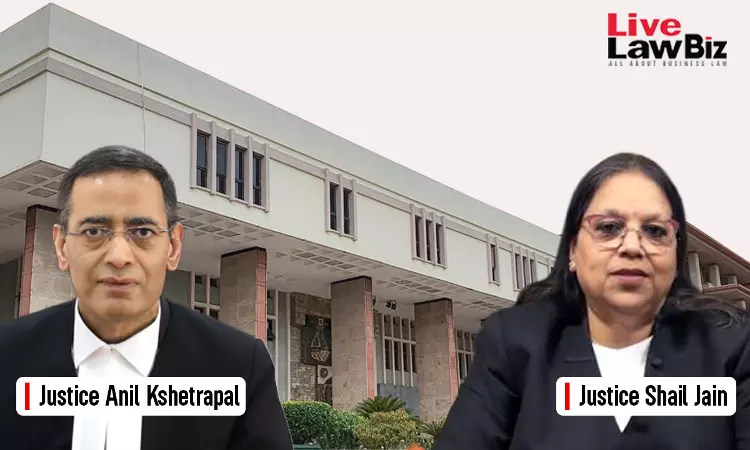
The Delhi High Court has held that the GST Appellate Authority is competent to decide what constitutes a "reasonable period" for issuance of a show cause notice under Section 76 of the Central Goods and Services Tax (CGST) Act, 2017.
The Division Bench of Justices Anil Kshetrapal and Shail Jain thus refused to entertain a writ petition in this regard, by bypassing the statutory appellate remedy.
The petition was filed by a security services company, challenging a show cause notice dated September 30, 2025 and the consequential demand order dated March 30, 2026.
Petitioner contended that although Section 76 of the CGST Act does not prescribe any limitation period for issuance of a show cause notice, the question of what constitutes a "reasonable period" could only be decided by the High Court and not by the Appellate Authority.
Reliance was placed on State of Punjab v. Bhatinda District Cooperative Milk Producers Union Ltd. (2007) where the Supreme Court ruled that statutory and administrative powers must be exercised within a reasonable time limit.
The High Court at the outset observed that the appellate remedy under Section 107 of the CGST Act is comprehensive in nature and cannot be narrowly construed so as to exclude the Appellate Authority's jurisdiction to interpret what constitutes a "reasonable period" based on the facts of each case.
It observed,
"In these circumstances, the appellate remedy, which is comprehensive in nature, cannot be narrowly construed so as to exclude the jurisdiction of the Appellate Authority to examine the question relating to the interpretation of expression “a reasonable period”, as laid down by the Courts from time to time. The question as to what constitutes a reasonable period is required to be adjudicated upon on the basis of the facts of each case. Such power is available with the Appellate Authority.”
The show cause notice had been issued under Sections 76 and 74 of the CGST Act in relation to the financial years 2017-18, 2018-19 and 2019-20, alleging that the petitioner had unlawfully availed input tax credit (ITC) and consequently failed to pay the tax due.
Petitioner argued that Section 76 alone had been invoked for the financial years 2017-18 and 2018-19, and not Section 74.
The Court held that this contention too could appropriately be examined by the Appellate Authority and as such, refused to entertain the plea.
For Petitioner: Senior Advocate Nisha Bagchi with N.K. Sharma, Advocate; Kapil Gautam, Advocate; and Deepak Gautam, Advocate.
For Respondents: Kavindra Gill, Standing Panel Counsel for Union of India, with Disha Choudhary, Government Pleader for Union of India; Arun Khatri, Senior Standing Counsel, with Anoushka Bhalla, Advocate for CGST.