
GST Refund Limitation Mandatory; Delay Can Be Condoned Under Article 226 In Cases Of Genuine Hardship: Karnataka HC
Mehak Dhiman
16 April 2026 9:20 PM IST
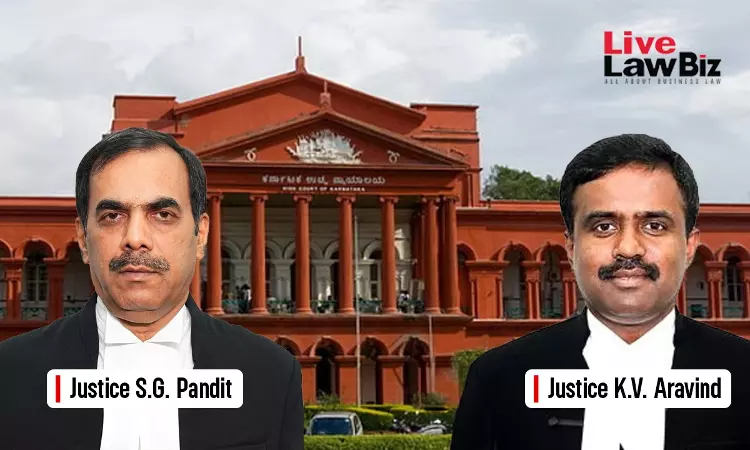
The Karnataka High Court held that the two-year limitation under Section 54 of the CGST Act is mandatory, and cannot be relaxed by tax authorities. However, in cases of genuine hardship, delay in filing refund claims may be condoned by invoking writ jurisdiction under Article 226, subject to safeguards protecting the Revenue.
The Division Bench comprising Justice S.G. Pandit and Justice K.V. Aravind made the ruling.
Section 54 of the CGST Act provides provisions for claiming refunds of excess GST paid by a registered person.
The bench stated that "There may be instances where, due to genuine or unavoidable reasons beyond the control of the taxpayer, the period prescribed under Section 54 lapses. If no remedy is made available in such circumstances, the provision may operate with undue harshness and arbitrariness. In the absence of any such enabling provision under the Act, the jurisdiction of this Court under Article 226 of the Constitution of India remains the only available remedy. Merely because the provision under Section 54 is held to be mandatory, it cannot be said that the jurisdiction vested in this Court under Article 226 stands excluded or rendered unavailable."
The respondent-assessee (taxpayer), Merck Life Science Pvt. Ltd., was engaged in providing intermediary services to foreign entities. Initially, for October 2017, it treated such services as “export of services” and paid IGST.
Subsequently, treating the same transaction as intra-State supply, it paid CGST and SGST. Since this resulted in double taxation, the assessee filed a refund application under Section 54 of the CGST Act on 30.03.2024 seeking refund of the IGST paid.
The refund claim was rejected by the department on the grounds of limitation, as it was filed beyond the prescribed two-year period, even considering the extended window under Rule 89(1A) of the CGST Rules introduced via Notification dated 24.09.2021.
The Single Judge allowed the writ petition, holding the limitation as directory and directing consideration of the refund. Aggrieved, the Revenue preferred writ appeals.
The Revenue contended that Section 54 clearly prescribes a mandatory limitation period of two years, which cannot be diluted by treating it as directory. It was argued that allowing belated refund claims would disrupt the time-bound framework of the GST regime and adversely affect related proceedings under Sections 73 and 74. The authorities emphasized that in the absence of any statutory provision for condonation, refund claims beyond limitation cannot be entertained.
On the other hand, the assessee argued that the tax was paid twice due to a bona fide mistake, and retention of such tax would violate Article 265 of the Constitution. It was submitted that the refund mechanism was operationalized only after insertion of Rule 89(1A), and hence, the limitation should not be strictly applied. The assessee also contended that denial of refund on technical grounds would result in unjust enrichment of the State.
The bench held that "The period of two years prescribed under Section 54 of the CGST Act, 2017 is mandatory."
It observed that the GST framework is inherently time-bound, and strict adherence to timelines is essential to maintain certainty and finality in tax administration. In the absence of any statutory power to condone delay, the proper officer cannot entertain belated refund claims.
At the same time, the court recognized that the CGST Act does not provide any mechanism to address genuine hardship arising from delayed claims. It held that in such cases, the writ jurisdiction under Article 226 can be invoked to seek condonation of delay, particularly where tax has been collected without the authority of law.
The bench opined that "As no remedy is provided under CGST Act to consider a refund claim under Section 54, if filed belatedly, it is open to any person claiming refund to avail remedy under Article 226 of the Constitution of India."
"This Court may exercise its jurisdiction under Article 226 of the Constitution of India where the Act does not provide any mechanism to remedy genuine hardship. There cannot be universal guidelines or a straitjacket formula to deal with every situation. The facts and circumstances of each case, as well as the object and purpose of the provision, are required to be considered by the Court while exercising jurisdiction under Article 226", added the bench.
Importantly, the court ruled that any condonation of delay must be accompanied by a corresponding extension of time to the Revenue to initiate proceedings under Sections 73 or 74, if warranted.
"Once condonation of delay is granted by the Court in filing the refund claim, the claim shall be treated as having been filed within the prescribed period of two years, thereby enabling all consequential benefits to the claimant as well as the exercise of appropriate powers by the proper officer under the Act", added the bench.
Applying these principles, the Court found that although the refund claim was filed beyond the limitation, the delay was only six months and the entitlement to refund was undisputed. Accordingly, the delay was condoned, and the authorities were directed to consider the refund application on merits.
The bench stated that "in the return filed for October 2017, the assessee had paid IGST treating the services as “export of services”. Subsequently, the transaction was treated as an intra-State supply, and the assessee paid CGST and SGST. The refund claim was thereafter made in respect of the IGST paid, under Section 54. The said refund claim was rejected on the ground that it was filed beyond the prescribed period of two years."
The appeals were thus partly allowed, setting aside the Single Judge's finding that limitation is directory, while granting relief to the assessee by permitting consideration of the delayed refund claim.
For Appellant: Senior Standing Counsel, Aravind V. Chavan
For Respondent: Advocate, Bharath B. Raichandani