
Madras High Court Upholds GST Authorities' Power To Block Electronic Credit Ledger For Tax Recovery
Mehak Dhiman
3 Sept 2026 2:56 PM IST
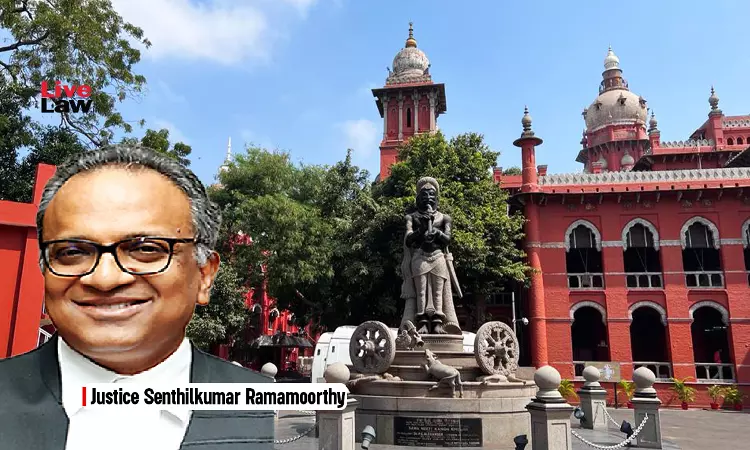
The Madras High Court on 25 August held that Goods and Services Tax (GST) authorities can block an electronic credit ledger, including through a negative blocking entry, to recover tax dues, even where recovery proceedings arising from the assessment order have been stayed.
Justice Senthilkumar Ramamoorthy passed the ruling while disposing of a writ petition filed by Zigma Machinery & Equipment Solutions against the Assistant Commissioner, Coimbatore-I Division. The Bench held:
“In contrast to Rule 86A, which is a provisional measure typically undertaken at the pre-determination of liability stage, the powers under Section 79 are wider on account of being measures taken at the post determination stage to recover amounts due and payable to the Government...”
The petitioner had challenged an assessment order dated 17 March 2023 covering the assessment periods from 2017 to 2020. It filed W.P. No. 41890 of 2025 before the High Court, primarily challenging the clubbing of multiple assessment periods.
Meanwhile, on 4 February 2025, the petitioner's electronic credit ledger was blocked.
On 25 February 2026, the High Court, in W.P. No. 41890 of 2025, passed an interim order staying recovery measures arising from the assessment order.
The petitioner thereafter filed the present writ petition, W.P. No. 32816 of 2026, challenging the blocking of its electronic credit ledger. Relying on the interim stay, it contended that the ledger could no longer remain blocked. It also argued that a negative blocking entry in the electronic credit ledger was not permissible under the GST law.
The Revenue opposed the plea, contending that the interim order merely kept recovery proceedings in abeyance and did not invalidate the earlier blocking of the electronic credit ledger.
The High Court accepted the Revenue's contention. It observed that the interim order only prevented the department from debiting amounts available in the electronic credit ledger towards recovery of the disputed dues. It did not, by itself, nullify the earlier action of blocking the ledger.
It noted that Section 79 of the Central Goods and Services Tax Act, 2017 confers wide powers on the proper officer to recover government dues through various modes, including deduction from money or goods, garnishee proceedings, and distraint and sale of assets.
The Bench held that blocking the electronic credit ledger, including through a negative blocking entry, falls within the scope of these recovery powers. It also distinguished these powers from the mechanism under Rule 86A of the Central Goods and Services Tax Rules, 2017, which permits authorities to restrict the use of input tax credit in specified circumstances as a provisional measure.
Further, it observed that Rule 86A operates at the pre-determination stage, whereas Section 79 provides wider recovery powers after the liability has been determined and the amount has become due and payable to the Government.
Rejecting the petitioner's contention that a negative blocking entry could not be made under the recovery provisions, the Bench held that the scope of the powers under Section 79 was wide enough to sustain such action.
Accordingly, the High Court disposed of the writ petition without imposing any costs.
For Petitioner: Bhagavath P, Advocate
For Respondent: Rajendran Raghavan, Senior Standing Counsel