
Delhi High Court Upholds ₹2.31 Crore Anti-Profiteering Liability Against LICHFL Care Homes
Kapil Dhyani
29 Sept 2026 9:58 AM IST
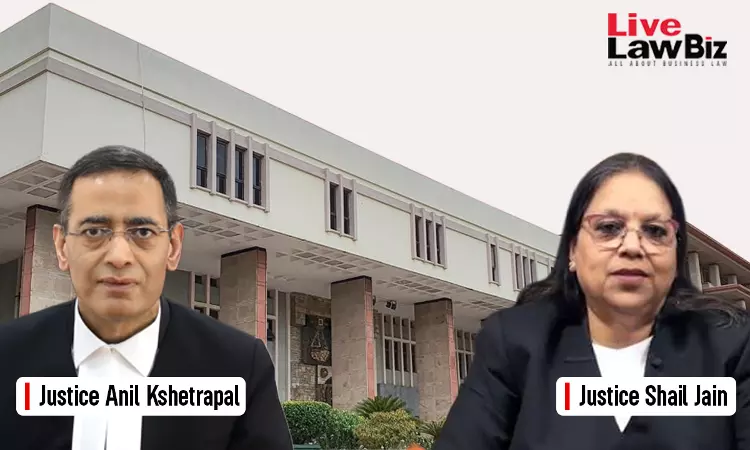
The Delhi High Court has upheld a ₹2.31 crore anti-profiteering liability imposed on LICHFL Care Homes Limited in relation to its residential project 'Jeewan Anand' in Bhubaneswar, Odisha.
The Division Bench of Justices Anil Kshetarpal and Shail Jain rejected the developer's contention that CENVAT credit which was legally available under the pre-GST regime but not actually availed should be taken into account while determining the benefit arising from the introduction of GST.
“The Petitioner may have been legally entitled to claim such credit. However, the authorities were justified in examining the actual ITC availed during the respective periods rather than introducing a hypothetical credit into the pre-GST computation,” it observed.
It thereby dismissed the developer's petition challenging an order of the Goods and Services Tax Appellate Tribunal (GSTAT), which had upheld the determination of profiteering of ₹2,07,08,131 and directed payment of ₹2,31,93,107 to homebuyers after adding GST at 12%, along with interest at 18%.
The Court was considering whether the methodology adopted by the Directorate General of Anti-Profiteering (DGAP), pursuant to an earlier remand, complied with the directions issued by the High Court in Reckitt Benckiser India Pvt. Ltd. v. Union of India (2024).
In Reckitt Benckiser, the High Court had found the methodology generally adopted for determining profiteering in the real estate sector, based on comparison of the ratio of input tax credit (ITC) to turnover in the pre-GST and post-GST periods, to be flawed.
It had directed that the total savings arising from the introduction of GST for each project be calculated and divided by the total area to arrive at the per-square-foot benefit to be passed on to flat buyers.
Following the remand, the DGAP examined the purchase value of goods and services and the ITC actually availed during the post-GST period. It determined the additional ITC benefit at ₹2,07,65,434 and, after apportioning it over the project area, arrived at a saving of ₹76.895 per square foot. This resulted in a profiteered amount of ₹2,07,08,131 in respect of the sold area.
The developer argued that it had been legally entitled to CENVAT credit of approximately ₹2.38 crore on service tax paid on input services during the pre-GST period, but had failed to avail the credit due to an inadvertent error. It contended that the post-GST ITC on input services therefore could not be treated as an additional benefit.
The High Court rejected this contention, drawing a distinction between eligibility for credit and its actual availment.
"The distinction between eligibility and actual availment is material," the Court observed, noting that the ST-3 returns for the relevant pre-GST period reflected NIL CENVAT credit actually availed, whereas the developer had admittedly availed GST ITC of ₹2,07,76,653 during the post-GST period.
The Court held that Section 171 of the CGST Act is concerned with the benefit of ITC actually accruing to the supplier and its consequential passing on to the recipient.
It observed that the developer could not "notionally treat an unavailed credit as though it had already reduced its pre-GST tax incidence", as this would amount to comparing an actual post-GST benefit with a hypothetical pre-GST benefit.
The anti-profiteering determination, the Court said, must proceed on the economic benefit that actually accrued under the respective tax regimes.
It also rejected the argument that the DGAP had merely revived the earlier, rejected methodology by replacing "turnover" with "purchase value".
It held that purchase value was used to quantify the proportion of ITC available against project expenditure, after which the resulting saving was converted into a project-wide per-square-foot figure.
As such, the Court dismissed the writ petition.
For Petitioner: Advocates Kishore Kunal, Runjhun Pare
For Respondents: Advocates Anurag Ojha, SSC with Dipak Raj, Aryaman Singh Chouhan, Aditya Chaudhary, Sharmila Upadhyay, Aditi Anup, for R-3. Niranjan Swain, R-3 through VC.