
Delhi High Court Reads Down GST Rule On Corporate Guarantees, Allows Valuation Lower Than 1% Minimum
Kapil Dhyani
17 Nov 2026 7:43 PM IST
The Delhi High Court on Tuesday held that prescribing a fixed minimum valuation of 1% per annum for corporate guarantees under the Goods and Services Tax (GST) regime is arbitrary and violative of Article 14 of the Constitution if taxpayers are not permitted to establish a lower open market value.
The Court accordingly read down Rule 28(2) of the Central Goods and Services Tax Rules, 2017, holding that the deemed valuation of 1% of the guaranteed amount per annum must give way to a lower open market value where the supplier establishes such value through cogent and verifiable evidence.
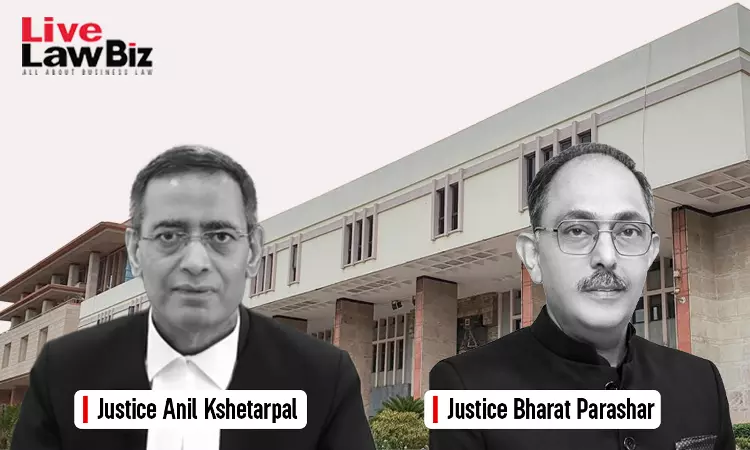
The Division Bench of Justices Anil Kshetarpal and Bharat Parashar clarified that the 1% valuation would operate as a rebuttable presumption rather than an inflexible minimum.
"The deemed value of 1% of the amount of the guarantee per annum shall yield to a lower open market value, where the supplier establishes such value on cogent and verifiable material. The burden lies on the supplier, and the proper officer is entitled to test the material. Thus, the deemed value is a rebuttable presumption, and not a fixed minimum," it observed.
The ruling came in a batch of petitions filed by Sterlite Power Transmission Limited, ReNew Private Limited, Jindal Stainless Limited, Azure Power India and several other companies challenging the GST treatment and valuation of corporate guarantees furnished by holding or group companies for loans obtained by their subsidiaries or related entities.
Rule 28(2), introduced through a notification dated October 26, 2023, prescribed a deemed valuation mechanism for corporate guarantees furnished to banks or financial institutions on behalf of related persons.
The provision, subsequently amended in July 2024, stipulated that the value of such services would be deemed to be 1% of the amount guaranteed per annum or the actual consideration, whichever is higher.
The petitioners challenged the provision, arguing that imposing a uniform valuation irrespective of the actual commercial value of the guarantee was arbitrary and unconstitutional.
They contended that the provision excluded alternative valuation methods even where the open market value was ascertainable. They also argued that the 1% benchmark had been borrowed from the Safe Harbour Rules under the Income Tax framework, where its application was optional, and had been converted into a compulsory minimum under the GST regime.
Appearing for the Revenue, Additional Solicitor General N. Venkataraman defended the provision, relying on the difficulties in determining the market value of corporate guarantees between related companies and the recommendations of the GST Council.
The High Court acknowledged that the GST Council had identified genuine difficulties in finding comparable transactions for corporate guarantees issued within corporate groups.
It held that adopting 1% as a presumptive valuation was not inherently objectionable. However, the difficulty in determining the market value could not justify refusing to accept a lower value where the same was demonstrably ascertainable.
The Court noted that the GST Council itself had recognised that banks charge between 0.5% and 3% for guarantees and sometimes do not charge anything.
It further observed that the 1% benchmark had been borrowed from the Safe Harbour Rules, which permit taxpayers either to accept the prescribed rate or establish an arm's length price.
"The Respondents have taken a figure meant to be an option for the taxpayer and turned it into a compulsory minimum. Therefore, the source chosen does not support the compulsion imposed," the Court observed.
It further noted that valuation methods such as fair value recognised under Ind AS 109, transfer pricing benchmarks accepted in assessments and pricing based on credit rating differentials could establish the actual market value of a corporate guarantee.
It held that mandating a higher deemed value despite the availability of reliable evidence of a lower market value would effectively amount to taxing a value that did not exist.
However, the Court clarified that the consideration mutually agreed upon between related companies, or the absence of any consideration, could not by itself be relied upon to displace the deemed valuation.
It explained that Section 15(1) of the CGST Act does not ordinarily accept prices agreed between related persons as a reliable measure of transaction value.
Accordingly, the appropriate comparison must be with the open market value between unrelated persons, rather than the consideration agreed upon within the corporate group.
The Court also rejected the contention that the GST Council's recommendations placed the valuation rule beyond judicial scrutiny. It observed that while such recommendations deserved deference on fiscal policy matters, they could not exclude judicial review on grounds of arbitrariness or statutory validity.
The Court ultimately held that Rule 28(2) was within the rule-making powers conferred by Sections 15 and 164 of the CGST Act. However, insofar as it prescribed an irrebuttable minimum valuation of 1% per annum, it was arbitrary and violative of Article 14. The Court therefore read down the provision.
It also upheld the proviso to Rule 28(2), under which the value declared in the invoice is accepted where the recipient is eligible for full input tax credit.
The Court also held that corporate guarantees issued by holding or group companies for the borrowings of related entities constitute a taxable supply of services under the CGST Act even in the absence of consideration.
For the Petitioners: Senior Advocate Balbir Singh; Advocates Kumar Visalaksh, Rahul Khurana, Udit Jain, Arihant Tater, Ajitesh Dayal Singh, Pranav Bansal, Vibhor Sharma, Disha Jham, Vedant Kohli and Karan Sachdev.
For the Respondents: Standing Panel Counsel Tanvi Nigam for the Union of India; Central Government Standing Counsel Shashank Dixit, along with Advocates Kunal Raj, Shagun Shahi Chugh and Rimpy Rohilla; Additional Solicitor General N. Venkatraman, along with Senior Standing Counsel Atul Tripathi and Advocates Akshay Sagar, Shubham Mishra and Gaurav Mani Tripathi.