
Excise Department Cannot Invoke Extended Limitation For Omission When Facts Were Already Known: Supreme Court
Rajnandini Dutta
13 Aug 2026 10:19 PM IST
The Supreme Court on Thursday reiterated that the Excise Department cannot invoke the extended limitation period when the relevant facts were already known to it. The court set aside an excise duty demand after finding that the Department knew the manufacturer had cleared the chassis at 110% of its manufacturing cost.
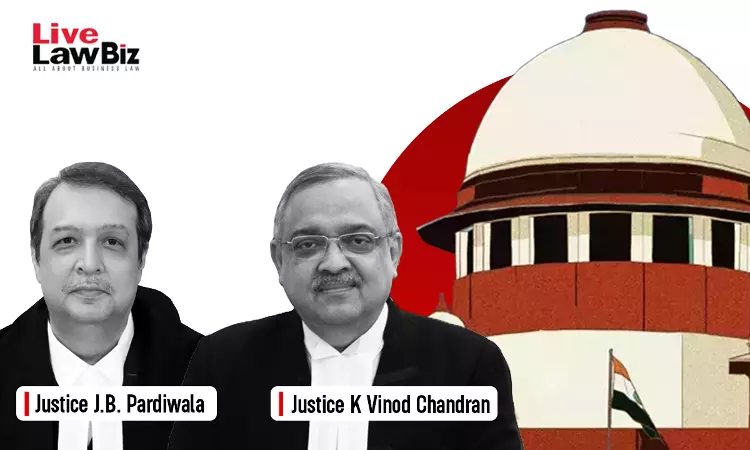
A Bench of Justices J.B. Pardiwala and K. Vinod Chandran, however, upheld the Department's position on valuation. It ruled that the additional 10% included in the valuation of the chassis under Rule 8 had to be included while determining the assessable value of the completed vehicle.
Referring to its earlier ruling in Continental Foundation Joint Venture Holding v. CCE, the court observed:
“More importantly, for our purpose, it was held that 'when the facts are known to both the parties, omission by one party to do what he might have done would not render its suppression'. In the instant case, we already noticed that the manufacturer cleared the chassis at 110% of its cost of manufacture, which was known to the Department. Hence, if 10% was not added when computing the duty at the time of clearance by the job worker, the department ought to have taken immediate action under subsection (1). The proviso cannot be invoked to extend the period of limitation.”
The dispute concerned appellants engaged in the bodybuilding of motor vehicles as job work. Vehicle manufacturers supplied them with chassis, on which the appellants built the bodies and returned the completed vehicles to the manufacturers.
At the time the chassis were cleared for body building, the manufacturers paid excise duty on their value. This value was calculated at 110% of the cost of manufacture under Rule 8 of the Central Excise Valuation (Determination of Price of Excisable Goods) Rules, 2000.
When the completed vehicles were cleared, the appellants calculated excise duty after taking CENVAT credit for the duty already paid on the chassis. They calculated the duty on the actual cost of manufacturing the chassis. The additional 10% was not included.
The Department took the view that this 10% had to be included in the assessable value of the completed vehicles.
The Supreme Court agreed with the Department on this issue. It held that the additional 10% was already part of the value of the intermediate product, namely the chassis. It therefore had to be included when the job worker calculated the assessable value of the completed vehicle.
The appellants had argued that the issue had remained in a state of flux until the larger bench of the tribunal decided it. They relied on the decisions in Ujagar Prints II and Ujagar Prints III in support of their argument.
The Supreme Court held that the Constitution Bench decision in Ujagar Prints applied squarely to the dispute. It rejected the argument that the issue had remained in a state of flux.
The court then considered whether the Department could rely on the extended limitation period under the proviso to Section 11A of the Central Excise Act.
It referred to its earlier decision in Larsen & Toubro Ltd. v. CCE, where it held that reasons for invoking the extended limitation period must be specifically stated in the show-cause notice. The court also referred to Continental Foundation Joint Venture Holding v. CCE, which explained the requirement of willful misstatement or suppression.
In Continental Foundation, the Supreme Court had held that “misstatement” and “suppression” of facts are qualified by the requirement that they be wilful.
It also held that a contravention of the Act or Rules must be accompanied by an intention to evade payment of duty.
Applying that principle, the court found that the Department already knew the manufacturer had cleared the chassis at 110% of its manufacturing cost. The appellants' failure to include the additional 10% when clearing the completed vehicles therefore could not be used to invoke the extended limitation period.
The demand is related to the period from November 1, 2004 to March 31, 2007. The show-cause notice was issued on April 30, 2008, beyond the one-year period prescribed under Section 11A(1).
The Supreme Court consequently set aside the order of the tribunal, which had affirmed the orders of the original and appellate authorities. It allowed the appeals.
The court made clear that the appellants' liability to include the entire value on which excise duty had been paid by the manufacturer when the chassis were supplied for body building was “unassailable”.
However, the demand for the relevant period could not be recovered because the limitation period had already expired.
For Petitioners: Charanya Lakshmikumaran, Advocate-on-Record
For Respondent: Senior Counsel Nisha Bagchi