
Starbucks Frappuccino Attracts 12% IGST As Milk-Based Beverage, Not 28% As Caffeinated Drink: CESTAT Mumbai
Arvind Kumar Tiwari
13 Nov 2026 7:07 PM IST
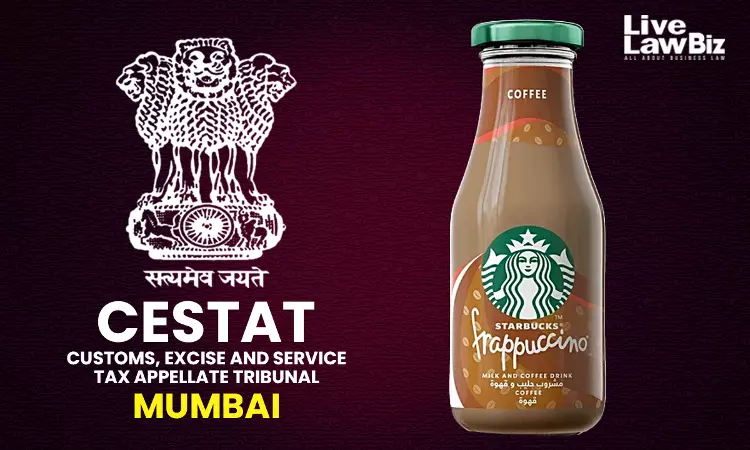
The Customs, Excise and Service Tax Appellate Tribunal (CESTAT), Mumbai, has ruled that Starbucks Frappuccino beverages imported by Fortune Gourmet Specialities Pvt. Ltd. attract 12% IGST as milk-based beverages, rather than 28% as caffeinated drinks.
It held that the products fall under the specific tariff entry for beverages containing milk.
A Bench of Judicial Member Dr. Suvendu Kumar Pati and Technical Member Sanjiv Srivastava observed:
“As the impugned imported goods undisputedly are milk based or are beverages containing milk they would be appropriately be classified under heading 22029930 which is more specific to the product rather than the residuary entry i.e. 22029990. It is basic principle of the classification that classification of the good is to be determined in terms of description of the tariff entries and the entry giving more specific description should be preferred over the residuary entry.”
The dispute arose after the company imported Starbucks Frappuccino beverages in Coffee, Mocha and Caramel flavours. It declared them under Customs Tariff Heading 2202 99 30, which attracts 12% IGST. However, Customs classified them as caffeinated beverages under heading 2202 99 90 and levied 28% IGST. The company claimed that this resulted in excess tax payment of ₹55,724.36. The appellate authority upheld the assessment.
The company argued that the products were milk-based beverages containing natural coffee extract, not water-based caffeinated drinks. It relied on Food Safety and Standards Authority of India (FSSAI) regulations, which prescribe separate standards for flavoured milk and caffeinated beverages. It also submitted the manufacturer's declaration, certificate of analysis, and product specifications to establish the products' composition.
The tribunal examined the ingredients, which included milk, water, sugar, coffee, organic fat-reduced cocoa powder, potassium carbonate, and natural coffee flavouring. It also compared the product packaging with caffeinated beverages such as Red Bull, Hell and Cloud 9.
Observing that the Frappuccino was milk-based while the other products were water-based, the tribunal noted that the caffeine in the imported beverages was naturally inherent in the coffee extract. It also found that milk was the primary characterising ingredient.
The tribunal criticised the appellate authority for reproducing the tariff entries and HSN explanatory notes without discussing the product's description, specifications, and labels while determining its classification.
Relying on the Supreme Court's decision in Hamdard (Waqf) Laboratories, the tribunal reiterated that a specific tariff entry must prevail over a residuary entry. The Supreme Court had observed:
“When an article has, by all standards, a reasonable claim to be classified under an enumerated item in the Tariff Schedule, it will be against the very principle of classification to deny it the parentage and consign it to an orphanage of the residuary clause.”
The tribunal accordingly held:
“Since we find that the impugned goods are 'Beverages Containing Milk' they are appropriately classifiable under heading 22029930 and will be outside the purview of entry 12A of the Notification No 14/2019-IT.”
Finding no merit in the impugned order, the tribunal allowed the appeal.
For Appellant: Advocate Anirudh Nansi
For Respondent: C.S. Vinod, Assistant Commissioner (Authorised Representative)