
Sugar Export Ban Was Well Thought Out, Not A Knee-Jerk Reaction: Bombay High Court
Rajnandini Dutta
5 Aug 2026 1:41 PM IST
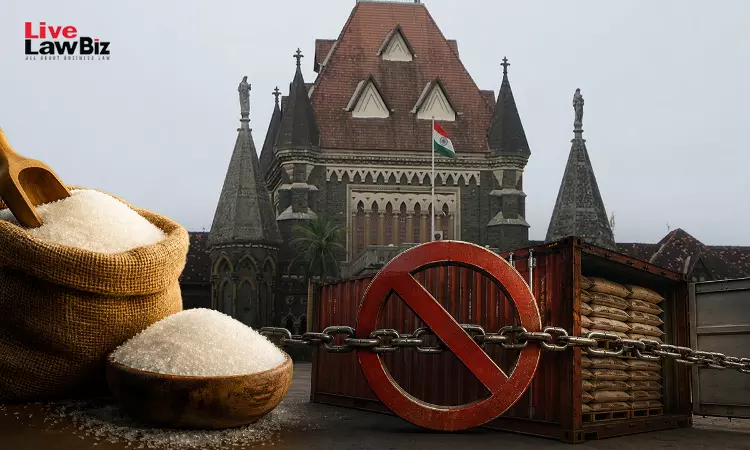
Holding that the export ban was a well-thought-out policy decision taken in public interest, the court dismissed exporters' challenge to the DGFT notification.
The Bombay High Court has upheld the Centre's decision to prohibit sugar exports until 30 September 2026, holding that the ban was a well-thought-out policy decision taken in the interest of the domestic sugar market and consumers, and that exporters cannot rely on private commercial contracts to avoid it
A Division Bench of Justice Suman Shyam and Justice Advait M. Sethna rejected the exporters' contention that advance payments and concluded export contracts gave them a right to complete their shipments despite the ban.
"However, we are unable to accept that execution of such bilateral private contracts, would confer any legal right on the Petitioner so as to supersede the Impugned Notification issued by the competent authority, under the provisions of the FTDR Act", the couru ruled.
The bench dismissed a batch of petitions challenging a notification issued by the Directorate General of Foreign Trade (DGFT) on 13 May 2026, which changed sugar's export status from "Restricted" to "Prohibited" with immediate effect until September 30, 2026, or until further orders.
The notification exempted exports to the European Union and the United States under specified quotas, shipments under the Advance Authorisation Scheme, government-to-government exports, and consignments that had already entered the physical export pipeline. The Centre defended the measure as one aimed at ensuring adequate domestic availability of sugar and maintaining price stability.
The petitions were filed by merchant exporters, including Premium Sugars, Rika Global Impex Ltd., Omvishkar Exports and Sucden India Pvt. Ltd.
They contended that they had entered into export contracts with overseas buyers before the notification was issued, received advance payments, and, in some cases, had already begun shipping consignments. They argued that the export prohibition should not apply to transactions that had been commercially concluded before the policy changed.
The Union Government opposed the petitions, arguing that the export ban was a policy decision taken after sugar production for the 2025-26 season declined from an estimated 343 lakh metric tons to around 308 lakh metric tonnes.
It told the court that the issue had been examined by the Inter-Ministerial Committee, the Committee of Secretaries and the Committee of Ministers before the DGFT notification was issued.
The government also submitted that Paragraph 1.05(b) of the Foreign Trade Policy, 2023 extends the benefit of a transitional arrangement only to exporters who satisfy the prescribed conditions, including having an Irrevocable Commercial Letter of Credit (ICLC) before the restriction comes into force. Since the petitioners admittedly did not fulfil those conditions, they were not entitled to any exemption from the export prohibition.
Accepting the government's stand, the bench held that there was no illegality in the decision-making process leading to the export ban.
"We, therefore, do not find any irrationality, irregularity, much less, illegality in the issuance of such Office Memorandum and/or the Impugned Notification," the court ruled.
It also rejected the contention that the prohibition had been introduced abruptly, observing, "In our view, issuance of the Impugned Notification after the said Office Memorandum is not a knee-jerk reaction as the Petitioners project it to be. However, as observed above, the same manifests a well thought about policy decision, taken in the interest of the domestic sugar market in India including domestic consumers."
The bench further held that the exportability of goods is governed by the Foreign Trade Policy in force on the date of export. It reiterated that private commercial contracts executed before the notification could not override a statutory restriction issued under the Foreign Trade (Development and Regulation) Act, 1992.
Since the petitioners did not satisfy the conditions for claiming the benefit of the transitional arrangement under the Foreign Trade Policy, the court dismissed the batch of petitions.
For Petitioners: Advocate Abhishek A. Rastogi with Advocates Pooja M. Rastogi, Meenal Songire, Aarya More and Diksha Pandey in WP(L)/18701/2026 and WP(L)/15306/2026; Advocate Somya Tripathi, instructed by T.N. Tripathi & Co., in WP/8024/2026; Advocate Nikhil Rungta with Advocates D.R. Singh, Jayesh Ramgini and Harsh Choudhary in WP/7850/2026.
For Respondents: Additional Solicitor General Anil Singh with Advocates Aditya Thakkr, Vijay Kantharia and Adarsh Vyas, instructed by Advocate Leena Patil, for the Union of India in WP(L)/18701/2026, WP/8024/2026 and WP/7850/2026, and for Respondent Nos. 1 to 3 in WP(L)/15306/2026; Advocate Y.R. Mishra with Advocates Sangeeta Yadav and Umesh Gupta for Respondent No. 4 in WP(L)/15306/2026; Advocate Shruti Vyas with Advocate Abhishek Mishra for Respondent No. 5 in WP(L)/18701/2026.