
Delhi High Court Grants Limitation Relief To Importer After Supreme Court's ITC Ruling Changed Customs Refund Rules
Kapil Dhyani
14 Aug 2026 4:05 PM IST
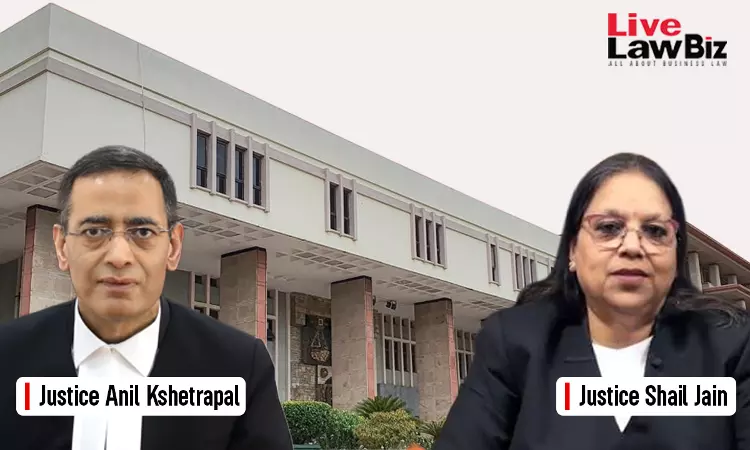
The Delhi High Court recently granted limitation relief to an importer whose customs refund remedy became ineffective following the Supreme Court's decision in ITC Limited v. Commissioner of Central Excise, Kolkata-IV.
The top court in the case had held that a refund claim could not be entertained unless the underlying assessment or self-assessment had first been modified in appeal or under another provision of the Customs Act.
The division bench of Justices Anil Kshetarpal and Shail Jain held that the time spent by the importer in pursuing the refund remedy could not be treated as ordinary inaction, particularly as the refund claim had been filed under the binding legal position prevailing at the relevant time.
The court was dealing with a batch of fifteen appeals filed by the importer, challenging CESTAT orders which had upheld the dismissal of several appeals as barred by limitation.
The controversy arose from the classification of pressure relief valves imported by the company and the higher customs duty paid on the goods.
At the time the Bills of Entry were assessed, the legal position laid down by the Delhi High Court in Aman Medical Products Limited and Micromax Informatics Limited permitted an importer to pursue a refund claim under Section 27 of the Customs Act without first challenging the assessment. Relying on this position, the Appellant filed refund applications on August 26, 2019, within the prescribed period of one year.
However, while the refund proceedings were pending, the Supreme Court delivered its judgment in ITC Limited on September 18, 2019. It held that a refund claim could not be entertained unless the assessment or self-assessment had first been modified under the Customs Act.
The Court noted that this altered the procedural basis on which the Appellant had pursued its refund claims.
Within six days of the ITC Limited decision, the Appellant applied under Section 149 of the Customs Act for amendment of fourteen Bills of Entry and sought to keep the refund proceedings in abeyance.
Subsequently, after one of the refund claims was rejected as premature for want of reassessed Bills of Entry, the Appellant filed appeals under Section 128 of the Customs Act along with applications seeking exclusion of the period spent pursuing the refund remedy on the principles underlying Section 14 of the Limitation Act.
The Commissioner (Appeals) rejected fourteen of the appeals as time-barred.
The High Court noted that the rejection proceeded on a factually incorrect premise that the refund application concerned only two Bills of Entry, whereas another refund file covered the remaining fourteen Bills of Entry.
The CESTAT also failed to independently examine the Appellant's claim for the benefit of Section 14 principles, the Court noted.
Referring to M.P. Steel Corporation v. Commissioner of Central Excise, the Court noted that while the Limitation Act does not apply proprio vigore to an appeal before the Commissioner (Appeals), the principles underlying Section 14 can apply to an appeal under Section 128 of the Customs Act.
The Court said the period spent bona fide and with due diligence in pursuing an abortive proceeding may be excluded from the computation of limitation.
The court, however, observed that the Appellant's case involved a peculiar situation since the Appellant had invoked the refund remedy within the prescribed limitation period under the legal position then binding on it. Once ITC Limited changed that position, it promptly pursued amendment of the Bills of Entry and continued to take steps in the refund proceedings.
"Its conduct, therefore, discloses neither negligence nor inaction," the Court observed.
It thus held that the period during which the appellant pursued the refund remedy and subsequently invoked Section 149 was liable to be excluded.
As such, the Court set aside the orders rejecting the appeals on limitation and restored the appeals.
For Appellant: Advocates Yogendra Aldak, Agrim Arora, Sonakshi Pandey
For Respondent: Gibran Naushad, SSC with Advocates Suraj Shekhar Singh, Hasan Haider, Anish Mishra,