
CESTAT
Missing Shipping Bills Cannot Deny IGST Refund For Bhutan Exports: CESTAT Kolkata
On 10 August, the Kolkata Customs, Excise and Service Tax Appellate Tribunal (CESTAT) held that failure to file Shipping Bills for exports to Bhutan, particularly during the initial implementation of the Goods and Services Tax (GST) regime, could not justify denial of Integrated Goods and Services Tax (IGST) refund where the actual export of goods and payment of IGST were undisputed. A Single Member Bench comprising Justice (Retd.) R. Muralidhar set aside the rejection of refund and Rs. 1 lakh...
Customs Duty Exemption On Flavour Compound Cannot Be Denied On Alcohol Content Alone: CESTAT Bengaluru
The Customs, Excise and Service Tax Appellate Tribunal (CESTAT), Bengaluru, has held that a customs duty exemption claimed on imported flavour compounds cannot be denied without establishing that the goods fall within the exclusion for compound alcoholic preparations of a kind used for the manufacture of beverages.The revenue must prove that the goods satisfy the exclusion. A bench comprising Judicial Member P.A. Augustian and Technical Member R. Bhagya Devi refering to a 2002 notification...

Registration In Exporting Country Before Import Does Not Make Vehicle Used: CESTAT Chennai
The Customs, Excise, and Service Tax Appellate Tribunal (CESTAT), Chennai, has held that a vehicle does not lose its eligibility for concessional customs duty available for new vehicles merely because it was temporarily registered in the country of export, so long as there is no evidence that it was actually used before being exported to India.The revenue must establish that the vehicle was actually used before it was exported to India.“Mere registration of a motor vehicle in the exporting...
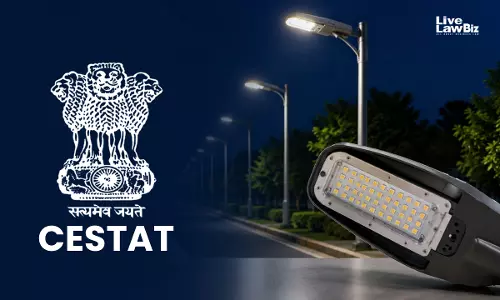
LED Modules Imported For Street Lights Attract 10% Customs Duty, Not 20% As Lamp Parts: CESTAT Delhi
The Customs, Excise, and Service Tax Appellate Tribunal (CESTAT), New Delhi has held that LED modules imported for manufacturing street lights cannot be classified as parts of lamps and lighting fittings merely because they are intended for use in street lights.A coram comprising Officiating President Dr. Rachna Gupta and Technical Member Hemambika R. Priya observed that while street lights are covered under the category for lamps and lighting fittings, “the usage/utility of the imported goods...

CESTAT Delhi Sets Aside ₹3.77 Crore Penalty Against Maruti Suzuki In Customs Classification Dispute
The Customs, Excise, and Service Tax Appellate Tribunal (CESTAT), New Delhi, has set aside a ₹3.77 crore penalty imposed on Maruti Suzuki India Ltd. over the classification of imported Glow Plug Control Units (GCUs).It held that customs authorities had accepted the company's classification of imported Glow Plug Control Units (GCUs) since 2015. The tribunal, however, ruled that the products are classifiable as components of electrical ignition or engine-starting equipment used in diesel engines. ...
Unauthenticated Foreign Authority Documents Can't Be Conclusive Proof In Customs Proceedings: CESTAT Chandigarh
The Customs, Excise and Service Tax Appellate Tribunal (CESTAT), Chandigarh has set aside a ₹4.95 crore customs duty demand against Findoc Impex, holding that unauthenticated documents allegedly obtained from the UAE Customs authorities could not, by themselves, establish that dry dates imported into India were of Pakistani origin. Emphasising that the burden rested on the Revenue to prove its allegations, the tribunal observed, "It is not for the appellant to disprove the allegations of the...
Cut Umbrella Panels Treated As Made-Up Textile Articles, Not Woven Fabric For Tax: CESTAT Kolkata
The Kolkata Customs, Excise and Service Tax Appellate Tribunal (CESTAT) on 4 August held that umbrella panel fabric cut into predetermined triangular shapes and sizes is classifiable as a “made-up textile article” under Customs Tariff Heading (CTH) 6307 and not as woven fabric of synthetic filament yarn under CTH 5407. A Bench comprising Judicial Member Justice R. Muralidhar and Technical Member K. Anpazhakan set aside the demand of differential customs duty, interest and penalty, holding that...
Excess Quantity, Enhanced Value Alone Don't Establish Misdeclaration Under Customs Act: CESTAT Mumbai
The Mumbai bench of the Customs, Excise and Service Tax Appellate Tribunal (CESTAT) has ruled that finding excess imported goods during examination, even when their assessable value is enhanced, does not by itself establish misdeclaration under the Customs Act, 1962. Technical Member M.M. Parthiban observed that the department had produced no evidence to show the importer had ordered or suppressed the excess quantity of goods, and held that confiscation, redemption fine and penalty could not be...
Father, Employee Can't Be Penalised Solely For Relationship With Gold Smuggling Accused: CESTAT Kolkata
The Kolkata bench of the Customs, Excise, and Service Tax Appellate Tribunal (CESTAT) has recently held that a person cannot be penalised for allegedly aiding or facilitating gold smuggling merely because he is the father or an employee of the principal noticee.The tribunal said such penalties can be imposed only where the Revenue produces cogent and independent evidence showing that the person consciously participated in or abetted the alleged smuggling. "The relationship of appellant no. 1...
CESTAT Chandigarh Quashes ₹99.59 Lakh Demand, Says DGOV Guidelines Cannot Override Valuation Rules
The Chandigarh Customs, Excise and Service Tax Appellate Tribunal (CESTAT) on 28 July held that Directorate General of Valuation (DGOV) guidelines cannot override the Customs Valuation Rules, 2007. Also that Customs authorities cannot reject a declared transaction value solely on the basis of such guidelines or London Metal Exchange (LME) prices without evidence proving that the declared value was incorrect.A Bench comprising Judicial Member S.S. Garg and Technical Member P. Anjani Kumar set...

CESTAT Chennai Quashes ₹14.88 Crore Customs Duty Demand Against Toyota Kirloskar Auto Parts
The Customs, Excise and Service Tax Appellate Tribunal (CESTAT), Chennai has set aside a ₹14.88 crore customs duty demand against Toyota Kirloskar Auto Parts Pvt. Ltd. It held that transmission gears imported by the company are classifiable as "gears and gearing" under the Customs Tariff and cannot be treated as motor vehicle parts merely because they are ultimately used in manufacturing vehicles.Holding that the imported goods were specifically classifiable as "gears and gearing" under the...
CESTAT Mumbai Slams Customs For Missing Records, Calls It Contrary To 'Viksit Bharat @2047' Vision
On 21 July, the Mumbai Customs, Excise and Service Tax Appellate Tribunal (CESTAT) criticised the Customs Department for rejecting a refund claim merely because it was unable to trace its own records, observing that such administrative failure is inconsistent with the vision of “Viksit Bharat @2047”. A Single Member Bench of Technical Member M.M. Parthiban made the observation while allowing an appeal filed by John Miranda and directing the Customs Department to refund Rs. 3 lakh deposited...