
BUDS Act Proceedings Don't Exempt Popular Finance Liquidator From Inviting Depositor Claims: NCLT Kochi
Shilpa Soman
16 Nov 2026 2:50 PM IST
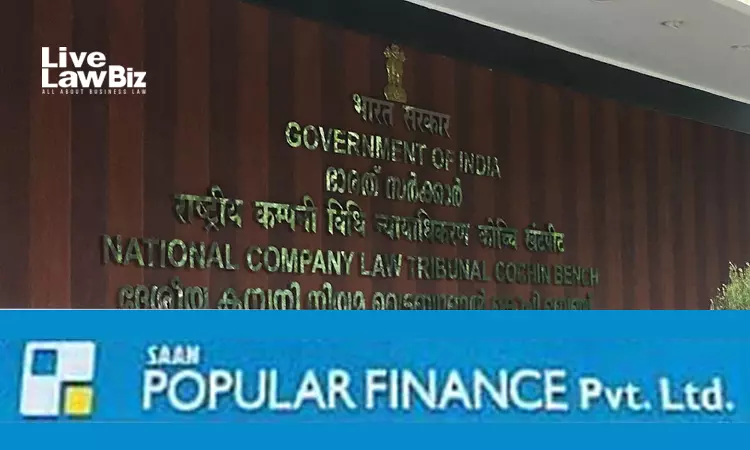
On 12 November, the Kochi Bench of the National Company Law Tribunal (NCLT), held that the pendency of proceedings under the Banning of Unregulated Deposit Schemes Act, 2019 (BUDS Act) does not dispense with an Official Liquidator's statutory obligation to invite depositor claims under the Companies (Winding Up) Rules, 2020.
A Bench comprising Judicial Member Vinay Goel and Technical Member Ravichandran Ramasamy dismissed an application filed by the Official Liquidator in the winding-up proceedings concerning the 14 entities of the Popular Finance Group. It said:
“…the pendency of proceedings before the Competent Authority under the BUDS Act, 2019, by itself, cannot absolve the Applicant of the statutory obligations cast upon him under the Companies Act, 2013 and the applicable Winding Up Rules.”
The Official Liquidator had informed the Tribunal that the Competent Authority under the BUDS Act had attached various movable and immovable properties belonging to the group and invited claims from depositors. The Enforcement Directorate (ED) had also handed over the group's properties to the Competent Authority for proceedings under the BUDS Act.
The Liquidator further submitted that the Competent Authority had received approximately 12,000 depositor claims and was taking steps for interim disbursement of 25% of the deposited amounts under the supervision of the Kerala High Court.
He also contended that initiating a separate claims process under Rule 100 of the Companies (Winding Up) Rules, 2020, could result in duplication of verification and cause confusion among depositors.
The Tribunal declined to direct the Competent Authority, the Central Bureau of Investigation (CBI), the Kerala Police Crime Branch and the ED to furnish details of the pending proceedings and attached assets. Noting that the Liquidator had already addressed communications to these authorities, it observed:
“….we are of the considered view that the Applicant ought to pursue the matter with the concerned authorities and exercise the powers available to the Liquidator under the provisions of the Companies Act, 2013 and the applicable Rules for obtaining the requisite information and documents. Therefore, no specific direction from this Tribunal is warranted at this stage.”
Further, the Bench clarified that the earlier direction in the winding-up orders to avoid unnecessary duplication of proceedings could not be interpreted as dispensing with the claims procedure prescribed under Rule 100.
In separate directions concerning the group's winding-up proceedings, it also dealt with the constitution of winding-up committees and the opening of special bank accounts for individual entities.
In the cases of Amala Popular Nidhi Limited, MRPN Chits Private Limited and Mary Matha Popular Nidhi Limited, the Tribunal directed the Liquidator to request the Serious Fraud Investigation Office (SFIO) to nominate a representative to the winding-up committee, as the companies had no secured creditors. The representative would be included as an additional member, subject to the Tribunal's approval.
For Mary Rani Popular Nidhi Limited and SAAN Popular Finance Limited, it constituted winding-up committees comprising the Official Liquidator, a nominee of Federal Bank, a secured creditor and an insolvency professional.
Separately, in respect of the partnership firms, the Bench permitted the Liquidator to open a separate bank account with Union Bank of India under Rule 58(1) of the LLP (Winding up and Dissolution) Rules, 2012.
The winding-up proceedings against the five companies and nine limited liability partnerships (LLPs) were initiated by the Union of India through the SFIO over allegations of fraud, misfeasance, misconduct and failure to comply with statutory filing requirements. On 6 October 2026, the Tribunal ordered their winding-up and appointed the Official Liquidator as Company Liquidator.
Accordingly, the NCLT dismissed the application and directed the Liquidator to proceed with inviting depositor claims while coordinating with the Competent Authority.
For Applicant: Arjun C, Official Liquidator