
Centre's Order To Change Similar Company Name Can't Be Invalid Because It Was Triggered By Complaint: Delhi High Court
Riya Rathore
27 July 2026 6:39 PM IST
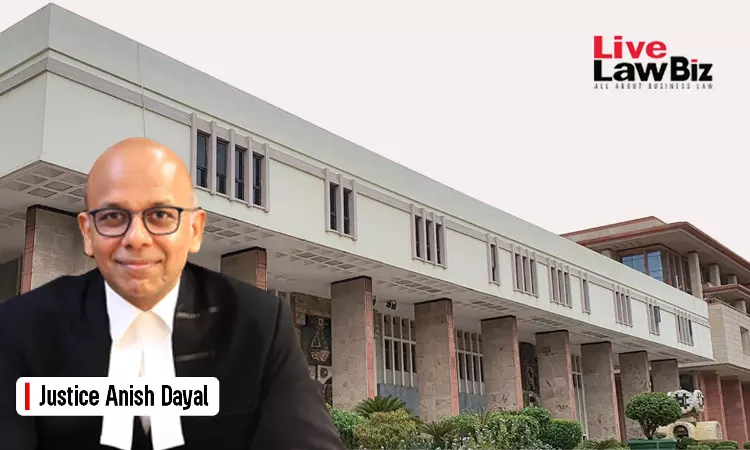
The Delhi High Court has upheld an order directing a DNA testing company to change its name, holding that the Central Government's power to rectify similar company names under the Companies Act is not rendered invalid merely because its opinion was triggered by an application from another company.
"The order being passed under Section 16(1)(a) of the Act, even though triggered by an application, cannot be considered to be invalid or without jurisdiction, for the simple reason that it was triggered on the basis of information given by an applicant," the court said.
Justice Anish Dayal, in a judgment delivered on July 24, observed that accepting the petitioner's interpretation would end up "curtailing and binding the hands down of the regulator to an extreme and illogical extent."
The bench dismissed a petition filed by DNA Forensics Test Solutions Private Limited. The company had challenged a Central Government order directing it to change its name on the ground that it too closely resembled DNA Forensics Laboratory Private Limited.
Section 16(1)(a) of the Companies Act, 2013, empowers the Central Government to direct a company to change its name if it is identical with or too nearly resembles the name of an existing company.
DNA Forensics Test Solutions Private Limited approached the court against a June 8, 2026 order passed by the Regional Director under Section 16(1)(a). The order required it to change its name because of its similarity to DNA Forensics Laboratory Private Limited.
Arguing that the order lacked jurisdiction, the petitioner contended that while Section 16(1)(a) permits the Central Government to act on its own "opinion," Section 16(1)(b) specifically contemplates action on an application by a registered trademark proprietor.
Since the proceedings were triggered by an application filed by DNA Forensics Laboratory Private Limited, it argued that the order could not have been passed under Section 16(1)(a).
To support its contention, the petitioner relied on the Madras High Court's decision in M/S T.T. Ltd. v. Union of India & Anr.. It argued that the two provisions operate in distinct fields and that allowing an application to trigger action under Section 16(1)(a) would render Section 16(1)(b) "completely redundant."
The Madras High Court had further observed that "the conjunction 'or' is also deliberately omitted between section 16(1)(a) and 16(1)(b) to make the distinction, which makes it clear that the intention of the legislature was not to grant right to a registered Proprietor of a trade mark to exercise its rights for rectification of the name both under section 16(1)(a) and section 16(1)(b)."
Appearing for the Union Government, Senior Panel Counsel Sarika Singh submitted that an opinion under Section 16(1)(a) is "routinely made on the basis of applications which have been preferred by existing companies that have a grievance" over similar or identical names.
Examining the Madras High Court judgment, Justice Dayal said those observations were made in the context of the facts before that court. They primarily related to its findings on limitation. The court also noted that the petitioner in that case had earlier failed to obtain an injunction before the Delhi High Court in a trademark dispute. That, too, formed part of the Madras High Court's reasoning.
Rejecting the petitioner's objection, the court held that an order under Section 16(1)(a) does not become invalid merely because it was triggered by information supplied through an application. The central government is still required to form its own opinion before exercising the power.
The court also explained why it disagreed with the petitioner's interpretation. It said the registering authority cannot be expected to scrutinise every newly registered company's name against the names of previously registered companies. An existing company could naturally be aggrieved if another company operating in the same field adopted a name that was identical or too similar.
On the facts of the case, the court noted that counsel for DNA Forensics Test Solutions Private Limited had admitted that both companies operated in the DNA testing business.
The court held that the names DNA Forensics Test Solutions Pvt. Ltd. and DNA Forensics Laboratory Pvt. Ltd. were "too similar/almost identical, to ignore."
Holding that the central government could not be prevented from forming an opinion under Section 16(1)(a) merely because it acted on information received through an application, the court dismissed the petition. All pending applications were also rendered infructuous.
For Petitioner: Advocates Mohd. Kashif and Mohd. Suza Faisal
For Respondents: Sarika Singh, SPC for Respondent nos.1 & 2