
'Meeting Of Minds' To 'Meeting Of Algorithms': Justice Vikram Nath Flags AI Challenges At UNCITRAL Event
Shivani PS
29 July 2026 4:46 PM IST
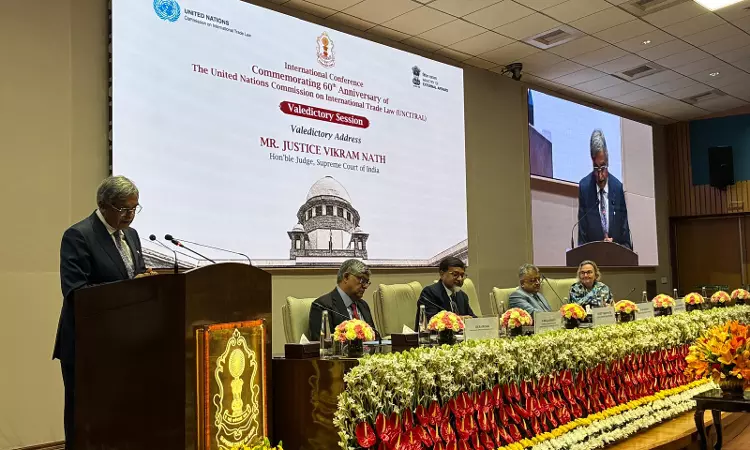
On Sunday, 26 July, Supreme Court Judge Justice Vikram Nath delivered the valedictory address at an international conference marking the 60th anniversary of the United Nations Commission on International Trade Law (UNCITRAL).
He told delegates that contract law may need to reconsider how it attributes legal intention in the age of artificial intelligence (AI)-driven commercial contracting, questioning whether the traditional doctrine of consensus ad idem still holds as autonomous systems increasingly shape agreements.
Consensus ad idem, a fundamental principle of contract law, refers to the “meeting of minds,” where parties agree to the same thing in the same sense before a binding contract comes into existence.
Turning to AI-negotiated commercial contracts, Justice Nath asked whether the traditional “meeting of minds” is giving way to a “meeting of algorithms”:
“If tomorrow, two autonomous AI systems negotiate and conclude a commercial agreement on behalf of their respective principals, where exactly does the consensus lie? Is it between the parties, between the programmers, within the algorithms, or do we continue to attribute that consensus to the human principal who deployed the technology? These are questions that strike at the very foundations of contract law. AI compels us to reconsider how legal intentions should be attributed when commercial decision making itself becomes increasingly autonomous.”
He traced the doctrine from its origins in Roman law through its development in English common law to its statutory recognition under Section 13 of the Indian Contract Act, 1872, which requires parties to agree upon the same thing in the same sense. Across legal traditions, he observed, lawyers have consistently understood contracts as the product of a conscious “meeting of minds” and ultimately of human intervention.
He added that “civil law jurisdictions speak of mutual consent or corresponding declarations of intention, while common law systems emphasize agreement and mutual assent. Yet, the underlying philosophy remains universal. Contracts are ultimately products of human intervention.”
Pointing out that AI is no longer confined to proofreading agreements or assisting lawyers in drafting clauses, he asked, “What happens when the meeting of minds is replaced by the meeting of algorithms?” He noted increasingly sophisticated systems, capable of negotiating commercial terms, evaluating commercial risks, modifying contractual language and, in some instances, recommending acceptance or rejection of contractual offers with minimal human intervention.
Further, he was careful to clarify that he was not suggesting the doctrine had become obsolete — only that its application may need re-examination as contracts are increasingly negotiated not merely by people, but with, and perhaps one day between, intelligent systems. In his words:
“I do not suggest that the doctrine of consensus ad idem has become obsolete, but its application may require careful re-examination in a world where contracts are increasingly negotiated, not merely by people, but with and perhaps one day between intelligent systems.”
Calling it “one of the next great frontiers of international commercial law,” he suggested UNCITRAL, which has harmonised international trade law for six decades, could eventually be “called upon to harmonize legal principles for an age that its founders could scarcely have imagined.”
Looking ahead, Justice Nath predicted that UNCITRAL's role over the next 60 years would extend beyond harmonising trade law to harmonising legal responses to rapidly evolving technologies. Commerce would keep evolving, he added, but the principles governing it must hold constant: “Good faith, party autonomy, procedural fairness, neutrality, predictability, and above all, the rule of law.”
The conference also featured remarks on mediation, international commercial dispute resolution and India's engagement with UNCITRAL from UNCITRAL Secretary Anna Joubin-Bret, Solicitor General Tushar Mehta and Senior Advocate Gaurav Banerjee.
Joubin-Bret said that “the UNCITRAL Secretariat stands ready to assist India, an original signatory of the Singapore Convention, in its continued consideration and possible ratification.” She added that they “were very encouraged by the strong stance taken by India in embracing mediation, and so we keep our fingers crossed.”
On his part, Mehta argued that the future of commercial dispute resolution would increasingly lie in mediation, noting that UNCITRAL had recognised this shift well before many domestic legislatures. Referring to the UNCITRAL Model Law on International Commercial Mediation and the Singapore Convention on Mediation, he remarked:
“UNCITRAL saw well ahead of many domestic legislatures that the future of commercial dispute resolution would not lie in litigation or adjudication but would lie in the dispute resolution as an alternative dispute mechanism even beyond and sometimes without the use of arbitration.”
Pointing to the Mediation Act, 2023 and the expansion of institutional mediation, the Solicitor General added that “a jurisdiction aspiring to be an attractive destination for international commerce trade must offer disputing parties not one door to justice but several, each suited to a different kind of disagreement between the parties.”
Senior Advocate and Chair of the UNCITRAL National Coordination Committee for India (UNCCI), Banerjee, urged Indian courts to make greater use of UNCITRAL's CLOUT (Case Law on UNCITRAL Texts) database, while highlighting India's significant contribution to it. He explained that it gave “comparative views of many countries on the Model Text, and it is free to access, most importantly.”