
Telangana High Court Dismisses MSME's Plea Against Arbitration Reference After Consent To Tribunal
Kirit Singhania
16 May 2026 11:54 AM IST
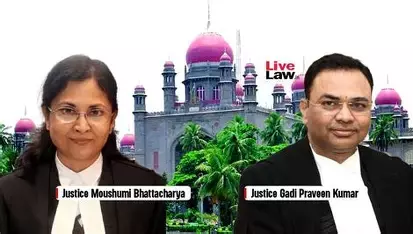
The Telangana High Court has held that a company cannot challenge an MSME arbitration reference after consenting to the constitution of the arbitral tribunal and participating in the proceedings.
“After giving consent to the constitution of the Arbitral Tribunal and thereafter having participated in the proceedings before it, the writ petitioner cannot subsequently challenge the reference of the dispute to arbitration on the ground of the dispute not amenable to arbitration,” the Court observed.
A Division Bench of Justices Moushumi Bhattacharya and Gadi Praveen Kumar dismissed SRP Minerals' writ petition challenging the MSME Facilitation Council's decision to refer its dispute with Sai Teja Construction Ltd to arbitration before the International Arbitration and Mediation Centre, Hyderabad.
The Court also vacated interim protection granted to the company.
Holding that the petition was an after-thought and a last-ditch attempt to scuttle the arbitral proceedings, the Court said:
“Thus, we are of the considered view that the writ petitioner has filed this Writ Petition only as an after-thought and as a last ditch attempt to scuttle the arbitration between the parties.”
On the availability of an alternative remedy, the Court said:
“The writ petitioner has an effective alternative remedy under The Arbitration and Conciliation Act, 1996, to raise its objections in terms of section 16 of the A&C Act. Invoking the Writ jurisdiction of the High Court is wholly unsustainable as conclusively settled in various decisions of the Supreme Court.”
The dispute arose after the MSME Facilitation Council referred the dispute between Sai Teja Construction Ltd. and SRP Minerals to arbitration by a letter dated July 22, 2023. SRP Minerals challenged the reference on the ground that the underlying agreement between the parties was a works contract and therefore fell outside the scope of the MSMED Act.
Rejecting the contention, the High Court relied on its Coordinate Bench decision in A.A. No. 55 of 2025, which had in turn relied on the Calcutta High Court's ruling in Hindustan Petroleum Corporation Limited v. West Bengal State Micro, Small Enterprises Facilitation Council, to hold that the MSMED Act does not distinguish between works contracts and other contracts.
The Court said the only relevant criterion for invoking the dispute resolution mechanism under the MSMED Act is whether the entity qualifies as a micro, small or medium enterprise under the statute and satisfies the registration requirements.
“Section 18 does not make any differentiation between works contracts and other contracts and more important, does not state, either expressly or by implication, that works, contracts would be excluded from the purview of section 18/reference of the dispute to the Council for conciliation/mediation and thereafter arbitration.”
The Bench noted that the arrangement of provisions under the MSMED Act shows that the focus is on unpaid dues owed by a buyer for goods sold or services rendered by a supplier and the mechanism for resolving such disputes through conciliation and arbitration.
The Court also rejected SRP Minerals' reliance on the Supreme Court's decision in India Glycols Limited v. Micro and Small Enterprises Facilitation Council.
Clarifying the scope of that judgment, the Court said:
“However, even a cursory reading of the judgment makes it clear that India Glycols was not at all concerned with the jurisdiction of the Facilitation Council, in relation to works contract or otherwise”
According to the Bench, India Glycols dealt only with whether a High Court could examine limitation issues in writ proceedings after holding that the writ petition itself was not maintainable and had no bearing on whether works contract disputes could be referred by MSME Facilitation Councils.
The High Court also took note of SRP Minerals' conduct before the arbitral tribunal. It recorded that counsel for both parties had appeared before the sole arbitrator and expressly stated they had no objection to the constitution of the tribunal.
The Court also referred to correspondence from IAMC showing that both parties had expressed a preference for an arbitrator who was a retired district judge or retired High Court judge, and that the appointment was made after considering those suggestions.
In these circumstances, the Court held that the challenge to the arbitration reference could not be sustained after the company had participated in the process and consented to the tribunal's constitution.
Accordingly, the writ petition was dismissed, and interim orders were vacated.
For Petitioner: Senior Advocate Surender Rao with Advocate Srikanth Kaveti
For Respondent: Senior Advocate Iyengar with Advocate Raja Shekar Reddy