
Can An Order Rejecting Impleadment Of Non-Signatory Be Appealed Under S 37 Arbitration Act? Supreme Court Reserves Verdict
Kirit Singhania
17 Nov 2026 2:07 PM IST
The Supreme Court on Tuesday reserved its verdict on whether an order passed by an arbitral tribunal rejecting an application for impleadment of a third party can be challenged in an appeal under Section 37 of the Arbitration and Conciliation Act, 1996.
The court was hearing a plea filed by Haridwar Highway Private Limited (HHPL) challenging the Delhi High Court's March 23, 2026 order directing the impleadment of ERA Infra Engineering Limited as a party to the arbitration dispute arising from the Muzaffarnagar-Haridwar highway project.
The Delhi High Court also held that the arbitral tribunal's rejection of ERA Infra's impleadment application was appealable under Section 37(2)(a) read with Section 16(2) and (3) of the Arbitration and Conciliation Act. It reasoned that by rejecting the application, the tribunal had effectively accepted NHAI's plea that it lacked jurisdiction to implead ERA Infra as a non-signatory to the Concession Agreement.
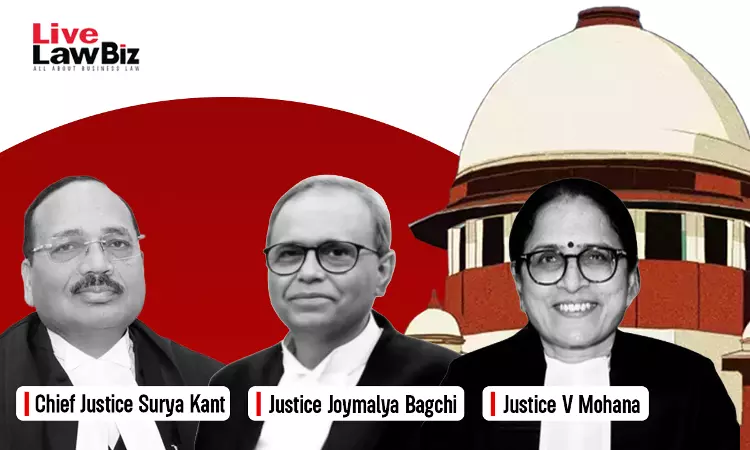
A Bench comprising Chief Justice of India Surya Kant and Justices Joymalya Bagchi and V. Mohana, after hearing the parties, proceeded to reserve its judgment in the matter.
Senior Advocate Shyam Divan appearing for HHPL, argued that the arbitration was strictly between HHPL and NHAI and that ERA Infra which was not a party to the concession agreement containing the arbitration clause, could not be permitted to enter the proceedings at an advanced stage.
He submitted that the arbitral tribunal had correctly rejected ERA Infra's impleadment application after finding that neither HHPL nor NHAI intended to refer disputes with ERA Infra to arbitration.
Divan told the Court that the arbitration had already reached the stage of evidence, with issues framed and affidavits of evidence filed by both HHPL and NHAI. He argued that permitting ERA Infra to join at this stage would disrupt the proceedings by requiring fresh pleadings, including a statement of claim and counterclaim.
“These are the two parties who are going ahead with the arbitration. This ERA seeks to parachute in.”, Divan said.
He further submitted that the arbitration agreement was contained in the concession agreement dated February 24, 2010 executed exclusively between NHAI and HHPL. Referring to Clause 44.1, which provides for dispute resolution between the parties to that agreement, Divan argued that the arbitral tribunal's jurisdiction was confined to disputes referred by those parties.
“The arbitration is a creature of contract and is based on consent of the parties.”
He contended that the creation of a Special Purpose Vehicle was a deliberate contractual arrangement under which NHAI intended to deal exclusively with the concessionaire and not the original consortium members who had secured the project.
Referring to the arbitral tribunal's findings, Divan submitted that NHAI had deliberately required the consortium to form an SPV before entering into the concession agreement. The tribunal had therefore concluded that the arrangement was intended to ensure that NHAI's contractual relationship remained with the SPV rather than the original bidder.
Divan also argued that the High Court's order was passed without the participation of HHPL's Resolution Professional, despite the company having been admitted into the Corporate Insolvency Resolution Process on November 4, 2025. He submitted that the erstwhile management had continued to represent HHPL in the Section 37 proceedings without informing the Resolution Professional who learnt of the litigation only after the High Court had delivered its judgment.
Divan also questioned the maintainability of ERA Infra's appeal under Section 37 of the Arbitration and Conciliation Act, 1996. He argued that the provision permits appeals only against specified orders and does not provide an appeal against an arbitral tribunal's refusal to implead a third party.
“Section 37 is extremely clear. Section 37 has very limited grounds which are available, and you don't fall under any of these grounds.”, Divan argued.
He additionally alleged that ERA Infra was attempting to interfere with the arbitration despite having invoked separate arbitration proceedings against HHPL under the EPC agreement. He referred to an arbitral award dated October 16, 2025 which, according to him, directed HHPL to transfer recoveries from NHAI to ERA Infra on a priority basis.
Appearing for NHAI, counsel supported the contractual arrangement requiring the consortium to incorporate an SPV and argued that NHAI had intended to contract only with that SPV. Referring to Clause 2.2.6(f) of the Request for Qualification, counsel submitted that consortium members were required to form an appropriate SPV if the project was awarded to the consortium.
He argued that the arrangement was intended to protect the public project and the substantial public funds involved. Referring to the concession agreement, counsel submitted that the agreement constituted the complete and exclusive statement of the contractual terms between NHAI and HHPL.
Relying on Clause 47.10, counsel argued that the agreement could not be modified except through a written amendment agreed to by the parties. He also referred to Clause 47.13, which states that the agreement is intended solely for the benefit of the parties and their permitted successors and assigns and does not create any rights or liabilities in favour of third parties.
Counsel questioned how ERA Infra could claim to have become a party to the concession agreement merely because it was subsequently awarded construction work under the separate EPC agreement.
Appearing for ERA Infra, Senior Advocate Kapil Sibal appearing for ERA Infra, opposed the challenge and argued that ERA Infra was not a mere third party to the project, but had played a central role in securing, financing and executing it.
Sibal explained that ERA Infra and OJSC-SIBMOST had formed the consortium that submitted the bid for the four-laning of NH-58. ERA Infra was the lead member, holding 74% equity and 99.70% voting rights, directly and indirectly in HHPL, the SPV subsequently incorporated for executing the project.
He argued that the formation of the SPV was not an independent or voluntary arrangement by the consortium members but a requirement imposed by NHAI's bidding framework. Referring to Clause 2.2.6(f) of the Request for Qualification, he submitted that the consortium members were required to form an SPV if the project was awarded to them.
Sibal further submitted that the consortium members were required to undertake joint and several responsibility for the concession obligations. He argued that ERA Infra had provided the financial standing and resources necessary for the project, including bid security and performance bank guarantees, and had also facilitated the loan arrangements for the SPV.
He emphasised that ERA Infra was not merely a shareholder in the SPV but had also been appointed as the Engineering, Procurement and Construction (EPC) contractor. Under the EPC agreement, it was responsible for the design, engineering, procurement, construction and completion of the highway project.
“We execute the project, we provide the finance, we provide the bank guarantees. We do the engineering, we do the procurement, we do the construction, we do the completion, and he says, I'm not involved in it.”, Sibal submitted.
Sibal relied on monthly progress reports prepared by the independent engineer and lenders' engineering consultants between 2011 and 2018, which, according to him, documented ERA Infra's role in executing the project. He referred to its involvement in establishing project camps and testing laboratories, mobilising manpower and machinery, shifting utilities, constructing structures and bridges, preparing designs and drawings, and carrying out other project activities.
He argued that the termination of the concession agreement also brought the EPC contractual relationship between HHPL and ERA Infra to an end, giving rise to independent contractual claims. He maintained that ERA Infra's claim in the present arbitration was against NHAI and not against HHPL.
Sibal contended that if ERA Infra were excluded from the arbitration, it would have no effective remedy in respect of its claims against NHAI, particularly if any amount awarded in the arbitration were paid to HHPL.
The Bench questioned the nature of ERA Infra's interest in the arbitration and whether its involvement in executing the project was sufficient to make it a party to the arbitration agreement.
During the exchange with Sibal, the Bench sought to distinguish between a party having an interest in the performance of the underlying contract and a third party merely seeking to benefit from the proceeds of an arbitral award.
The Court asked whether ERA Infra's interest was that of a person involved in the performance of the contract or merely that of a person seeking to enjoy the fruits of an award. It also questioned whether the obligations under the concession agreement extended to ERA Infra, given that the agreement had been executed between NHAI and the SPV.
The Bench further examined Sibal's submission that ERA Infra had an independent claim against NHAI, asking how that claim could be reconciled with the separate contractual arrangement under the EPC agreement.
Sibal responded that ERA Infra's claim against NHAI was distinct from its separate disputes with HHPL under the EPC agreement. He maintained that the existence of a separate contractual arrangement did not extinguish its interest in the arbitration between HHPL and NHAI.
Senior Advocate Mahesh Jethmalani, also appearing for ERA Infra, argued that the arbitral tribunal had failed to consider the company's substantial involvement in the project and its status as a “veritable party” to the underlying transaction. He submitted that the tribunal had devoted considerable attention to ERA Infra's claim that it was a necessary party but had rejected its impleadment application without adequately addressing those arguments.
Referring to paragraph 27 of the arbitral tribunal's order, Jethmalani pointed out that the tribunal had observed:
“Arbitration is a process that can only be entered with the consent of the parties. The arbitral tribunal is the creature of the contract and, unlike a court, should not ordinarily add a party that is not a party to the arbitration agreement.”
Jethmalani argued that the tribunal had relied on this general proposition without adequately considering the principles laid down by the Supreme Court in ONGC and Cox and Kings concerning the impleadment of non-signatories.
He submitted that ERA Infra had performed the substantive work under the project and that its role went beyond that of an ordinary third party.
“They are nothing. I perform every part of the contract.”, Jethmalani contended.
He further argued that the SPV was ERA Infra's wholly owned subsidiary in substance and was the entity through which project related payments were received. He contended that ERA Infra had a direct and substantial interest in the outcome of the arbitration.
During the exchange, the Bench questioned Jethmalani about other proceedings initiated by ERA Infra and whether those proceedings were connected with its request to participate in the arbitration between HHPL and NHAI. Jethmalani maintained that those proceedings were independent and collateral to the present dispute.
The Court after hearing the parties, proceeded to reserve its judgment in the matter.