
Supreme Court
Unstamped Arbitration Agreement Survives; Objection Must First Be Raised Before Arbitrator: Supreme Court
The Supreme Court on Wednesday held that non-stamping or insufficient stamping of an agreement does not invalidate it and that the arbitral tribunal must decide such objections in the first instance, discouraging High Court interference in ongoing arbitration proceedings. A bench of Justice J.K. Maheshwari and Justice Atul S. Chandurkar held “The agreement survives non-stamping or insufficient stamping, and the defect can be cured by getting the agreement sufficiently stamped at any stage,...
Supreme Court Refuses To Set Aside “Patently Illegal” Arbitral Award, Modifies Relief Instead
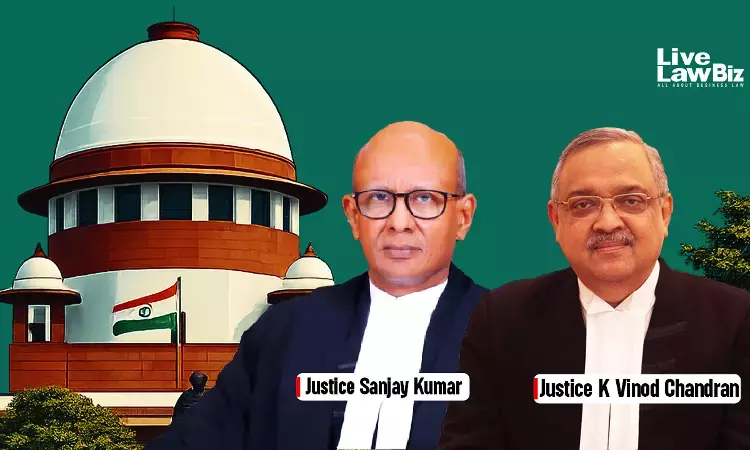
The Supreme Court on Tuesday refused to set aside an arbitral award despite finding it to be patently illegal, choosing instead to modify the award itself to bring finality to a dispute that has been pending since 2012. A Bench of Justice Sanjay Kumar and Justice K. Vinod Chandran observed that sending the parties back into fresh litigation would cause further hardship and delay. “Though the award, being patently illegal, deserves to be set aside under Section 34(2A) of the Arbitration Act, we...
Power To Correct Clerical Errors In Arbitral Awards Can't Be Used To Substantially Modify Them: Supreme Court
The Supreme Court on Tuesday reiterated that the limited power to correct clerical, computational, or typographical errors in an arbitral award cannot be used to substantially modify it by replacing simple interest with compound interest. Setting aside Gujarat High Court and Commercial Court orders, the Court held that Saryu Plastics Pvt. Ltd. was entitled only to simple interest at 21.675% during the pendency of arbitration, reversing a modification that had increased Gujarat Water Supply and...

Supreme Court To Examine If It Can Invoke Article 142 To Enable Arbitral-Style Dispute Resolution Where Existing Remedies Fail
The Supreme Court on Tuesday issued notice on applications filed by an intervenor raising the question of whether, in exceptional cases involving complex disputes where existing remedies are incapable of producing effective and expeditious resolution, the top court can create a court-supervised dispute resolution mechanism with arbitral characteristics. The question particularly concerns matters involving State instrumentalities. A Bench of Justices Prashant Kumar Mishra and N V Anjaria issued...

LiveLawBiz Arbitration Cases Weekly Digest: May 18 - May 23, 2026
NOMINAL INDEXPatanjali Ayurved Limited and Ors. Versus Ashav Advisory LLP, 2026 LLBiz SC 196Pandrol Rahee Technologies Pvt. Ltd. v. IRCON International Ltd., 2026 LLBiz HC(DEL) 518Cinda Engineering and Construction Private Limited v. CY Engineering India Private Limited, 2026 LLBiz HC(DEL) 506Sarvesh Security Services Pvt. Ltd. v. Institute of Human Behavior Resource and Allied Sciences, 2026 LLBiz HC(DEL) 516Dewan and Sons and Ors. Vs Harsh International, 2026 LLBiz HC(DEL) 526Hazel Mercantile...
Supreme Court Asks Delhi HC To Dispose Patanjali-Ashav Arbitration Dispute Over Ruchi Soya Deal
The Supreme Court recently asked the Delhi High Court to take up for disposal the pending arbitration dispute between Patanjali Ayurved Ltd and Ashav Advisory LLP over a share transaction linked to the acquisition of Ruchi Soya Industries. A Bench of Justices Pamidighantam Sri Narasimha and Alok Aradhe requested the High Court to decide the pending petitions at the next date of hearing, scheduled for July 28. “We had earlier recorded in our order dated 07.01.2026 that Section 34 objections...
West Asia Crisis: Supreme Court Lets SpiceJet Move Delhi HC Over ₹144 Crore Deposit Order In Dispute With Kalanithi Maran
The Supreme Court on Tuesday allowed SpiceJet Limited and its chairman Ajay Singh to approach the Delhi High Court to seek modification of a direction requiring a cash deposit of ₹144.51 crore in the long-running arbitration dispute with Kalanithi Maran and Kal Airways Private Limited. The airline cited the ongoing West Asia crisis and said it expected additional funding under the Centre-backed emergency credit guarantee scheme for airlines.A Bench of Justices P.S. Narasimha and Alok Aradhe,...
SpiceJet Moves Supreme Court Against Delhi HC Refusal To Modify ₹144.51 Crore Deposit Condition In Dispute With Kalanithi Maran
SpiceJet Limited and its chairman, Ajay Singh, have moved the Supreme Court against a Delhi High Court order refusing to allow them to secure ₹144.51 crore due to Kalanithi Maran and Kal Airways by depositing title deeds of SpiceJet's Gurugram property instead of making a cash deposit in their long-running arbitration dispute.A Bench of Justices Pamidighantam Sri Narasimha and Alok Aradhe will likely hear Spicejet's plea on May 19. On review petitions filed by SpiceJet and Ajay Singh, the High...

Earlier Arbitration Clause Binds Developer, Society Members As Redevelopment Agreements Adopted All Terms: Supreme Court
The Supreme Court has recently referred a redevelopment dispute between a developer and five members of a co-operative housing society to arbitration, holding that an arbitration clause in an earlier development agreement became binding through later accommodation agreements that adopted all its terms. "This was, thus, not a case of mere reference to an earlier agreement but a case where the parties to the later contract clearly intended to import the Development Agreement, body and soul, into...
High Court Cannot Reopen Arbitration Maintainability In Award Challenge After Final Reference-Stage Ruling: Supreme Court
The Supreme Court has recently held that where a court has already conclusively ruled in proceedings under Section 11 of the Arbitration and Conciliation Act, 1996 that arbitration is maintainable and that finding has attained finality, the issue cannot be reopened later in a Section 37 challenge to the arbitral award. “When the Courts have ruled on the fact that application under Section 11 of the Act was maintainable and when such a decision has attained finality, revisiting the issue of...
Supreme Court Appoints Arbitrator In Ucon-Utracon Dispute Over 'Utracon' Brand Use, Share Sale Pact
The Supreme Court on April 30 appointed former Punjab and Haryana High Court judge Justice K. Kannan as sole arbitrator to resolve a dispute between Chennai-based Ucon PT Structural System Pvt. Ltd. and Singapore-based Utracon entities over an alleged breach of a 2012 share sale agreement. A bench comprising Chief Justice Surya Kant and Justice Joymalya Bagchi said objections relating to limitation, arbitrability, and the scope of the arbitration clause would be decided by the arbitral...

Non-Signatory Collaborator Whose Role Was Essential To Contract Can Invoke Arbitration: Supreme Court
The Supreme Court has held that a collaborator whose technical expertise was essential for a contractor to qualify for a project bid can invoke the arbitration clause in the principal contract.This would apply where the collaborator's role makes it effectively a party to the agreement.“The meetings convened between the Employer, the Contractor and the Collaborator, after delay in execution of the contract, the tripartite agreement entered into between them and the further communications...