
Supreme Court
Arbitration | When Delay In Pronouncing Arbitral Award Can Be Ground To Set It Aside : Supreme Court Explains
If delay has adversely impacted the award and made it unworkable, it can be a ground to set aside the award.
Decision On Limitation Made On Demurrer Not Final; Party Autonomy In Arbitration Cannot Override Statute: Supreme Court
A decision made on demurrer will not foreclose the final determination of merits, the Court said.
Hidden Doctrine In Gayatri Balasamy: How Supreme Court Used Implied Powers To Transform Arbitration Law
When the Supreme Court ruled on Gayatri Balasamy v. ISG Novasoft Technologies Ltd[1] it made waves, earning the title of the “modification judgment.” Most discussions centered on a key takeaway: Indian courts can now, in certain situations, modify arbitral awards rather than just nullifying them. However, if you dig a little deeper into those 61 pages, you'll uncover a more subtle yet significant shift. For the first time, the Court tapped into the Doctrine of Implied Powers to broaden the...
Right To Seek Arbitration Not Lost Just Because Arbitration Clause Became Inoperable Due To Statutory Amendment: Supreme Court
The Supreme Court held that the invalidity or inoperability of an arbitration clause, such as one naming an ineligible arbitrator under Section 12(5) of the Arbitration and Conciliation Act, 1996, does not nullify the underlying arbitration agreement between the parties. The Court clarified that in such cases, the Court is empowered to step in and appoint a neutral arbitrator under Section 11(6) of the Act to preserve the efficacy of the arbitration mechanism.The Court emphasised that the...
Arbitral Award Must Be Within Parameters Of Agreement Between Parties : Supreme Court Dismisses Chinese Company's Appeal
The Supreme Court has recently upheld the setting aside of an arbitral award of nearly ₹995 crore granted in favour of Chinese company SEPCO Electric Power Construction Corporation, holding that the arbitral tribunal had erred by re-interpreting contractual terms and departing from the agreed stipulations in violation of Section 28(3) of the Arbitration and Conciliation Act, 1996.“Numerous precedents laid down by this Court have often emphasised that an arbitrator lacks the power to deviate from...

S. 31(7)(b) Arbitration Act | Claim For Additional Post-Award Interest Barred When Award Fixes Rate Until Payment : Supreme Court
The Supreme Court on Wednesday (Sep. 24) held that if an arbitral award provides a composite interest rate covering the entire period from the cause of action to payment, the award holder cannot claim additional compound interest at the post-award stage under Section 31(7)(b) of the Arbitration and Conciliation Act, 1996 (“Act”). Section 31(7)(b) of the Act provides for post-award interest at 18% from the date of the award until payment. However, if the arbitral award specifies a composite...
Arbitration | Execution Of Award Cannot Be Stalled Merely Due To Pendency Of Section 37 Appeal : Supreme Court
The Supreme Court held that the execution of an arbitral award cannot be stalled merely on the ground that an appeal under Section 37 of the Arbitration and Conciliation Act is pending.A bench of Justices Manoj Misra and Ujjal Bhuyan heard the case where the appellant (award-holder/decree-holder) sought execution of the arbitral award. The respondents (judgment-debtors) argued that since a Section 37 appeal was pending against the dismissal of their Section 34 objections, the execution should be...

S. 37(1)(a) Arbitration Act | Clause Restricting Interest On Delayed Payments By Itself Won't Bar Pendente Lite Interest : Supreme Court
The Supreme Court on Tuesday (Sep.2) observed that an Arbitral Tribunal can grant pendente lite interest unless expressly or impliedly barred in the contract. It added that a contractual clause barring interest on delayed payments does not prevent an arbitral tribunal from awarding pendente lite interest, i.e., the interest for the period during which the arbitration is pending. “…arbitral tribunal can be denuded of its power to award pendente lite interest only if the agreement/ contract...
Arbitration | Delivery Of Award To Govt Official Not Connected With Case Doesn't Amount To Valid Service On State : Supreme Court
The Supreme Court has clarified that when the government or one of its departments is a party to arbitration, delivery of an arbitral award to an official who is not connected with or aware of the proceedings cannot be treated as valid service for commencing the limitation period to challenge the award. Citing its ruling of Union of India vs. Tecco Trichy Engineers & Contractors (2005), the Court said that the delivery of the copy of the arbitral award should be made to the “party to the...
Mere Non-Signing Won't Invalidate Arbitration Agreement If Parties Otherwise Consented To Arbitration : Supreme Court
The Supreme Court observed that merely because an arbitration agreement was not signed, there is no bar to refer the dispute to arbitration, if the parties have otherwise consented to arbitration.The bench comprising Justices Sanjay Kumar and Satish Chandra Sharma set aside the Delhi High Court's decision which declined reference to arbitration merely because Respondent No.1 didn't sign the arbitration agreement. Since the Respondent No.1 consented to the contractual terms via email, the...
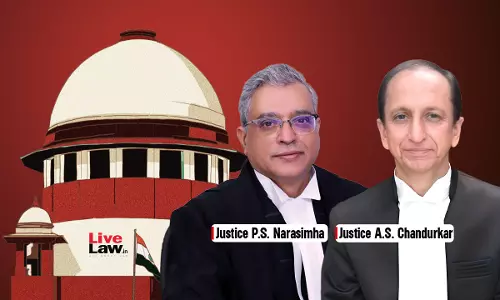
Non-Signatories Have No Right To Attend Arbitration Proceedings, Their Presence Breaches Confidentiality : Supreme Court
The Supreme Court on Wednesday (Aug. 13) observed that a party non-signatory to an arbitration agreement cannot participate in the arbitration proceedings, as the signatories to an arbitration agreement are only entitled to remain present in the arbitration proceedings. The bench comprising Justices PS Narasimha and AS Chandurkar set aside the Delhi High Court's decision, which allowed the non-signatories to an arbitration agreement to attend the arbitration proceedings in the presence of their...
Place Of Exclusive Jurisdiction Deemed As 'Seat' Of Arbitration : Supreme Court
The Supreme Court observed that in the absence of a seat or venue of arbitration in the arbitration agreement, the place where the exclusive jurisdiction has been vested as per the agreement would be regarded as the 'seat' of the arbitration.The bench of Justices P.S. Narasimha and A.S. Chandurkar set aside the Punjab & Haryana High Court's order allowing an application for the appointment of an arbitrator in a dispute where the arbitration agreement conferred exclusive jurisdiction for...