
Supreme Court Upholds Interim Relief To Unsuccessful Arbitration Party In 'Rare, Compelling' Case
Shivani PS
12 Aug 2026 2:13 PM IST
The Supreme Court on Tuesday upheld interim relief granted to an unsuccessful party in arbitration, finding that it had met the higher threshold required for post-award relief under Section 9 of the Arbitration and Conciliation Act, 1996.
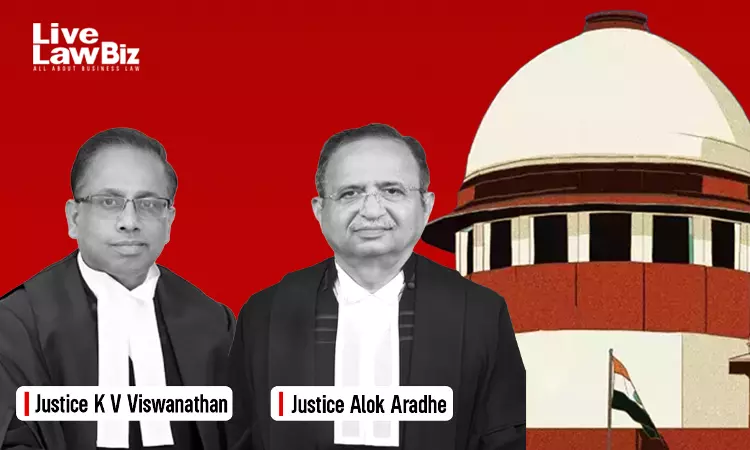
A bench of Justice K.V. Viswanathan and Justice Alok Aradhe upheld a Delhi High Court order directing National Projects Construction Corporation Ltd. (NPCC) to deposit ₹3.5 crore, which it had realised by invoking bank guarantees furnished by Ishvakoo (India) Pvt. Ltd.
The bench noted that the maintainability of a Section 9 application by an unsuccessful party after an arbitral award was already settled. It relied on its recent judgment in Home Care Retail Marts Pvt. Ltd. v. Haresh N. Sanghavi, where the court held that the distinction between a winning and losing party does not by itself determine access to Section 9 relief.
However, an unsuccessful party seeking such relief faces a higher threshold. The court held that relief may be granted in rare and compelling cases to prevent irreparable prejudice and preserve the efficacy of the Section 34 challenge.
The bench held that the present case met that threshold.
“An analysis of the facts and the application of the principles led us to the irresistible conclusion that the respondent, in fact, did fulfil in ample measure, the necessary parameters for obtaining relief under Section 9.”, the court ruled.
The dispute arose from an August 16, 2002 Memorandum of Understanding between NPCC and Ishvakoo for work relating to the Taj Mahal Bus Stand, UPST Bus Stand, Idgah Bus Stand and development of the Taj Trapezium Zone Heritage Corridor in Agra for the Uttar Pradesh Government.
In December 2002, Ishvakoo received ₹3.5 crore as mobilisation advance against bank guarantees furnished by it.
Disputes later arose between the parties, following which Ishvakoo invoked arbitration. It also approached the Delhi High Court under Section 9, seeking to restrain NPCC from invoking the guarantees.
On December 15, 2005, the high court recorded an arrangement under which Ishvakoo undertook to keep the guarantees alive until the arbitration was adjudicated. If a Section 34 petition was filed, the guarantees were to remain alive until its disposal.
NPCC agreed not to invoke the guarantees unless an executable award entitled it to recover an amount from Ishvakoo.
Ishvakoo was later unable to keep the guarantees alive. NPCC invoked them in or around September 2017.
The arbitrator delivered the award on December 5, 2017, dismissing Ishvakoo's claims. NPCC had not filed any counterclaim before the arbitrator.
Ishvakoo challenged the award under Section 34 and subsequently sought interim protection under Section 9.
On April 5, 2019, a single judge of the Delhi High Court directed NPCC to deposit ₹3.5 crore with the court registry. A Division Bench upheld that order on May 21, 2019, following which NPCC approached the Supreme Court.
NPCC argued that Ishvakoo's claims had been dismissed and that it therefore had no adjudicated amount in its favour to protect. It also argued that Ishvakoo was seeking to recover money that NPCC had already realised through the bank guarantees.
NPCC further relied on a November 1, 2017, order of the Delhi High Court. It argued that the order had already dealt with the legality of its decision to invoke the guarantees after Ishvakoo failed to keep them alive.
Ishvakoo, on the other hand, pointed out that NPCC had filed no counterclaim. It also contended that the arbitral award contained no finding that the mobilization advance had not been utilised.
The Supreme Court identified several reasons for granting the relief.
First, NPCC had filed no counterclaim before the arbitrator. The 2005 high court arrangement had contemplated invocation of the guarantees if, after adjudication, NPCC was found entitled to recover an amount from Ishvakoo.
The bench also noted that the arbitrator appeared to have been unaware that the guarantees had already been invoked before the award was pronounced.
The court further noted that there was prima facie no finding in the award that Ishvakoo had failed to utilise the mobilisation advance. It clarified that this issue would ultimately be decided in the Section 34 proceedings.
The top court also considered the effect of the Delhi High Court's November 1, 2017 order. That order had found no fault with NPCC's conduct in invoking the guarantees after Ishvakoo failed to keep them alive.
The bench held that the earlier order did not prevent Ishvakoo from seeking relief in the fresh post-award Section 9 proceedings. It noted that the question in the present proceedings was whether, in light of the arbitral award, allowing NPCC to retain the money would amount to unjust enrichment.
In these circumstances, the bench held that allowing NPCC to retain the money pending the Section 34 proceedings could result in unjust enrichment. It would also be contrary to the arrangement recorded by the high court in 2005.
The Supreme Court therefore found that the higher threshold applicable to an unsuccessful party seeking post-award interim relief had been met.
It described the case as a “rare and compelling” one in which relief was required to prevent irreparable prejudice and preserve the efficacy of the Section 34 challenge.
The court also found that the Delhi High Court had properly considered the prima facie case, balance of convenience and irreparable prejudice. It held that the high court had exercised its Section 9 jurisdiction judicially and not arbitrarily.
The Supreme Court dismissed NPCC's appeal and granted it four weeks to deposit ₹3.5 crore with the Delhi High Court Registry.
The amount will be kept in a fixed deposit with a nationalized bank on an auto-renewal basis until disposal of the Section 34 application.
For Appellant (National Projects Construction Corporation Ltd.): Advocate Rajat Arora.
For Respondent (Ishvakoo (India) Pvt. Ltd.): Advocate Kuldip Singh.