
Simultaneous Withdrawal Of All Three Arbitrators Cannot Be Treated As Termination Of Arbitration: Delhi High Court
Shivani PS
21 Oct 2026 1:04 PM IST
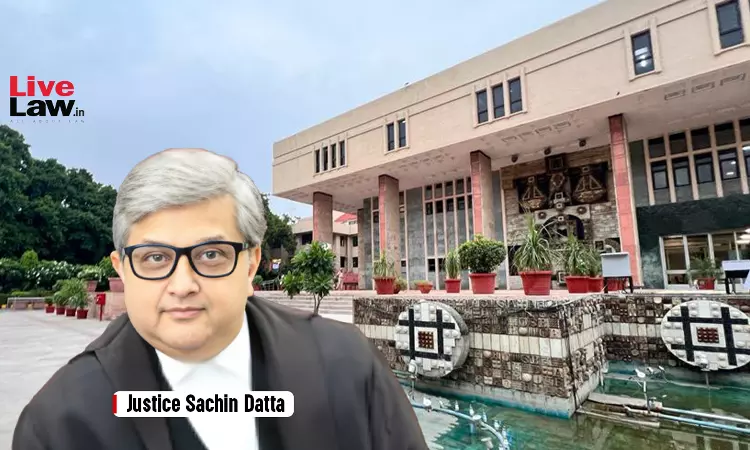
The Delhi High Court has reiterated that arbitration proceedings do not automatically end when all three members of an arbitral tribunal withdraw from a case. Instead, their withdrawal requires the appointment of substitute arbitrators under the Arbitration and Conciliation Act, 1996.
Justice Sachin Datta relying on apex court's ruling in Yashwith Constructions (P) Ltd. v. Simplex Concrete Piles India Ltd, observed, “Thus, the consequence prescribed by the legislature in the event of withdrawal from office, is 'substitution'. It is also relevant to note that under the scheme of the A&C Act, an arbitrator is not required to justify his/her withdrawal. It is also not envisaged that a withdrawal may be 'recalled'. The authority of an arbitrator flows entirely from his mandate; upon the arbitrator's withdrawal, that mandate terminates by operation of Section 15(1)(a) itself, and Section 15(2) is attracted.”
The court was hearing a petition filed by the National Highways Authority of India (NHAI) seeking appointment of a substitute presiding arbitrator in its dispute with IRB Westcoast Tollway Limited and others. Allowing the petition, it appointed former Supreme Court judge Justice Rajesh Bindal as presiding arbitrator, holding that the earlier tribunal's collective recusal had not terminated the arbitration proceedings.
The dispute arose from a concession agreement dated March 25, 2013, between NHAI and IRB Westcoast for four-laning the Goa–Karnataka border to Kundapur section of National Highway 66 in Karnataka.
On January 8, 2024, IRB Westcoast raised compensation claims of approximately ₹2,987.45 crore for damages and losses allegedly arising from its continued presence at the project site beyond the scheduled four-laning date. Further disputes concerned the collapse of the old Kaali Bridge, replacement or rehabilitation of old structures, and the deemed modification of the concession period.
A three-member arbitral tribunal was constituted on October 17, 2024. On June 16, 2025, IRB Westcoast, IRB Infrastructure Trust and IRB Infrastructure Developers Limited filed a consolidated statement of claims valued at approximately ₹3,515 crore.
On July 16, 2025, all three arbitrators recused themselves following a disagreement over their fees. The tribunal's order recording the recusal was circulated on July 21, 2025.
Both sides subsequently nominated replacement arbitrators. The Delhi High Court appointed a presiding arbitrator on December 1, 2025, but he withdrew on January 5, 2026. NHAI then approached the High Court seeking appointment of another presiding arbitrator.
IRB Westcoast opposed the petition, arguing that the simultaneous recusal of all three arbitrators had terminated the proceedings under Section 32 of the Act. Relying on the Supreme Court's decision in Harshbir Singh Pannu v. Jaswinder Singh, it argued that NHAI should first seek recall of the recusal order and, if unsuccessful, approach the court under Section 14(2) of the Act.
Rejecting this argument, the court held that the Act treats an arbitrator's withdrawal from office differently from the termination of arbitration proceedings. Under Section 15, an arbitrator's withdrawal requires the appointment of a substitute. Section 32, by contrast, governs the termination of the proceedings themselves.
“When each of the three individuals withdraws from office, the legal consequences prescribed by Section 15 attach to each of them. Nothing in the A&C Act suggests that three withdrawals occurring simultaneously undergo a transmutation into a deemed order under Section 32(2)(c) of the A&C Act,” the court observed.
The court further explained that the Act does not provide for recalling an arbitrator's withdrawal or empower a court to compel an arbitrator to resume office.
“It is notable that the A&C Act defines Arbitral Tribunal to mean 'a sole arbitrator or a panel of arbitrators'. The A&C Act contains no provision for 'recall' of a recusal/withdrawal order and also no provision empowering a Court to compel an arbitrator who has withdrawn, to resume office. The same would also be wholly illogical,” it observed.
To illustrate its reasoning, the court considered a hypothetical situation in which arbitrators withdraw because they lack the technical expertise needed to decide a particular dispute. Requiring them to reconsider their withdrawal, it observed, would be illogical.
The court also held that Section 15 applies whether an arbitrator withdraws individually or all members withdraw simultaneously or one after another. The provision's use of the singular does not mean that collective withdrawals attract a different legal consequence. The court also relied on Section 13(2) of the General Clauses Act, 1897, which provides that words in the singular include the plural and vice versa.
“Moreover, there is no logic to treat simultaneous withdrawal of members of an arbitral tribunal any differently from an individual or sequential withdrawal of all its members,” the court observed.
Distinguishing the Supreme Court's ruling in Harshbir Singh Pannu, the court noted that the case concerned an arbitrator who had expressly terminated proceedings over non-payment of fees. The Supreme Court had considered the remedies available to a party challenging an express order terminating arbitral proceedings, including seeking recall before the tribunal and approaching the court under Section 14(2) if recall was refused.
In the present case, however, the July 16, 2025 order merely recorded the arbitrators' decision to recuse themselves. It did not invoke Section 32, declare the proceedings terminated or record a finding that their continuation had become unnecessary or impossible.
The court emphasised that “the two events i.e. withdrawal from office and consequent substitution, and termination, are quite distinct.”
The court also noted that IRB Westcoast had itself nominated a replacement arbitrator after the recusal and previously approached the High Court seeking appointment of a presiding arbitrator. Having sought that appointment on the basis that the arbitration reference continued, the respondents could not now contend that the proceedings had ended.
Allowing NHAI's petition, the court appointed former Supreme Court judge Justice Rajesh Bindal as presiding arbitrator, alongside former Allahabad High Court judge Justice Sakha Ram Singh, NHAI's nominee, and former Bombay High Court judge Justice Virendrasingh Gyansingh Bisht, the respondents' nominee.
The appointment of Justice Bindal is subject to his furnishing the declaration required under Section 12 of the Act. The court directed the arbitration to resume from the stage it had reached on July 16, 2025, subject to the tribunal's discretion.
It clarified that its order concerning IRB Infrastructure Trust and IRB Infrastructure Developers Limited would remain subject to the outcome of NHAI's pending appeal challenging their inclusion in the arbitration proceedings.
For Petitioner (National Highways Authority of India): Senior Advocate Ankur Mittal; Advocates Abhay Gupta, Ankur Saboo, Ipshita Dutta and Aviraj Pandey.
For Respondents (IRB Westcoast Tollway Limited & Ors.): Senior Advocate Atul Nanda; Advocates Rameeza Hakim, Devika Mohan, Uday Khanna, Aalam Bir Singh Nijar, Annamaya Nanda and Pratyush Srivastava.