
Delhi High Court Upholds Auction Of Judgment Debtor's Property Share Despite Pre-Attachment Transfer
Shivani PS
7 Oct 2026 6:01 PM IST
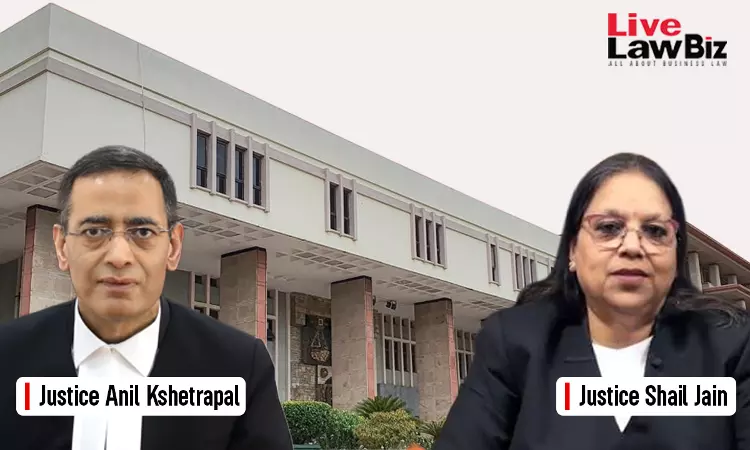
The Delhi High Court has upheld the auction of a judgment debtor's one-half undivided share in a Delhi property. The share had been transferred before formal attachment, but the court held that the transfer could not take it outside the pending execution proceedings.
A Division Bench of Justice Anil Kshetarpal and Justice Shail Jain held that the property had already been identified in the execution petition. Its attachment and sale had also been sought before the transfer.
“That claim cannot succeed. The property had already been identified in the pending Execution Petition and its attachment and sale had been sought before the conveyance. The transfer remained subject to the rights enforceable in those proceedings under Section 52 TPA,” the court observed.
The dispute arose from an arbitral award dated November 6, 2021. The award directed SPA Engineering Services and other judgment debtors to pay ₹50,34,888, along with interest and costs, to INTEC Capital.
INTEC filed an execution petition on May 13, 2022. It identified House No. 161, Gali No. 4, Durgapuri Extension, Shahdara, Delhi, as an immovable property belonging to Manju Sharma and sought its attachment and sale.
Notice of the execution petition was served on Manju on July 30, 2022. She subsequently transferred her undivided share in the property to her sister-in-law Nisha Sharma, who already owned the remaining half.
The Sale Deed recorded a consideration of ₹32.50 lakh. The transfer took place before the property was formally attached.
INTEC subsequently sought attachment of the property under Order XXI Rule 54 of the Code of Civil Procedure. The executing court ordered attachment on November 24, 2022, which was effected on December 17, 2022.
Nisha objected to the attachment. She argued that Manju had already transferred her share before the attachment order.
The executing court rejected those objections on April 24, 2023. Nisha did not challenge that order.
The executing court later directed the sale of Manju's undivided share. The auction was held on December 11, 2023, with Nisha's son-in-law Rahul Sharma emerging as the successful bidder for ₹84.50 lakh.
Nisha filed another set of objections. The executing court rejected them on June 3, 2026 and confirmed the auction sale.
She then approached the High Court through an Execution First Appeal.
Before the High Court, Nisha relied on the fact that the transfer preceded formal attachment. She also relied on an Agreement to Sell dated October 3, 2020.
The court held that Section 64 of the CPC did not invalidate the transfer. The Sale Deed had been executed before the attachment order.
Section 52 of the TPA, however, operated on a different principle. The court held that the provision applied because the property had already been specifically identified in the execution proceedings and its attachment and sale had been sought.
The Bench clarified that the Sale Deed itself was not void. It held that Nisha acquired whatever interest Manju could transfer, subject to the rights enforceable in the pending proceedings.
The court observed that the transfer “did not take the share of Judgment Debtor No.5 outside the pending execution.” It also held that this did not mean that “the Sale Deed was void or that no title passed between the parties.”
The Bench further held that Nisha could not reopen the same ownership claim. Her first objection under Order XXI Rule 58 CPC had already been adjudicated on April 24, 2023, and she had not challenged that order.
The Agreement to Sell dated October 3, 2020 did not alter the position. The court noted that it was available when the first objection was filed but was not relied upon at that stage.
The circumstances surrounding the transfer were also examined under Section 53(1) of the TPA.
The court noted that the arbitral award had already been passed and execution proceedings had commenced when the transfer took place. Manju had also been served with notice of the execution petition before the transfer.
The court further noted that substantially the entire consideration under the asserted family transaction was paid after the notice. Manju and her immediate family continued to occupy the property.
The Bench concluded:
“On a preponderance of probabilities, these circumstances establish that the transfer was made with the intent to defeat or delay the enforcement of the Decree Holder's rights against Judgment Debtor No.5. The circumstances also do not support the Appellant's claim to the protection available to a transferee in good faith under Section 53(1) TPA.”
Nisha also questioned the enforceability of the arbitral award. She challenged the constitution and authority of the arbitral tribunal and contended that a signed copy of the award had not been delivered to Manju under Section 31(5) of the Arbitration and Conciliation Act.
The High Court held that the scope of an executing court's jurisdiction was limited. It found that the objections concerning the arbitral tribunal and the underlying loan transaction involved disputed questions that could not be examined in the appeal as though it were a challenge to the award under Section 34 of the Arbitration and Conciliation Act.
On the Section 31(5) issue, the court did not determine whether statutory delivery of the award had been completed. It held that Nisha, as a transferee who acquired the share after the award and commencement of execution, could not rely on that issue to resist execution or undo the auction sale.
Nisha also invoked Section 60(1)(ccc) of the CPC, which provides protection in Delhi for a residential house belonging to and occupied by a judgment debtor.
The Bench held that the exemption was personal to the judgment debtor. Nisha, who was not a judgment debtor under the award, could not claim the exemption as a transferee.
The court also rejected the challenge to the sale of the undivided share. It held that an undivided share could be transferred and that the auction purchaser acquired only Manju's undivided interest.
The High Court accordingly dismissed the appeal. It upheld the order dated June 3, 2026 confirming the auction sale of Manju's one-half undivided share.
For Appellant (Smt Nisha Sharma): Advocates S. K. Srivastava, Shubhi Srivastava.
For Respondent (INTEC Capital Limited and Ors.): Advocates Pranav Goyal, Pooja Chaudhary, Vishant Singh, Mreeganka Goyal.