
Reproducing Substantial Portions Of Award While Deciding Challenge Not Non-Application Of Mind: Delhi High Court
Shivani PS
16 Oct 2026 5:46 PM IST
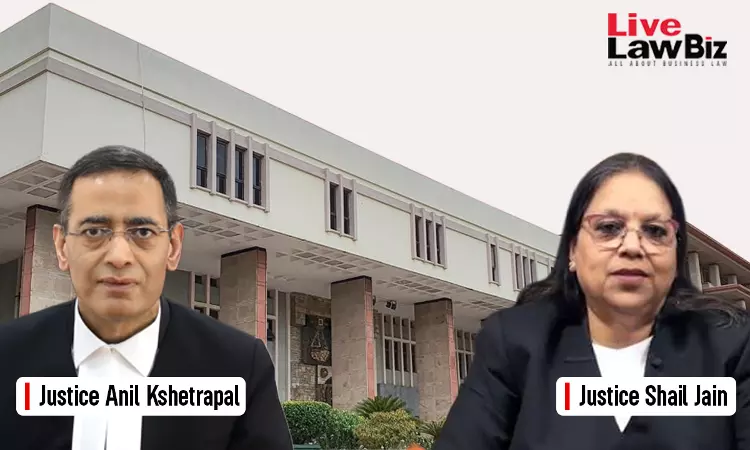
The Delhi High Court has ruled that a judge's reproduction of substantial portions of an arbitral award while deciding a challenge to it does not, by itself, establish non-application of mind, provided the judge meaningfully examines the objections raised.
“The distinction lies not in the extent of textual reproduction, but in the existence or absence of judicial engagement with the controversy. Consequently, the mere circumstance that substantial portions of an arbitral award have been reproduced in a judgment does not, without more, establish non-application of mind,” a Division Bench of Justice Anil Kshetarpal and Justice Bharat Parashar observed.
The court clarified that a judge need not formulate every reason afresh if the reasoning already on record is legally sustainable.
“Where a court examines the challenge before it and finds the reasoning of the decision under challenge to be legally sustainable, it may adopt that reasoning as the basis for its conclusion. Such adoption may be expressed by reproducing the relevant reasoning, referring to it, or expressly agreeing with it. The form in which the court conveys its agreement is not, by itself, determinative of the validity of the order. What matters is whether the judgment, read as a whole, demonstrates that the court has considered the controversy in the light of the applicable legal principles,” it ruled.
The bench made these observations while dismissing an appeal filed by Mumbai International Airport Limited against the Airports Authority of India over the alleged obligation to transfer the Authority's lessor interest under a lease granted to Sahara (Batra) Hospitality Private Limited at Mumbai airport.
The dispute arose from a lease agreement dated June 5, 2002, under which the Authority leased approximately 30,047.12 square metres of land at Chhatrapati Shivaji Maharaj International Airport, Mumbai, to Sahara (Batra) Hospitality for 29 years, until June 4, 2031.
Following the airport's privatisation, Mumbai International Airport Limited entered into an Operation, Management and Development Agreement with the Authority on April 4, 2006, and took over airport operations on May 3, 2006.
The agreement excluded land covered by existing leases, including the Sahara lease, from the land to be leased to the airport operator. The company, however, relied on a separate provision concerning the transfer or novation of existing contracts to argue that the Authority was required to transfer its rights as lessor under the Sahara lease.
The Authority passed on lease payments to the company for around ten years but stopped doing so from April 1, 2019. The company subsequently initiated arbitration, seeking transfer of the lease and monetary relief.
A three-member arbitral tribunal comprising retired Supreme Court judges Justice Deepak Gupta, Justice C.K. Thakker and Justice (Dr.) Arijit Pasayat unanimously rejected the company's claims on March 23, 2023.
Mumbai International Airport Limited challenged the award under Section 34 of the Arbitration and Conciliation Act, 1996. After a Single Judge dismissed the challenge on April 10, 2024, the company appealed under Section 37 of the Act.
The company argued that the Single Judge had reproduced substantial portions of the award without independently examining its objections. It also contended that the tribunal had misinterpreted the agreement and failed to adequately consider a letter issued by the Authority on June 9, 2006, and the rent payments made over the years.
The Authority maintained that the tribunal had reasonably interpreted the agreement and that the payments were an interim arrangement, rather than proof that the lease had been transferred.
The bench made clear that its ruling did not permit judges to mechanically endorse arbitral awards without examining material objections.
“If the Section 34 court merely reproduces the Award without examining a material objection, or if the reasoning adopted fails to answer the challenge or rests on a legally untenable premise, the judgment may remain vulnerable notwithstanding the reproduction of reasons,” the court observed.
The bench acknowledged that the Single Judge could have dealt more expressly with the significance of the June 9, 2006 letter and the subsequent rent payments.
The letter recorded the Authority's understanding that existing commercial and land licence or lease agreements were required to be assigned or novated to the joint venture company during the transition period. However, the court observed that the letter was issued after the agreement was executed and could not, by itself, amend its terms.
The rent payments were relevant to understanding how the parties implemented or understood the arrangement. But the court held that the payments did not, by themselves, establish that the lessor's interest had been transferred or that the agreement required such a transfer. Their evidentiary value had to be assessed alongside the circumstances in which they were made and the relevant contractual provisions.
The court reiterated that an arbitral award cannot be set aside merely because another interpretation of the contract is possible. The question was whether the tribunal's interpretation warranted interference under the limited grounds available under Section 34.
Finding no ground to interfere with the decision upholding the award, the Division Bench dismissed the appeal.
For Appellant (Mumbai International Airport Limited): Senior Advocate Rajiv Nayar; Advocates Kanika Singh, Ishanee Kapoor, Janhavi Negi, Pratham Vir Agarwal and Naman Maheshwari.
For Respondent (Airports Authority of India): Additional Solicitor General Raghavendra P. Shankar; Advocates Karan Lahiri, Prateek Arora, Pallavi Mishra and Kanishka Singh.