
Provision For Termination Of Arbitrator's Mandate Cannot Be Used To Challenge His Appointment: Telangana High Court
Shivani PS
13 April 2026 3:03 PM IST
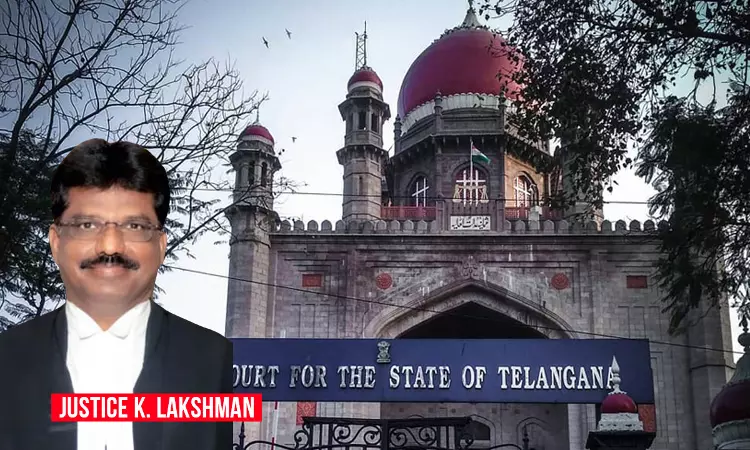
The Telangana High Court has recently held that Section 14 of the Arbitration and Conciliation Act, 1996 (provision for termination of an arbitrator's mandate) is a narrow provision and cannot be used to indirectly challenge the validity of an arbitrator's appointment once that issue has attained finality.
Justice K. Lakshman dismissed an application filed by Galore Infratech Pvt. Ltd. under Sections 14, 15 and 11 of the Act. The company had sought termination of the arbitrator's mandate and appointment of an independent arbitrator in its dispute with SEW Krishnagar Bahrampore Highways Ltd.
Refusing the plea, the court observed, “Section 14 of the Act provides for termination of the mandate of an arbitrator where he becomes de jure or de facto unable to perform his functions or fails to act without undue delay. The scope of the provision is narrow and is confined to situations where the arbitrator suffers from a legal or factual incapacity which renders continuation of the mandate impossible. The provision cannot be invoked as a substitute for challenging the validity of the appointment itself”
The dispute arises from a work order–cum–agreement dated September 26, 2012. Under the contract, Galore Infratech was to install crushing plants and supply about 11,00,000 metric tonnes of aggregates for the four-laning of the Krishnagar–Baharampore stretch of NH-34 in West Bengal.
According to Galore Infratech, it mobilised resources and began operations in September–October 2012. However, SEW allegedly failed to lift the materials and defaulted on payments, resulting in losses of around Rs 12.21 crore.
The issue of appointment of the arbitrator had already been litigated earlier. Galore Infratech had approached the High Court under Section 11(6), seeking appointment of an independent arbitrator. By an order dated June 9, 2020, the Court rejected the plea and upheld the contractual mechanism permitting unilateral appointment, noting that the arbitration was governed by the pre-2015 amendment regime.
This ruling was carried to the Supreme Court by way of a Special Leave Petition, which was dismissed on March 15, 2024. The question of the validity of the appointment thus attained finality between the parties.
Despite this, Galore Infratech filed the present application. It argued that the unilateral appointment and re-appointment of the arbitrator violated the requirement of independence under Section 12. It also contended that once the earlier arbitrator recused, SEW lost its right to appoint a substitute, and a neutral arbitrator ought to have been appointed by the Court.
SEW opposed the plea, pointing out that the appointment had been made strictly in terms of the contract and had already been upheld in earlier proceedings up to the Supreme Court. It argued that the present application was an attempt to reopen a settled issue.
The court agreed with SEW. It held that the present application, though framed under Sections 14 and 15, was in substance an indirect challenge to the arbitrator's appointment, which had already been upheld and could not be re-agitated.
The court made it clear that Section 14 comes into play only in limited situations. It applies where the arbitrator is legally or factually unable to carry out their role or where there is an unexplained failure to proceed. It cannot be stretched to question how the arbitrator was appointed in the first place.
On the question of neutrality, the Court drew a firm line. The safeguards introduced by the 2015 amendment, it said, do not operate retrospectively. They cannot be used to unsettle an appointment made under the earlier legal regime, particularly when that appointment has already been upheld and affirmed by the Supreme Court.
The court also noted that once an arbitrator is appointed in terms of the agreed procedure and that appointment has been judicially upheld, the court's role under Section 11 comes to an end.
The same issue cannot be brought back in a different form on identical grounds.
Consequently, the court found the application to be not maintainable. It dismissed the plea and allowed the arbitral proceedings to continue in accordance with law.
For Petitioner (Galore Infotech Pvt. Ltd) : Advocates M. Govind Reddy, E. Varun Kumar.
For Respondent (SEW Krishnagar Bahrampore Highways Ltd): Not specified.