
Pre-Named Arbitrator Can Constitute Tribunal Only If Mutual Consent Continues: Delhi High Court
Shivani PS
17 Sept 2026 5:29 PM IST
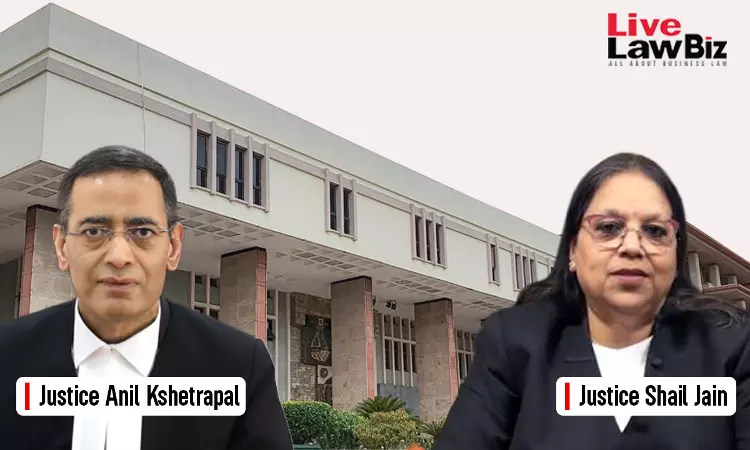
On 16 September, the Delhi High Court held that naming an arbitrator in an arbitration agreement may reflect the parties' mutual and continuing consent to his appointment. However, where one party alone appoints the named arbitrator after a dispute arises, the appointment must satisfy the safeguards under Section 12(5) read with the Seventh Schedule to the Arbitration and Conciliation Act, 1996.
A Division Bench of Justices Anil Kshetrapal and Shail Jain dismissed Matsya Fincap Pvt. Ltd.'s appeal and upheld the Commercial Court's order setting aside an ex-parte arbitral award in its favour against guarantor Mohd. Hassinuddin. The judges held:
“A named arbitrator may validly constitute the tribunal where the designation itself represents the parties' mutual and continuing consent to such constitution. However, where the record demonstrates that one party alone invokes the clause and appoints the named person after the dispute has arisen, the Court is required to examine the appointment in the context of the statutory safeguards contained in the A&C Act.”
The dispute arose from a Rs. 2 lakh business loan advanced by Matsya Fincap to Allahuddin under a Loan Agreement dated 7 May 2019.
Hassinuddin stood as guarantor and undertook to repay the outstanding amount if Allahuddin defaulted. Under the agreement, Allahuddin was required to repay Rs. 2.34 lakh in 90 daily instalments, with late-payment charges at 36% per annum.
Following alleged defaults, Matsya Fincap invoked the arbitration clause and appointed advocate Manohar Lal Saini as the sole arbitrator by a letter dated 18 August 2020. Although Saini was named as the arbitrator in the agreement, Hassinuddin did not participate in his appointment or the subsequent arbitral proceedings.
Saini proceeded ex-parte and, on 12 October 2020, awarded Matsya Fincap Rs. 5.18 lakh, along with 18% annual interest from 1 July 2020 until realisation and costs. Hassinuddin challenged the award before the Commercial Court at Tis Hazari, Delhi, arguing, among other grounds, that Matsya Fincap had unilaterally appointed Saini.
On 31 August 2024, the Commercial Court set aside the award, finding that Matsya Fincap had made the appointment unilaterally and that there was no post-dispute written agreement by Hassinuddin waiving the statutory safeguards governing the arbitrator's eligibility. Matsya Fincap then approached the High Court under Section 37 of the Arbitration and Conciliation Act.
It argued that Saini was specifically named in the arbitration agreement and that his appointment therefore could not be treated as unilateral. It also questioned the Delhi court's territorial jurisdiction, the limitation of Hassinuddin's challenge and the applicability of the Rajasthan Money-Lenders Act, 1963.
Hassinuddin submitted that the award itself recorded that Matsya Fincap had appointed Saini after the dispute arose and that he had never subsequently consented to the appointment in writing.
The High Court held that naming an arbitrator in an agreement is not, by itself, invalid. In this case, however, Matsya Fincap constituted the tribunal on its own after the dispute had arisen. Hassinuddin neither participated in Saini's appointment nor subsequently consented to it in writing.
The Bench also clarified that repeated appointment of the same arbitrator does not, by itself, establish statutory ineligibility under the Seventh Schedule. It said:
“The mere fact that the same Arbitrator may have been appointed in several proceedings cannot, by itself, establish statutory ineligibility under the Seventh Schedule to the A&C Act.”
Accordingly, the High Court dismissed Matsya Fincap's appeal and upheld the Commercial Court's 31 August 2024 order setting aside the arbitral award.
Appearances for appellant (Matsya Fincap Pvt. Ltd.): Advocate Nikita Kumari.
Appearances for respondent (Mohd. Hassinuddin): Advocate Amit Sinha.