
Permission To Cross-Examine Witnesses Cannot Revive Forfeited Right To Seek Arbitration: Madras High Court
Shivani PS
12 Oct 2026 6:02 PM IST
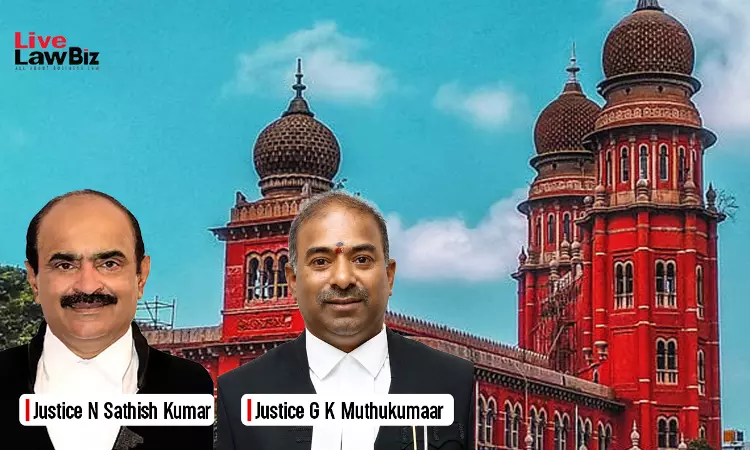
The Madras High Court has ruled that a party cannot seek arbitration in a commercial suit after forfeiting its right to file a written statement within the mandatory 120-day deadline, even if it is subsequently allowed to cross-examine witnesses.
A Division Bench of Justice N. Sathish Kumar and Justice G.K. Muthukumar held that allowing a party to participate in cross-examination does not permit it to bypass the statutory deadline by subsequently seeking reference to arbitration.
“Merely because the appellant was permitted to participate in the proceedings to cross-examine the plaintiff side witnesses, the appellant cannot take advantage of the same and use Section 8 of the Arbitration and Conciliation Act, 1996, as a procedural device to circumvent the mandatory time limit introduced by the Commercial Courts Act, 2015,” the Bench observed.
The ruling came in an appeal filed by BGR Energy Systems Limited against an order refusing to refer its ₹37.45 lakh recovery dispute with TUV SUD South Asia Private Limited to arbitration.
TUV SUD, which provides certification, testing, auditing, inspection and training services, had provided technical evaluation services to BGR Energy, an engineering, procurement and construction company. It raised invoices for the services and claimed that BGR Energy owed ₹37,45,109. TUV SUD subsequently filed a recovery suit before the Principal Commercial Court at Egmore, Chennai.
BGR Energy received summons on April 2, 2026, but failed to file its written statement within the prescribed 120-day period. The commercial court consequently set it ex parte on June 16, 2026.
TUV SUD filed its proof affidavit on July 10. On August 13, BGR Energy applied under Order IX Rule 7 of the Code of Civil Procedure to set aside the ex parte order and sought permission to participate in the proceedings.
The commercial court allowed the application on September 3, subject to payment of ₹7,000 in costs. It permitted BGR Energy to cross-examine witnesses but maintained that its right to file a written statement had already been forfeited.
BGR Energy also sought reference to arbitration under Section 8 of the Arbitration and Conciliation Act, 1996, relying on Clause 15 of the contractual terms. The commercial court rejected the application on September 3, prompting the company to appeal before the High Court under Section 37(1)(A) of the Arbitration Act read with Section 13(1) of the Commercial Courts Act, 2015.
Before the High Court, BGR Energy argued that the contract provided for arbitration and that the deadline for filing a written statement did not prescribe a separate limitation period for an application seeking reference to arbitration.
It contended that its failure to file a written statement within 120 days did not, by itself, amount to a waiver of its right to arbitration. BGR Energy also argued that the commercial court had failed to examine the arbitration agreement before rejecting its application.
Rejecting these arguments, the High Court held that a party must seek reference to arbitration no later than the stage at which it can file its first statement on the substance of the dispute. In the context of a civil suit, the Bench interpreted this stage as the filing of the written statement.
“If the right of the party to file written statement has already been forfeited by the Statute, later, the party cannot seek reference as a procedural device to circumvent the time limit held to be mandatory in filing the written statement in commercial suits,” the Bench observed.
The court referred to amendments introduced by the Commercial Courts Act, 2015, which prescribe a strict timeline for filing written statements in commercial suits. Under the amended provisions of the Code of Civil Procedure, a written statement must be filed within 120 days of service of summons. Once that period expires, the right to file it stands forfeited, and the court cannot accept the written statement on record.
The Bench also relied on the Delhi High Court's decision in SPML Infra Limited v. Trisquare Switchgears Private Limited, which held that a party cannot seek reference to arbitration under Section 8 after its right to file a statement of defence has been closed.
Emphasising that the statutory timelines are intended to ensure speedy resolution of commercial disputes, the High Court held that BGR Energy could not use its permission to cross-examine witnesses to circumvent the forfeiture of its right to file a written statement.
The bench dismissed the appeal, upheld the commercial court's order dated September 3, 2026, imposed no costs and closed the connected miscellaneous petition.
For Appellant (BGR Energy Systems Limited): Advocate P.J. Rishikesh.
For Respondent (TUV SUD South Asia Private Limited): Advocate E.K. Amalnath.