
State Cannot Bypass Statutory Limitation By Challenging MSME Award Through Writ: Karnataka High Court
Shivani PS
15 Sept 2026 4:43 PM IST
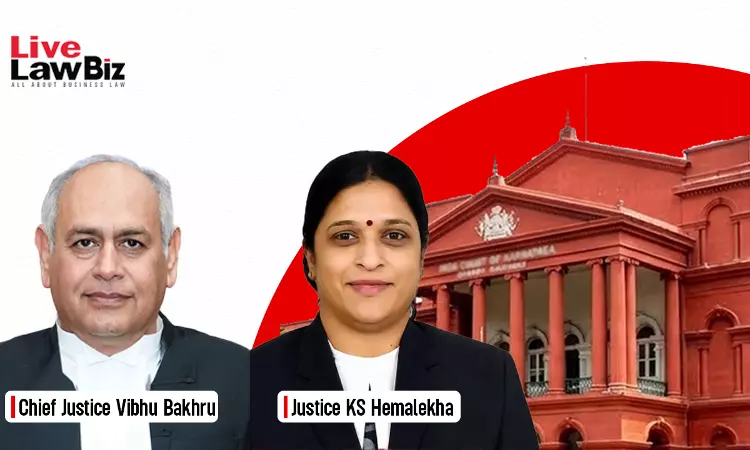
The Karnataka High Court on 3 September held that the State cannot circumvent the statutory limitation for challenging an arbitral award passed by the Micro and Small Enterprises Facilitation Council by invoking the High Court's writ jurisdiction for a merits review.
A Division Bench of Chief Justice Vibhu Bakhru and Justice K.S. Hemalekha allowed the writ appeal filed by the Commissioner, Bhoomi Monitoring Cell, only to the extent of holding that the State's writ petition challenging a Rs. 29.32 lakh award in favour of Connoinseur Electronics Pvt. Ltd. ought not to have been entertained on merits. The judges held:
“Plainly, the appellant cannot be permitted to overcome the period of limitation by avoiding the statutory remedy and seeking the extraordinary remedy under Article 226 of the Constitution of India.”
The dispute arose from a notification issued by the Bhoomi Monitoring Cell on 25 August 2011 inviting tenders for the supply of handheld devices for its Bhoomi Project. Connoinseur Electronics emerged as the successful bidder, following which a work order for supplying universal handheld devices was issued on 9 January 2012.
The company supplied 100 devices and raised an invoice for Rs. 46,90,900 on 22 March 2012. It subsequently supplied another tranche of devices and raised further invoices. The State later raised concerns regarding the functioning of the devices through a letter dated 3 September 2012.
On 1 March 2013, the Karnataka Government approved payment of Rs. 17,58,087, which was credited to the company's account. The balance remained unpaid, prompting Connoinseur to approach the Karnataka Micro and Small Enterprises Facilitation Council for recovery of Rs. 29,32,813.
The Facilitation Council passed an award on 8 January 2017 under Section 18 of the Micro, Small and Medium Enterprises Development Act, 2006, directing the State to pay Rs. 29,32,813 with interest at 8% per annum.
The State did not challenge the award under Section 34 of the Arbitration and Conciliation Act, 1996 within the prescribed period. It instead approached the High Court under Article 226 on 11 August 2017, after the limitation period had expired.
The High Court noted that the State's challenge was directed at the merits of the award and raised no jurisdictional ground. It also found that the writ petition contained no explanation for the failure to pursue the statutory remedy under Section 34.
A Single Judge nevertheless examined the challenge on merits and dismissed the writ petition on 25 June 2024, finding no error in the Facilitation Council's award.
Before the Division Bench, the State relied on the Supreme Court's subsequent reference in Tamil Nadu Cements Corporation Limited v. Micro and Small Enterprises Facilitation Council, questioning whether writ petitions challenging Facilitation Council awards are completely barred and, if not, the circumstances in which they may be entertained.
The State also contended that the Supreme Court had expressed reservations about its earlier decision in India Glycols Limited and Another v. Micro and Small Enterprises Facilitation Council, Medchal-Malkajgiri and Others, which held that writ petitions under Articles 226 and 227 were not maintainable against such awards when a statutory remedy under Section 34 was available.
The High Court held that it was unnecessary to decide the larger question referred to the Supreme Court since the State's petition sought only a merits review of the arbitral award. It reiterated that the writ jurisdiction cannot be invoked for such a review. It held:
“Thus, even without going into the question as to whether in certain circumstances, a writ petition can be maintained against an award passed under Section 18 of the MSMED Act, the petition preferred by the appellant ought not to have been entertained as it sought merits review of the award passed by the Facilitation Council.”
Further, the Bench held that, notwithstanding the reference in Tamil Nadu Cements Corporation Limited, the decision in India Glycols continued to bind the Karnataka High Court.
It noted that the State had approached the writ court only after the award had become final and the period for seeking its setting aside had expired, without explaining the delay. It held that the Single Judge ought not to have examined the State's challenge on merits and should have rejected the writ petition at the threshold.
Accordingly, the High Court dismissed the writ appeal and disposed of the pending interlocutory applications.
Appearances for appellant (Commissioner, Bhoomi Monitoring Cell): Additional Government Advocate, S.R. Khamroz Khan.
Appearances for respondent (M/s Connoinseur Electronics Pvt. Ltd.): Advocate N. Dinesh Rao.