
Investor-State Arbitration Needs Standing Mechanism, Appellate Review: Justice PS Narasimha
Shivani PS
8 Oct 2026 12:27 PM IST
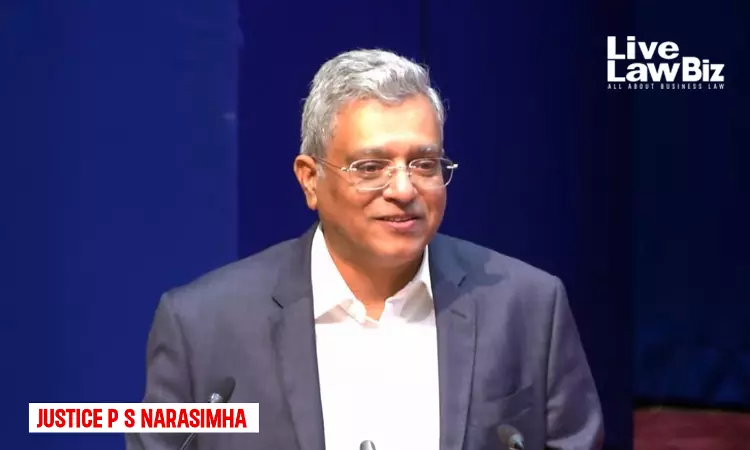
Justice Narasimha was delivering the keynote address, titled “The Next Generation of International Investment Law” at an event marking the ninth anniversary of the Centre for Trade and Investment Law (CTIL).
Supreme Court Judge Justice PS Narasimha on Wednesday highlighted the need for a standing investment dispute resolution mechanism and appellate review. He said such a system could help address inconsistent decisions by ad hoc arbitral tribunals in investor-State disputes.
He noted that investment disputes can involve government decisions affecting millions of people. Yet, these disputes are traditionally decided by tribunals constituted for individual cases.
Different tribunals may interpret similar treaty provisions differently. There is also no general appellate structure to correct errors and develop a consistent body of law.
“One of the most significant proposals is the creation of a standing mechanism. Moving from ad hoc tribunals towards a more permanent system could bring greater consistency and continuity to investment adjudication. It could also create clearer rules for the appointment and conduct of adjudicators and provide, through appellate review, a way of correcting legal errors,” he observed.
Justice Narasimha was delivering the keynote address, titled “The Next Generation of International Investment Law” at an event marking the ninth anniversary of the Centre for Trade and Investment Law (CTIL).
He said international investment law is now entering a third stage. The focus is shifting from the competing claims of investor protection and State regulatory freedom to the institutions that decide where that balance should lie.
“The debate today is no longer simply about how much protection an investor should receive, or how much regulatory freedom a State should retain. The deeper question is institutional. What kind of institutions can maintain a legitimate balance between these interests over the long term?” he said.
Explaining this shift, Justice Narasimha said the first generation of investment law focused largely on protecting foreign investment. The reaction that followed placed greater emphasis on preserving the regulatory freedom of States.
The present debate, he said, is increasingly concerned with the institutions that interpret and apply these protections.
“Different tribunals may interpret similar treaty provisions differently. And unlike most domestic judicial systems, investment arbitration does not have a general appellate structure for correcting errors and developing a consistent body of law,” he observed.
He also flagged concerns over the length and cost of investment proceedings. Other concerns included large compensation claims and the appointment, independence and repeated appointment of arbitrators.
Referring to disputes arising from Argentina's financial crisis, Justice Narasimha noted that different tribunals examined similar emergency measures. They nevertheless reached different conclusions on issues including necessity and Argentina's treaty obligations.
“The problem, therefore, is not only about what investment treaties say. It is also about the institutions that interpret and apply them. We cannot address every weakness in investment law simply by adding another exception to another treaty,” he said.
Against this backdrop, Justice Narasimha highlighted the reform work undertaken by the United Nations Commission on International Trade Law (UNCITRAL) Working Group III since 2017.
The proposals include a standing dispute resolution mechanism and appellate review. They also cover rules on damages and compensation, mediation and dispute prevention.
At the same time, he cautioned that greater consistency in adjudication would not necessarily produce consistency in investment law.
“Greater consistency in adjudication cannot by itself produce consistency in the law,” he said. Reform, he stressed, must address “both the institutions that decide disputes and the treaties they are asked to apply.”
Justice Narasimha also criticised an approach to reform that responds to individual controversies rather than taking a longer-term institutional view.
“For too long, reform in investment law has been driven by the problem immediately before us. A controversial award leads to a new clause. An unexpected interpretation leads to a new exception. A procedural weakness leads to another procedural rule,” he observed.
Turning to India's experience, Justice Narasimha referred to White Industries v. India. In that case, a tribunal found that the delay in enforcing the investor's award had breached India's treaty obligations.
He also discussed the Vodafone and Cairn disputes involving retrospective taxation. He referred to the Devas-Antrix litigation concerning telecommunications, satellite spectrum, and national security.
These disputes, he said, demonstrated how investment arbitration can extend beyond commercial disagreements. They can also raise broader questions of domestic governance, sovereign policy and public interest.
Justice Narasimha then also took time to trace the evolution of India's investment treaty policy. He noted that the 2015 Model Bilateral Investment Treaty narrowed the definition of investment and omitted the most-favoured-nation clause.
It also required investors to pursue domestic remedies before commencing international arbitration.
“India was seeking greater control over the scope of the obligations it assumed under international investment law. Yet India's subsequent experience also shows why reform cannot simply move from one extreme to the other,” he observed.
He pointed to the India-UAE investment treaty signed in 2024 as an example of this evolution. Unlike the 2015 Model Treaty, the 2024 treaty reduced the period for pursuing domestic remedies before arbitration from five years to three.
Justice Narasimha said India's position also reflects its changing role in the global investment system. India is now both a destination for foreign investment and the home of companies investing abroad.
Its interests, therefore, cannot be viewed solely from the perspective of either a host State or an investor's home State.
“The objective, therefore, cannot be maximum protection for investors or maximum freedom for States. It must be a framework in which investment receives credible protection while governments retain sufficient authority to govern in the public interest,” he said.
Extending this argument to the Global South, Justice Narasimha referred to Brazil's emphasis on dispute prevention. He also referred to South Africa's greater reliance on domestic law and the African Union's regional investment framework.
“Countries that were once largely rule-takers are increasingly becoming rule-makers. This is not a retreat from international investment law. It is an opportunity to participate in its reconstruction,” he said.
Justice Narasimha concluded by stressing the need for long-term institutional reform. He said such reforms should create institutions capable of commanding confidence in the future.
“Institution-building takes time. But the true test of reform is not whether it answers today's controversy. It is whether it creates institutions that can command confidence tomorrow,” he said