
J&K High Court Says Final Bill Cannot Revive Time-Barred Claim, Upholds Set-Aside Award
LiveLaw Network
8 Oct 2026 4:54 PM IST
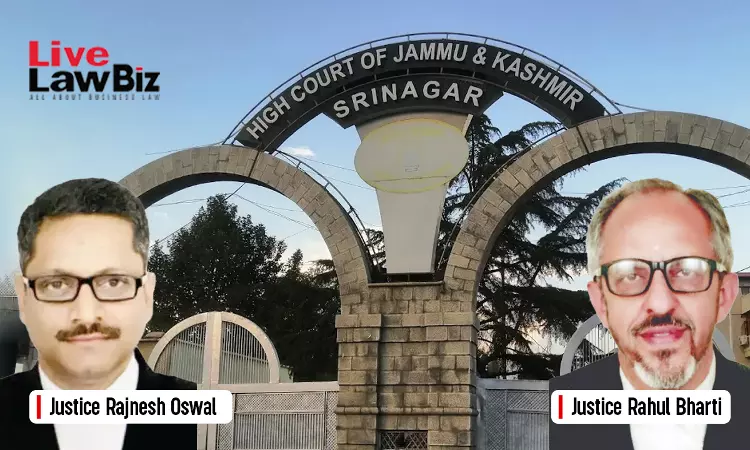
The Jammu & Kashmir and Ladakh High Court on 6 October held that a time-barred claim cannot be revived merely because a department subsequently prepared a final bill, particularly when the bill was neither approved by the competent authority nor amounted to a written acknowledgment of liability under Section 19 of the J&K Limitation Act, Samvat 1995.
A Division Bench comprising Justices Rajnesh Oswal and Rahul Bharti dismissed a contractor's appeal against a Single Bench judgment that had set aside an arbitral award, except to the extent of the arbitrator's fee. The award had granted various monetary claims arising from a contract for execution of work at Wangat Weir, USHP-II, Kangan. It observed:
“entertaining a time-barred claim violates statutory mandate, rendering the resulting award vulnerable to being set aside for violating Public Policy.”
The appellant received the contract in 1988, but the work remained incomplete and the department terminated the contract in May 1998. He made several representations between 2000 and 2011 seeking payment towards various claims. He invoked arbitration in 2013, leading to an award in December 2018 that granted amounts towards restoration work, earnest money, security deposit, escalation and the final bill, besides interest.
An interim award concerning escalation had attained finality. The Single Bench subsequently held that the remaining claims were time-barred and set aside the final award to that extent. The contractor then challenged that decision before the Division Bench.
The Division Bench examined whether the appellant could rely on a departmental communication to contend that limitation remained deferred until related civil litigation ended in 2011.
It found that the communication had expressly rejected the appellant's claims relating to restoration of flood damages and diversion bunds. It had left only consideration of the final bill, security deposit, earnest money and escalation for further action.
Therefore, the Bench held that the communication did not defer the entire claim until the civil suit concluded. The appellant was required to pursue the rejected claims within the prescribed limitation period.
It also noted that the appellant had obtained clarification from the Civil Court in 2005 that no prohibitory order prevented release of the amount. Despite this, he invoked arbitration only in 2013. Also, that even if the 2000 communication had deferred consideration of some claims, those claims had become time-barred by the time the appellant invoked arbitration.
The appellant had relied on the preparation of a final bill in February 2011, arguing that it amounted to an acknowledgment of liability and triggered a fresh limitation period under Section 19 of the J&K Limitation Act.
The Court rejected the argument, holding that mere preparation of a final bill does not amount to an acknowledgment of liability, particularly when the competent authority has not approved it. It further noted that the claims had already become time-barred by then. It observed:
“the preparation of the final bill, without an approval by the competent authority, could in no manner be considered as an acknowledgment of liability so as to furnish any fresh cause of action.”
Further, the Bench rejected the argument that the respondents had waived their right to object to limitation by participating in the arbitration proceedings without raising the issue during the earlier Section 11 proceedings.
Relying on the Supreme Court's judgment in Bharat Sanchar Nigam Limited v. Nortel Networks India Pvt. Ltd., it distinguished between jurisdictional objections and objections concerning the admissibility of a claim.
It noted that a limitation objection concerns the admissibility of the claim and not the arbitrator's jurisdiction to adjudicate it. Therefore, failure to invoke Section 16 of the Arbitration and Conciliation Act, 1996 could not, by itself, amount to waiver of the respondents' right to object to stale and time-barred claims.
The judges held that “the procedural issues, including the claims being time barred, cannot be confused with jurisdictional issues.” They also relied on M/s B&T AG v. Ministry of Defence and M/s Arif Azim Co. Ltd. v. M/s Aptech Ltd., and made no error in the Single Bench's decision to set aside the award, except to the extent of the arbitrator's fee.
Accordingly, the Division Bench of the High Court dismissed the appeal and upheld the Single Bench judgment.
For the Appellant (Kamal Krishan Chibber): Mr. M. A. Dar, Advocate
For the Respondents (UT of J&K and Power Development Department authorities): Mr. M. A. Chashoo, Senior Advocate, Ms. Hikma, Advocate