
Remedy Against Refusal To Recall Arbitral Termination Lies Under Section 14(2), Not Section 34: Delhi HC
Arpita Pande
28 May 2026 3:35 PM IST
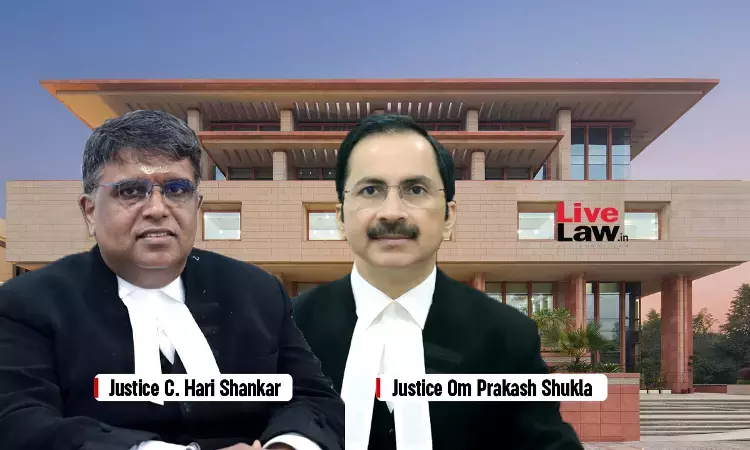
The Delhi High Court has held that a party cannot invoke Section 34 of the Arbitration and Conciliation Act, 1996 to challenge an order refusing to recall termination of arbitral proceedings passed under Section 25, and that the only remedy lies under Section 14(2) of the Act.
A Bench of Justices C. Hari Shankar and Om Prakash dismissed the appeal filed by U.P. Infraestate Pvt. Ltd. against Rivaj Infratech Pvt. Ltd., holding that the Section 34 petition itself was not maintainable. The judges observed:
“Clearly, therefore, the petition of the petitioner before the learned Single Judge, having been preferred under Section 34 of the 1996 Act, was not maintainable and the order of the learned Single Judge, having been passed under Section 34 of the 1996 Act, is equally unsustainable in law on that ground alone.”
The sole arbitrator terminated the proceedings on 1 November 2019 under Section 25 of the Arbitration Act after U.P. Infraestate Pvt. Ltd. failed to file its statement of claim within time. The arbitrator later dismissed Infraestate's recall application on 14 January 2023.
Infraestate then filed a petition under Section 34, which the Single Judge dismissed on 26 April 2023. Infraestate challenged that order in the present appeal under Section 37.
Rivaj Infratech Pvt. Ltd. objected to the maintainability of the Section 34 petition. It argued that Infraestate should have challenged the refusal to recall the termination order under Section 14 of the Arbitration and Conciliation Act, 1996, and not under Section 34. It further argued that even if the order fell under Section 14, Section 37 does not permit an appeal. It relied on the Supreme Court judgment in Harshbir Singh Pannu v. Jaswinder Singh.
The Court held that the impugned judgment did not arise from an exercise of jurisdiction under Section 14 and therefore it could not treat the order as one passed under that provision. The Court identified the core issue as whether Infraestate could maintain a Section 34 petition against an order refusing to recall termination under Section 25.
Relying on Harshbir Singh Pannu, the Bench held that a party must challenge the dismissal of a recall application before the arbitrator under Section 14(2). It rejected Infraestate's attempt to rely on any alleged divergence in remedies, clarifying that the challenge did not concern the original termination order but the refusal to recall it.
The judges further rejected Infraestate's contention that the arbitrator's order dated 14 January 2023 amounted to a fresh termination under Section 25. It held that arbitral proceedings terminate only once and cannot terminate again. It therefore treated the later order only as a refusal to recall the earlier termination.
Finally, the Bench concluded that the Section 34 petition failed the test of maintainability under the Arbitration and Conciliation Act, 1996 as clarified in Harshbir Singh Pannu.
Accordingly, the High Court quashed the Single Judge's order and granted liberty to Infraestate to pursue remedies under Section 14(2).
For Petitioner: Advocate Raman Gandhi
For Respondent: Senior Advocate Ramesh Singh with Advocates Harish Kumar Garg, Nisha and S. Panda