
Parties Cannot Choose Court To Extend Arbitrator's Mandate After Statutory Period Ends: Gujarat High Court
Shivani PS
3 July 2026 2:30 PM IST
The Gujarat High Court on Thursday held that once the statutory period for making an arbitral award expires, parties cannot rely on party autonomy or institutional arbitration rules to choose the court that will extend an arbitral tribunal's mandate.
It held that, beyond the period expressly permitted under the Arbitration and Conciliation Act, only the court recognised under the statute can extend the tribunal's mandate.
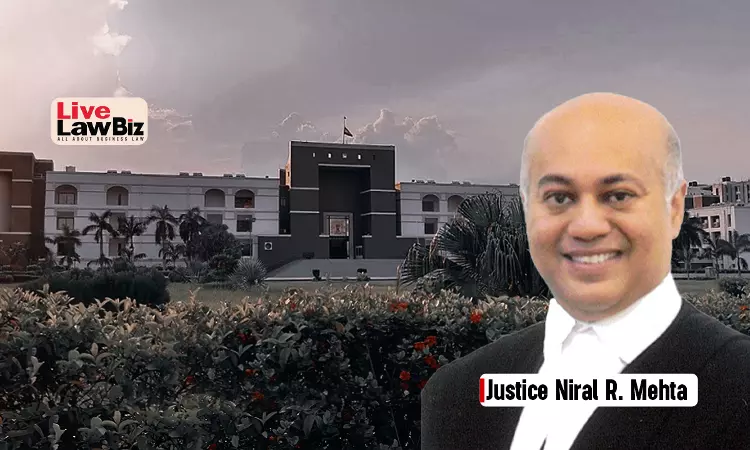
Justice Niral R. Mehta delivered the judgment while upholding a preliminary objection raised by a partnership firm in an arbitration arising from business transactions of the partnership firm and disputes among its partners.
The court held that it lacked jurisdiction to entertain the applications and granted liberty to the parties to approach the competent court for extension of the arbitrator's mandate.
Noting that Rule 34.6 of the Arbitration Centre (Domestic and International), High Court of Gujarat Rules, 2021 provides for applications to the High Court for extension of an arbitral tribunal's mandate, the court directed the Registry to place the judgment before the concerned committee to consider amending the Rule in light of the Supreme Court's ruling in Jagdeep Chowgule v. Sheela Chowgule.
The court observed, "When the party autonomy is restricted for extension of mandate, it is not digestible that a party can choose a court who can extend the mandate. Party autonomy does not give any leverage to any of the parties to the arbitration to have their own choice of court by way of agreement,they can invest powers for extension of mandate de hors the provisions of Section 29A(4) of the Arbitration Act, 1996."
It further observed, "Consequently, irrespective of whether the arbitration is ad hoc or institutional, any extension of the arbitral tribunal's mandate beyond the statutory period must necessarily be sought from the 'Court' as understood under Section 29A read with the definition contained in Section 2(1)(e) of the Act."
The dispute arose from business transactions of a partnership firm and disputes among partners of Parth Developers.
In January 2022, the Gujarat High Court appointed Justice H.N. Devani (Retd.) as the sole arbitrator under the Gujarat High Court Arbitration Centre Rules. After pleadings were completed, the tribunal recorded evidence from nineteen witnesses and heard final arguments before reserving the matter for the award in April 2024.
The award could not be pronounced because of the voluminous record and the complexity of the partnership dispute. Although the parties first extended the arbitrator's mandate by consent and the High Court granted further extensions, the award remained pending. Abhishek Suresh Mehta and the other applicants then sought another six-month extension.
Parth Developers opposed the applications, relying on the Supreme Court's decision in Jagdeep Chowgule v. Sheela Chowgule.
It argued that only the court competent to entertain a challenge to the arbitral award had jurisdiction to extend the tribunal's mandate.
The applicants contended that the arbitration had throughout been governed by the Gujarat High Court Arbitration Centre Rules. They argued that previous extensions had been granted by the High Court without objection and that Rule 34.6 empowered the High Court to extend the tribunal's mandate.
Rejecting the contention, the court held that party autonomy operates only where the statute expressly permits it. It observed, "Party autonomy under the Act is not absolute.It operates only in those areas where the statute expressly permits the parties to exercise their choice. Wherever the Act prescribes a mandatory statutory procedure, party autonomy necessarily gives way to the legislative mandate."
The court held that once the initial twelve-month period and the additional six-month extension by consent expire, continuation of the arbitral tribunal falls exclusively under the control of the court.
It ruled that institutional arbitration rules cannot override the statutory framework governing extension of an arbitrator's mandate.
For Petitioners (Abhishek Suresh Mehta & Ors.): Advocates Deven Parikh, Rutul P. Desai, Amit Thakkar.
For Respondents (Parth Developers & Ors.): Advocates Mehul Sharad Shah, K.K. Trivedi, Mayank K. Trivedi.