
MP High Court Sets Aside Arbitral Award In Insulator Supply Dispute For Patent Illegality
Arpita Pande
25 April 2026 11:19 PM IST
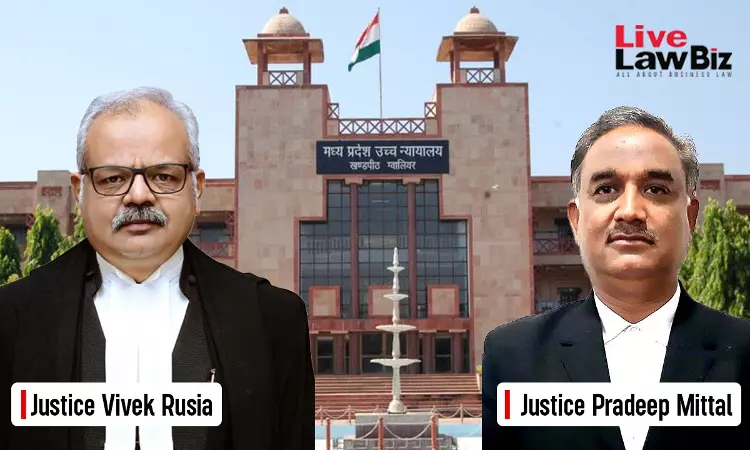
Setting aside an arbitral award in a dispute over the supply of disc insulators for transmission lines, the Madhya Pradesh High Court has found that the award was vitiated by patent illegality, noting that the arbitrator overlooked key provisions of the Contract Act and returned findings that did not align with the contractual record.
The Bench of Justices Vivek Rusia and Pradeep Mittal said the November 16, 2018 award was marked by fundamental errors. It pointed out that the arbitrator had wrongly applied Sections 20, 62, 73 and 74 of the Contract Act and failed to properly engage with crucial aspects of the agreement between the parties.
The court held:
“The award is set aside on the ground of patent illegality, inasmuch as the learned Arbitrator has: (i) failed to consider the Appellant's objections founded on Sections 20, 73 and 74 of the Contract Act; (ii) misapplied Section 62 of the Contract Act by treating a bilateral contractual amendment, validly entered into between the parties, as a nullity; and (iii) rendered a finding on rejection of goods that is contrary to the documentary record and the terms of the contract. Each of these infirmities independently constitutes patent illegality within the meaning of Section 34(2A) of the Act, 1996, warranting interference”
The court therefore set aside both the arbitral award and the Commercial Court's order dated January 3, 2024, which had upheld the award.
The dispute arose from contracts awarded by Madhya Pradesh Power Transmission Company Limited (MPPTCL) to V.K. Udyog Ltd. for supply of disc insulators for extra-high voltage transmission lines under an ADB-funded project. After defects were found in the supplied materials and parts of the contract were rejected, arbitration was invoked and an award was passed in favour of the supplier.
Before the High Court, MPPTCL argued that the contract was a “works contract” under the Madhya Pradesh Madhyastham Adhikaran Adhiniyam, 1983, and therefore outside the jurisdiction of an arbitral tribunal under the Arbitration and Conciliation Act, 1996.
The Court accepted this position and held:
“The cumulative effect of these expansions is that any agreement for supply of goods or material which is integrally connected to, or directly relates to, the execution of works enumerated in Section 2(1)(i) including powerhouses, transformers and electric lines is brought within the definition of 'works contract' under the Adhiniyam, 1983.”
Explaining the test, the court further held, “The test is one of nexus and purpose whether the agreement for supply of goods is meaningfully connected to the execution of specified works.”
It also observed, “A supply contract for goods procured solely for a specific enumerated work, pursuant to a project document, forms the material substratum of that work and cannot be disaggregated from it simply because the physical act of installation is to be performed by the purchaser or another contractor."
However, the court clarified that this jurisdictional finding could not by itself lead to setting aside the award, since no objection to jurisdiction had been raised at the appropriate stage during arbitration proceedings.
While the court accepted that the contract would fall within the scope of a works contract, it made it clear that this by itself was not enough to set aside the award.
What weighed with the Bench was the way the arbitrator dealt with the dispute. It found the reasoning on contract amendment and breach to be legally flawed. A valid contractual arrangement had been treated as void, and the statutory framework governing compensation was not properly applied. On that basis, the Court concluded that the award was vitiated by patent illegality.
The arbitral award, along with the Commercial Court's order, was therefore set aside. The parties have been left free to take their dispute to the Madhyastham Tribunal under the 1983 Act.
For Petitioner – Shreesh Agarwal
For Respondent – K.T. Thakre with Vaishali Dubey