
Madras High Court Restores Arbitral Award, Says District Judge Erred In Calling It 'Hypothetical'
Shivani PS
27 Jun 2026 3:05 PM IST
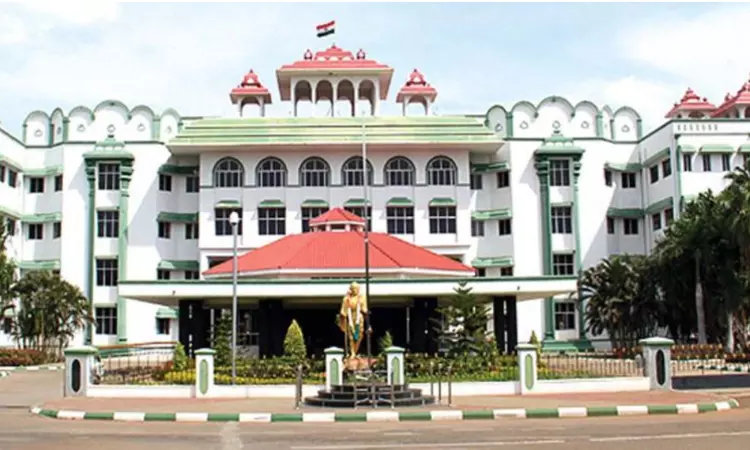
The Madras High Court at Madurai has recently set aside an order of the Madurai Principal District Judge insofar as it annulled an arbitral award granting ₹14.04 lakh as an early completion bonus to a contractor in a dispute with the Union of India over the construction of a Kendriya Vidyalaya school building at Sivagangai.
The bench of Justice V. Lakshminarayanan held that the Principal District Judge's characterisation of the arbitral award as "hypothetical" reflected non-application of mind.
Restoring the award, the court observed that the arbitrator had taken a plausible view, based on documentary evidence, that had the Union of India supplied cement, steel, structural drawings, and the colour scheme in time, the contractor would have completed the work 92 days in advance and earned the contractual bonus.
The bench observed, "It was not a hypothetical conclusion as concluded by the learned Principal District Judge. In order to arrive at the conclusion, he referred to page no.4 of CSF as well as Ex.C6. Hence, the conclusion arrived at by the learned Principal District Judge that it is a hypothetical conclusion and therefore, requires interference, shows non-application of mind by the learned Principal District Judge."
The dispute arose from a July 15, 2008 contract awarded by the Central Public Works Department (CPWD) to G. Selvam for the construction of a Kendriya Vidyalaya school building at Sivagangai at a tender value of about ₹4.68 crore.
The work was to commence on July 22, 2008 and be completed within a year.
Clause 2A of the contract entitled the contractor to an early completion bonus at the rate of 1% of the tendered value per month, computed on a per-day basis, subject to a maximum of 5%.
Although the work was ultimately completed on November 30, 2009, beyond the stipulated completion date, Selvam claimed that CPWD's failure to supply cement, steel, structural drawings and the colour scheme in time had delayed the work.
He contended that, but for those delays, he would have completed the project ahead of schedule and become eligible for the contractual bonus. The arbitrator ultimately found that the work would have been completed 92 days in advance.
Invoking the arbitration clause, Selvam raised eleven claims before the arbitral tribunal.
By an award dated February 4, 2013, the arbitrator directed the Union of India to pay ₹20.51 lakh with simple interest at 10% per annum from April 24, 2011, the date on which arbitration was invoked.
This included ₹14.04 lakh towards the early completion bonus after the arbitrator found that, but for delays attributable to CPWD, the work would have been completed 92 days in advance.
The Union of India challenged the award under Section 34 of the Arbitration and Conciliation Act before the Principal District Judge, Madurai.
By an order dated January 29, 2025, the District Judge upheld the award in respect of Claims 2 to 11, but set aside the award on Claim No.1 relating to the bonus, holding that it was based on a hypothetical conclusion.
Aggrieved, Selvam approached the high court under Section 37 of the Act.
Before the high court, Selvam relied on CPWD's own records to show delays in the supply of cement, steel, structural drawings and the colour scheme.
The Union of India contended that the structural drawings had been supplied in stages and that the contractor had completed the work with a delay of 101 days.
The court examined records detailing the hindrances faced during execution, the department's assessment of delay and correspondence exchanged between the parties.
It held that the records showed the site was handed over only on August 22, 2008 and that CPWD's own records recognised 182 days of justified hindrance arising from delays in supplying cement, steel, structural drawings and the colour scheme.
Reiterating the limited scope of judicial interference under Sections 34 and 37 of the Arbitration and Conciliation Act, the court held that an arbitrator may adopt "honest guesswork" or a rough-and-ready methodology in engineering contracts where precise quantification is difficult.
Since CPWD's delay stood proved on record, interference with the award was unwarranted, it said.
It observed, "An arbitrator may adopt an “honest guesswork” or a rough-and-ready methodology in engineering contracts where precise quantification is difficult. When the delay on the part of the respondent stands proved by virtue of Ex.C5 and Ex.C6, the learned Appellate Judge erred in interference with the same."
Accordingly, the court allowed the appeal and set aside the January 29, 2025 order insofar as it interfered with the award.
For Appellant (G. Selvam): Advocate S. Sukumar for M/s APN Law Associates.
For Respondent (Union of India represented by the Executive Engineer, Madurai Central Division, Central PWD, Madurai): Deputy Solicitor General of India. K. Govindarajan.