
Himachal Pradesh High Court Sets Aside Award Over Unilateral Arbitrator Appointment Without State's Consent
LIVELAW NEWS NETWORK
8 Oct 2026 10:22 AM IST
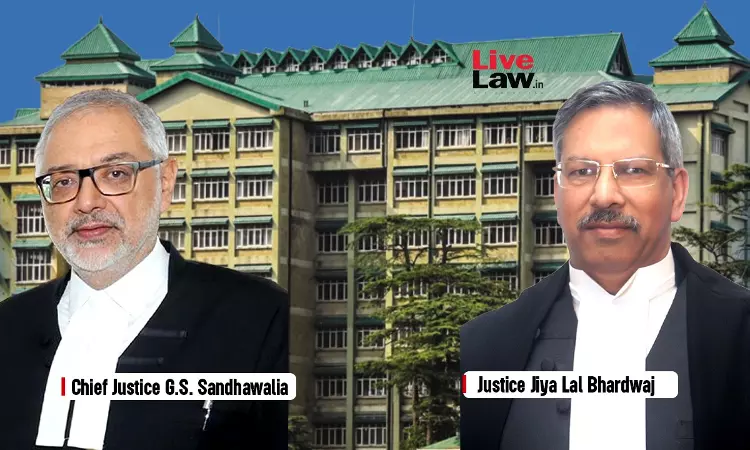
The Himachal Pradesh High Court has emphasized that where a party consistently objects to the unilateral appointment of an arbitrator, seeks appointment of an independent arbitrator, and does not consent to the tribunal's constitution, such objection cannot be treated as waived.
The court further noted that despite the absence of consent, the arbitrator proceeded with the arbitration and failed to decide the State's application challenging his appointment under Section 13 of the Arbitration and Conciliation Act, 1996.
Division Bench of Chief Justice G.S. Sandhawalia and Justice Jiya Lal Bhardwaj remarked that: “Right from day one, the State has always objected to the appointment of the learned Arbitrator and had rather filed an application before this Court for the appointment of an independent Arbitrator. The Arbitrator had chosen to proceed in spite of the fact that there was a lack of consent, and then had chosen not to decide the application under Section 13 of the Act.”
Background
The dispute arose out of the Pre-Implementation Agreement concerning the Dhancho Hydro Electric Project and Malana-III Hydro Electric Project. Following cancellation of the project allotment and forfeiture of the upfront premium, the contractor invoked the arbitration clause and unilaterally proposed the appointment of Justice S.N. Jha (Retd.) as the sole arbitrator.
The State expressly withheld its consent and approached the High Court seeking appointment of an independent arbitrator. Despite the State's objections, the arbitrator proceeded with the proceedings and ultimately passed an ex parte award, which was subsequently challenged by the State. bmd
The Division Bench held that the unilateral appointment of the arbitrator, made without the State's consent and contrary to the agreed procedure, was void ab initio. The arbitrator also failed to decide the State's application under Section 13 of the Arbitration and Conciliation Act, 1996, despite being statutorily required to do so. bmd
The Court further held that the State had consistently objected to the appointment and had not waived its objection. Since the unilateral constitution of the tribunal went to the root of its jurisdiction, the arbitral award was held unsustainable and was accordingly set aside.