
Entertaining Time-Barred Arbitration Claims Violate Public Policy Of India: Jammu & Kashmir & Ladakh High Court
LiveLaw Network
28 Oct 2026 12:35 PM IST
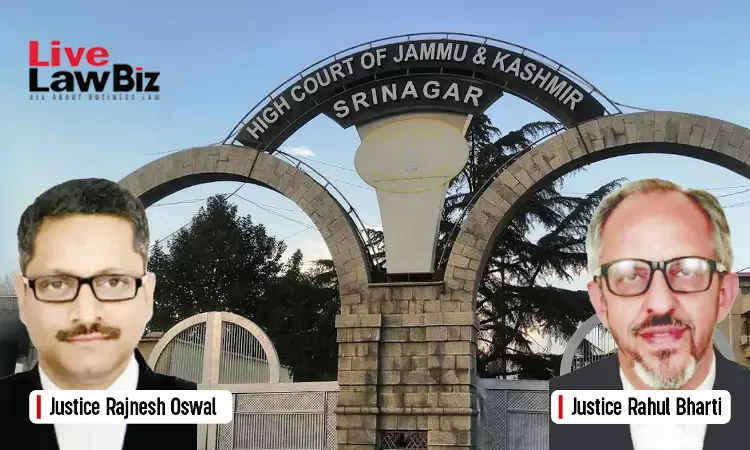
The Jammu & Kashmir and Ladakh High Court has recently held that entertaining time-barred claims in arbitration violates the statutory mandate under Section 43 of the Jammu and Kashmir Arbitration and Conciliation Act, 1997, making the resulting award vulnerable to being set aside as contrary to public policy.
“Consequently, entertaining a time-barred claim violates statutory mandate, rendering the resulting award vulnerable to being set aside for violating Public Policy,” a division bench of Justice Rajnesh Oswal and Justice Rahul Bharti observed.
The court made the observation while dismissing a contractor's appeal against a single judge's decision setting aside an arbitral award in a dispute over construction work for the Wangat Weir project at Kangan.
The contractor argued that the claims were not time-barred because the department had deferred consideration of the final bill until the conclusion of civil litigation. However, the court found that the department had already rejected the claims for restoration work and diversion bunds in a communication dated September 12, 2000.
The court held that the contractor could not rely on that communication to argue that the limitation period for those claims had been deferred. He had not invoked arbitration within the prescribed period after the claims were rejected.
The court also rejected the argument that preparation of a final bill in February 2011 revived the claims. It observed that the bill had not been approved by the competent authority and that the claims had already become time-barred by the time it was prepared.
Rejecting the argument that the department had waived its right to object to limitation by participating in the arbitration proceedings, the court observed:
“The procedural issues, including the claims being time barred, cannot be confused with jurisdictional issues which only can be raised by invoking Section 16 of the Act. Thus, it cannot be said that failure to invoke section 16 of the Act would, by itself, amount to a waiver of the respondents' right to raise an objection to the stale and time barred claims of the appellant.”
The court clarified that a limitation objection concerns the admissibility or maintainability of a claim, rather than the arbitrator's jurisdiction to decide it.
Finding no error in the single judge's decision, the division bench dismissed the appeal.
For Petitioner: Advocate M. A. Dar
For Respondents: Senior Advocate M. A. Chashoo, with Advocate Hikma