
Service Rule Cannot By Itself Make Consumer Commission President Ineligible As Arbitrator: Delhi High Court
Mohd.Rehan Ali
29 Sept 2026 12:02 PM IST
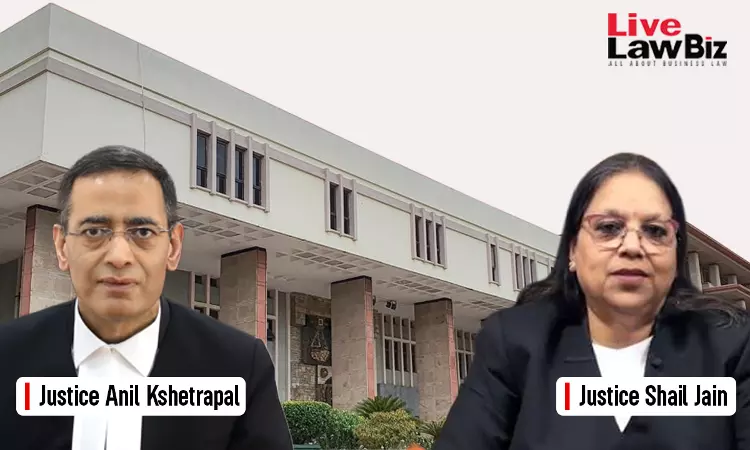
The Delhi High Court has ruled that a restriction in the service rules governing the President of a State Consumer Disputes Redressal Commission cannot, by itself, make the person ineligible to act as an arbitrator under Section 12(5) of the Arbitration and Conciliation Act, 1996 (A&C Act).
A division bench of Justice Anil Khetarpal and Justice Shail Jain observed relying on ruln in Delhi Integrated Multi Modal Transit Systems Ltd. ruled, “A breach of a condition governing the office held by an arbitrator may entail consequences under the statutory or regulatory framework governing that office. Such consequence, however, cannot automatically be equated with termination of the arbitral mandate under Section 12(5), particularly when the alleged disability does not arise from any of the circumstances specified in the Seventh Schedule.”
The court allowed the appeal filed by Airport Handling Services and restored an arbitral award of ₹27,76,996, including interest on the principal amount, passed in its favour against the Indian Institute of Technology, Kanpur (IIT Kanpur).
The dispute arose from service agreements for customs clearance, shipping, and freight forwarding services. Airport Handling Services, an MSME, had raised invoices of about ₹21.29 crore between 2004 and 2018, against which IIT Kanpur had paid about ₹21.16 crore.
After conciliation before the Micro and Small Enterprises Facilitation Council failed, the dispute was referred to the Delhi Arbitration Centre under Section 18(3) of the MSMED Act. The provision allows an unresolved dispute to be referred for arbitration.
The DAC appointed Justice (Retd.) Sangita Dhingra Sehgal, who was then President of the Delhi State Consumer Disputes Redressal Commission, as the sole arbitrator. She later passed an award of ₹27,76,996, including interest, in favour of Airport Handling Services.
IIT Kanpur challenged the award under Section 34 of the A&C Act. It relied on Rule 11(3) of the Consumer Protection (Conditions of Service of President and Members of the State Commission or District Commission) Model Rules, 2020.
The rule governs the conditions of service of consumer commission members. IIT Kanpur contended that it barred the President of the SCDRC from undertaking arbitral work.
The District Judge accepted the objection and held that the rule made the arbitrator de jure unable to act. In other words, the judge found that she was legally barred from acting as an arbitrator while holding the office of SCDRC President. The award was consequently set aside.
The high court disagreed with this approach.
The main question before the bench was whether a restriction under the service rules could also make an arbitrator ineligible under Section 12(5) of the A&C Act.
Section 12(5) covers specific relationships or circumstances that make a person ineligible to act as an arbitrator. These circumstances are listed in the Seventh Schedule to the A&C Act.
Section 14(1)(a), on the other hand, deals more broadly with situations where an arbitrator becomes legally or factually unable to perform the functions of the office. The mandate can terminate in such circumstances.
Referring to the Supreme Court's decision in Bhadra International (India) Pvt. Ltd. v. Airports Authority of India, the court explained that de jure inability is the broader category. De jure ineligibility under Section 12(5) read with the Seventh Schedule is a narrower category within it.
A person falling within the Seventh Schedule would therefore necessarily be de jure unable to act as an arbitrator. But every legal disability does not automatically amount to ineligibility under Section 12(5).
The bench relied on its earlier ruling in Delhi Integrated Multi Modal Transit Systems Ltd. v. Delhi Jal Board, which involved a similar objection concerning the service conditions of a consumer forum member.
The court had then observed that even if undertaking arbitral work violated the person's service conditions, the consequences would follow under the rules governing that office. That violation would not, by itself, automatically terminate the arbitral mandate.
Applying the same reasoning, the high court found no material showing that the sole arbitrator had any relationship with the parties, their counsel, or the subject matter of the dispute that fell within the Seventh Schedule.
The objection was based entirely on Rule 11(3). The court held that a service-condition restriction cannot, without more, be converted into an ineligibility under Section 12(5).
The bench also noted that the sole arbitrator had furnished the declaration required under Section 12 before entering upon the reference. IIT Kanpur then participated in the arbitration without objecting to her competence.
No objection under Section 16(2) was raised during the arbitration. Nor was an application made seeking termination of the arbitrator's mandate on the ground later raised before the District Judge.
The court, however, clarified that its decision did not rest solely on waiver. The fundamental issue was that Rule 11(3) had not been shown to create an ineligibility covered by Section 12(5) and the Seventh Schedule.
That also meant that the requirement of an express written waiver did not arise. Such a waiver becomes relevant when the statutory prohibition under Section 12(5) applies.
It cannot be used to turn a separate service restriction into a Section 12(5) disqualification.
The high court further noted that the arbitration arose from a statutory reference under Section 18 of the MSMED Act. The MSEFC had referred the dispute to the DAC, which appointed the sole arbitrator.
The bench made clear that the issue was not whether a person holding office under the consumer protection framework should undertake arbitral assignments as a matter of service discipline.
The question was whether such a restriction by itself made the person ineligible under Section 12(5). “The answer must be in the negative,” the court held.
The high court accordingly set aside the District Judge's finding that the arbitrator was de jure unable to act because of Rule 11(3).
Since this was the only ground on which the award had been set aside, the court restored the ₹27,76,996 arbitral award. The District Judge's findings on the other grounds were left undisturbed.
For Appellant: Advocates Jawahar Raja, Anirudh Ramanathan, Sonali Shelar, Tamanna Pankaj, Sumit Wadhva, Priya Vats, Anoop George, Mr. Nitai Hinduja, Mr. Ishaan Goel, Advs.
For Respondent: Advocate Manish Paliwa