
Death Of Partner Who Signed Arbitration Agreement Does Not Abate Proceedings In Firm's Name: Allahabad High Court
Upasna Agrawal
2 Nov 2026 9:34 AM IST
The Allahabad High Court has held that a statement of claim filed in the name of a partnership firm does not become non-est merely because the partner who signed it had died by the time it was placed before the arbitrator.
It held that where the remaining partners were alive the proceedings would not abate, and that the objection was at best a procedural irregularity touching neither the merits of the claim nor the arbitrator's jurisdiction.
Order XXX Rule 4 of the Code of Civil Procedure provides that where two or more persons sue or are sued in the name of a firm and any of them dies, whether before the institution or during the pendency of the suit, it is not necessary to join the legal representatives of the deceased as a party.
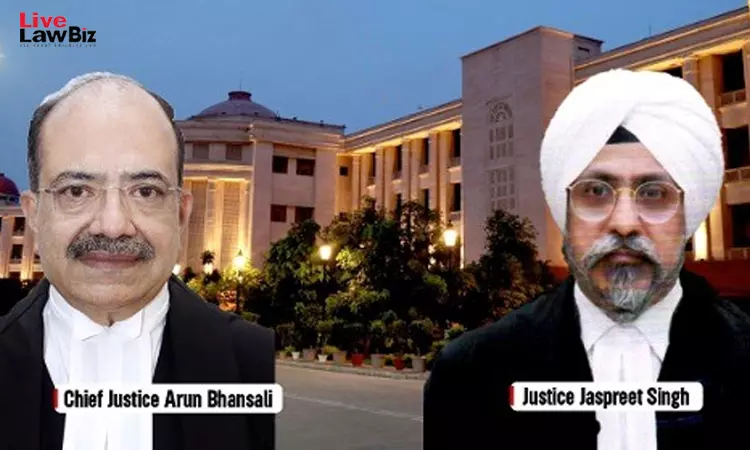
The bench of Chief Justice Arun Bhansali and Justice Jaspreet Singh held
“The firm is a collective name of its partners. Even if one partner had died but the remaining partner were alive, which fact came to be informed while filing the replication and once the claimant was a partnership firm, hence, borrowing the principles of Order XXX C.P.C., the proceedings were to go on and it would not abate.”
U.P. Electronics Corporation Ltd. floated a tender on 02.02.2018 for supply and installation of instruments for the DNA Unit of the Forensic Science Laboratory at Varanasi, followed by a corrigendum on 08.02.2018. The respondent firm bid on 24.02.2018 and, after negotiations, a work order was issued to it on 30.03.2018.
The firm furnished a performance bank guarantee of Rs. 93,79,535/- and supplied all 31 items within time, which were installed and demonstrated. The Deputy Director of the laboratory certified that the equipment was working satisfactorily, and on 22.06.2018 the ADG, Technical Services Headquarters, informed the Corporation in writing that the items were working and payment could be released. On the same day, the Corporation terminated the work order on the strength of an inquiry committee report and confiscated the bank guarantee.
A sole arbitrator was appointed in pursuance of an order of the High Court dated 12.01.2021. By award dated 04.02.2022, the arbitrator allowed the firm's claims to the tune of Rs. 8,99,38,275/- with interest at 8% per annum. The Corporation's petition under Section 34 of the Arbitration and Conciliation Act, 1996 was dismissed by Commercial Court No. 2, Lucknow on 15.12.2025, and this appeal under Section 37 followed.
Counsel for the Corporation argued that the proceedings were non-est as the claim had been filed on behalf of a dead person, into which no life could be infused later. It was argued that the Corporation was only a facilitator, the real contracting party being the State of U.P. through the U.P. Police Technical Services, a necessary party in whose absence the claim could not have been allowed. It was also argued that the firm and two other bidders had formed a cartel to manipulate the bidding, making the award contrary to the public policy of India, and that the firm, unregistered when it bid, had later produced a 2018 deed showing registration and three partners to get around Section 69(3) of the Indian Partnership Act, 1932. The Commercial Court, it was said, had reproduced the parties' submissions without reasons of its own.
Counsel for the firm submitted that the partner who signed the claim, Shiv Kumar Verma, had appeared before the arbitrator on the first date and filed the vakalatnama, that the claim was signed on 01.04.2021 when he was alive, that the dates fixed thereafter were lost to the COVID-19 lockdown, and that the counsel who filed it on 26.06.2021 did not know he had died on 26.04.2021. The death was disclosed in the replication at the first opportunity.
Noting the dates, the Court found that the partner was alive when the claim was signed and had died by the date it was submitted. It held that on the principles of Order XXX CPC neither substitution under Order XXII nor abatement was attracted, that the objection was a technical one, and that the Corporation had shown no prejudice.
“..procedural irregularities which do not impact the merits of the matter cannot be a ground to set aside a judgment/an award. In Arbitral proceedings where the Rule of C.P.C. are not strictly applicable in such cases merely by raising an issue of procedural irregularity would not vitiate the award unless it is established that the said issue of procedural irregularity was raised at the first given opportunity and the same led to substantial prejudice which impacted the jurisdiction of the Arbitral Tribunal or the case on merits.”
On non-joinder, the Court observed that the tender was floated, the bids screened, the negotiations held, the work order issued and the termination letter sent, all by the Corporation, so the entire sequence giving rise to the cause of action lay between the Corporation and the firm.
“..the appellant is a Government Corporation which has its separate legal identity and has full freedom to contract and even though the State of U.P. may have its deep and pervasive control, but that by itself will not amount to creating a privity of contract between the State/Uttar Pradesh Police Technical Services and the respondent.”
Turning to the allegation of fraud and cartelisation, the Court held
“A plea of fraud or corrupt practice is easier to plead than to establish the same. Unless a plea is established by cogent evidence, it cannot form the basis of any finding. In case if the evidence is not led or evidence is not sufficient to establish the said fact of fraud or corrupt practice till then it merely remains a plea.”
The arbitrator had framed a specific issue on the question and, after considering Condition 6.17 of the contract requiring 30 days' prior notice before termination, had found that the Corporation neither established the firm's involvement in any corrupt or fraudulent practice nor issued it any notice before terminating the contract.
The Court observed that there was no material to show a defect in the equipment, any rigging of the bid or any influence over the tender screening committee, and that the Corporation had itself issued the corrigendum because there was a single original equipment manufacturer in the world for the tendered items, which was why the experience certificates of all three bidders were common. These being pure findings of fact, the Court held they were immune from challenge under Section 34 or in appeal under Section 37 unless shown to be patently illegal.
On Section 69(3) of the Partnership Act, the Court held that the firm had been registered on 17.06.2019 and the arbitration was initiated in 2021, so the bar was not attracted, and that in any case, on the decision of the Supreme Court in Umesh Goel v. Himachal Pradesh Cooperative Group Housing Society Limited, the bar does not apply to arbitral proceedings.
Refusing the prayer for remand, the Court held that the scope of Section 34 is narrow, that the Commercial Court had decided the pleas before it with reasons, and that briefly stated reasons are no ground for a routine order of remand.
Accordingly, the appeal was dismissed and the award of the sole arbitrator was affirmed.
For Appellant: Senior Advocate S.C. Mishra with Rajesh Chadha, Akhilesh Kumar Srivastava
For Respondent: Senior Advocate Arohi Bhalla with Sunil Kumar Singh, Kartikeya Yadav, Prateek Agarwal