
Arbitrator's Ineligibility Goes To Root of Jurisdiction, Can Be Challenged At Any Stage: Delhi High Court
Mohd.Rehan Ali
28 Oct 2026 6:17 PM IST
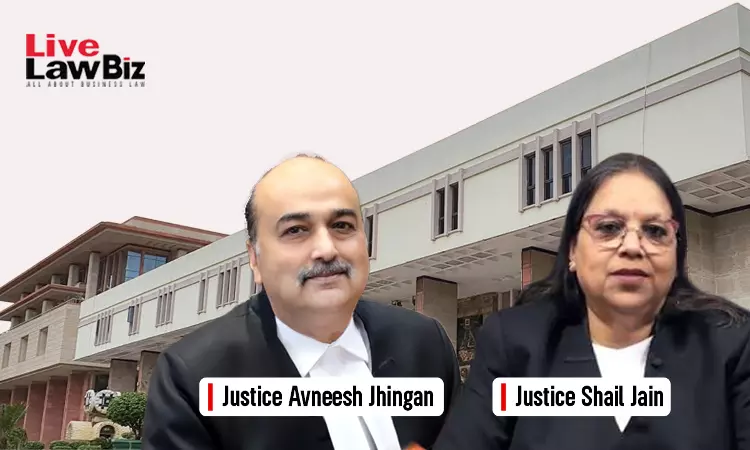
The Delhi High Court has ruled that an objection to an arbitrator's ineligibility under Section 12(5) of the Arbitration and Conciliation Act, 1996, can be raised for the first time in an appeal and even at the execution stage, as the issue goes to the root of the arbitrator's jurisdiction.
“This issue of ineligibility of arbitrator goes to the root of the jurisdiction and can be raised for the first time in an appeal under Section 37 of the Act, even at the stage of execution,” a Division Bench of Justice Avneesh Jhingan and Justice Shail Jain ruled
The court set aside an arbitral award passed in favour of Vista Information Systems Private Limited after holding that the appointment of the sole arbitrator by Telecommunications Consultants India Limited (TCIL) violated Section 12(5), read with the Seventh Schedule of the Act.
TCIL had appointed the arbitrator under an agreement with Vista. After the arbitrator passed an award in Vista's favour on July 1, 2019, TCIL challenged it before a Single Judge, who dismissed the challenge on April 18, 2023. TCIL then approached the Division Bench.
TCIL argued that the appointment violated Section 12(5) and relied on the Supreme Court's decision in Bhadra International (India) Pvt. Ltd. v. Airports Authority of India and the Delhi High Court's ruling in Mahavir Prasad Gupta and Sons v. Government of NCT of Delhi. It contended that the appointment was void from the outset and could be challenged even at the appellate stage.
Vista opposed the appeal, arguing that it had accepted the appointment and that TCIL was raising the objection for the first time before the Division Bench. It also contended that the appointment mechanism differed from those considered by the Supreme Court in TRF Ltd. v. Energo Engineering Projects Ltd., Perkins Eastman Architects DPC v. HSCC (India) Ltd. and Bharat Broadband Network Ltd. v. United Telecoms Ltd.
The court observed that waiver of the statutory bar under Section 12(5) requires an express written agreement between both parties after the dispute has arisen. Participation in arbitration or failure to object to the appointment cannot, by itself, amount to such a waiver.
Relying on Bhadra International, the court held that Vista's failure to object to the appointment did not validate it. It also relied on Mahavir Prasad Gupta and Sons to hold that even a party that appointed an ineligible arbitrator could subsequently challenge the appointment. The act of appointment itself did not amount to an express written waiver.
The court allowed TCIL's appeal and set aside both the arbitral award and the Single Judge's judgment.
For Appellant: Senior Advpcates Viraj Datar, with Advocates Karnnika A Seth, Gurneev Singh, Garvit Mathur,
For Respondent: Adocates Saurav Aggarwal, Omar Ahmed, Asav Rajan, Ajay Sharma, Devang Shrotriya, Kashish Chadha