
Arbitral Award Cannot Be Protected As 'Plausible View' Without Proof Of Essential Facts: Karnataka High Court
Mohd.Rehan Ali
23 Nov 2026 4:05 PM IST
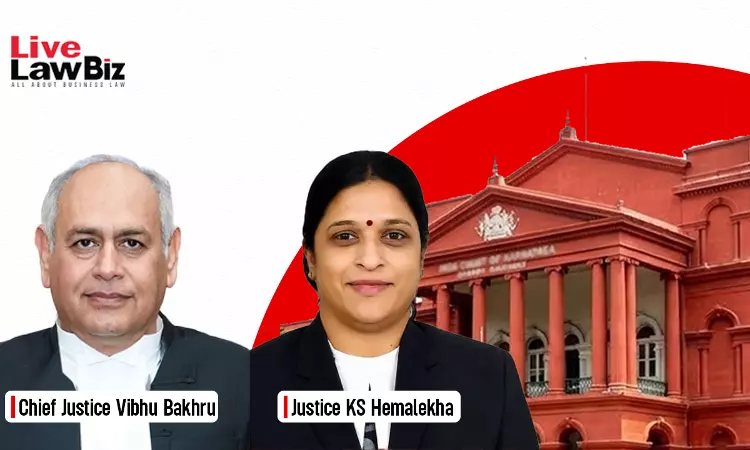
The Karnataka High Court has held that an arbitral tribunal's monetary award cannot be protected as a “plausible view” when it grants relief without determining whether an essential statutory requirement has been met.
A Division Bench of Chief Justice Vibhu Bakhru and Justice K.S. Hemalekha observed:
“Where the statutory provision invoked by the Arbitral Tribunal requires proof of a particular fact, and the award proceeds to grant relief without determining that essential requirement, the conclusion cannot be protected merely by describing it as a plausible view.”
The court made this observation while setting aside monetary compensation awarded to Shri Aditya Constructions Private Limited under Section 64 of the Contract Act, 1872. It held that the tribunal had quantified the developer's expenditure on development works without determining whether the landowners had received a corresponding benefit capable of restitution.
The dispute arose from development agreements dated January 17, 2014, under which Aditya Constructions was to develop the landowners' properties into residential layouts. The parties had agreed to share the saleable sites, with 60% going to the landowners and 40% to the developer.
The tribunal found that Aditya Constructions had failed to obtain a fresh layout approval or renew the earlier approval from the Shivamogga Urban Development Authority (SUDA). It rejected the developer's plea for specific performance and held that the landowners were justified in terminating the agreements.
However, the tribunal also awarded the developer Rs.1.21 crore and Rs.1.09 crore in the two arbitration proceedings under Section 64 of the Contract Act. The amounts carried interest at 8.5% per annum from the date of the award until payment.
Both sides challenged the award before the Commercial Court. It rejected the developer's challenge to the refusal of specific performance but accepted the landowners' petitions and set aside the monetary awards.
Aditya Constructions then filed four appeals before the High Court.
On specific performance, the High Court found that the tribunal's conclusion that the developer had failed to meet its contractual obligations was a plausible view based on the material on record. It therefore saw no reason to interfere.
The monetary award was a different matter. The court held that Section 64 requires proof that the party rescinding the contract received a benefit that could be restored. While the tribunal had calculated the developer's expenditure, it had not examined whether the landowners had actually benefited from the works, particularly since the required statutory approval was missing.
The court made clear that expenditure by one party does not, by itself, prove a benefit to the other. The developer had to establish the existence and extent of that benefit.
Finding this omission to be patent illegality, the High Court upheld the setting aside of the monetary awards. All four appeals were dismissed.
For Appellant: Dwarakanath H.S
For Respondent: Prashanth Chandra S.N.