
Arbitral Tribunal Can't Award Compound Interest In Absence Of Stipulation In Contract: Allahabad High Court
Upasna Agrawal
26 Oct 2026 10:06 AM IST
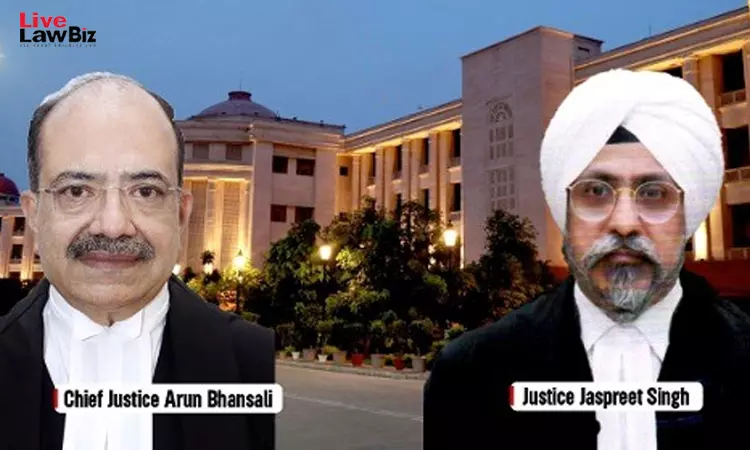
The Allahabad High Court has held that an arbitral tribunal cannot award compound interest, or interest upon interest, where the contract between the parties makes no provision for it. The Court held that while the tribunal retains the power to grant interest both for the period before the reference and for the pendente lite and future periods, the compounding of that interest is impermissible in the absence of a specific stipulation.
Section 31(7)(a) of the Arbitration and Conciliation Act, 1996, gives the arbitral tribunal, unless the parties have agreed otherwise, the discretion to include in the sum awarded interest at such rate as it deems reasonable, on the whole or any part of the money, for the whole or any part of the period between the date the cause of action arose and the date of the award.
Clause (b) provides that a sum directed to be paid by an arbitral award shall, unless the award otherwise directs, carry interest at 2% higher than the current rate of interest prevalent on the date of the award, from the date of the award till payment.
The bench of Chief Justice Arun Bhansali and Justice Jaspreet Singh held
“It is now too well settled to be disputed that the compound interest cannot be granted unless there is a stipulation in the contract. The Arbitral Tribunal is a creature of the contract and it is bound to act within the four corners of the contract.”
The dispute arose out of a contract for the widening and strengthening of the Raya-Math Road in District Mathura, awarded to Apex Construction Company. The contract value was subsequently enhanced from Rs. 737.85 lakh to Rs. 1,137.29 lakh. The contractor completed the work on August 31, 2009, and submitted a final bill for Rs. 53,158,238, which the State disputed.
A three-member arbitral tribunal came to be constituted in 2015, before which the contractor claimed Rs. 23,79,90,727 with interest at 18% per annum with quarterly rests and Rs. 10 lakh as the cost of arbitration. The State denied the claim, pleading breach of the contract conditions and use of substandard material, and set up a counterclaim.
By its award dated July 30, 2017, the tribunal held the contractor entitled to Rs. 1,56,79,034.65 with 14% interest per annum from September 1, 2009, compounded annually till the date of reference, and thereafter through the proceedings and until realisation, besides Rs. 10 lakh as costs. A sum of Rs. 1,39,619 with 14% interest was directed to be deducted from the amount awarded. The State's petition under Section 34 of the Arbitration and Conciliation Act, 1996, was dismissed by Commercial Court No. 1, Lucknow, on February 9, 2023, and the appeal under Section 37 followed.
For the State, it was urged that the work had not been completed, that substandard material had been used and that no completion certificate had been issued under Clause 48.1 of the contract, so the tribunal could not have found the work complete without rewriting the contract. On interest, it was submitted that the contract was silent on the subject, that the Interest Act, 1978, brought an arbitrator within the meaning of “court” and barred interest upon interest, and that Section 31(7) of the Act of 1996 likewise did not permit compounding.
The contractor defended the award, submitting that the findings were pure findings of fact resting on evidence and could not be disturbed under Section 34 or Section 37. It was pointed out that the reports of the Public Works Department and the Central Road Research Institute traced the wear and tear of the road not to bad workmanship but to its use by heavy vehicular traffic, although the contractual specifications were for light and medium traffic.
On interest, it was urged that Section 31(7) confers the power to grant pre-reference, pendente lite and future interest at a rate the tribunal considers appropriate, and that annual rests were in any event less onerous than the quarterly rests at which banks lend.
On the first limb, the Court noted that no notice, complaint or correspondence had ever been issued by the State alleging non-completion, deficiency or use of substandard material, and that neither the CRRI report nor the PWD report recorded that the work was incomplete or substandard. Holding the tribunal's finding on completion to be a finding of pure fact that could not be called perverse, the Court held:
“merely because the completion certificate was not issued by the appellant it would not mean that the work was incomplete.”
Turning to interest, the Court observed that the contract was silent on the grant of interest, whether simple or compound, and that the statutory provisions therefore came into play. It held that Section 31(7) operates only where the contract is silent on interest, that the provision was consequently attracted, and that the tribunal could not be said to have lacked jurisdiction to award interest for the pre-reference period as well as for the pendente lite and future periods. The rate of 14% was neither under challenge nor, the Court said, excessive for a commercial contract.
The difficulty, the Court held, lay in the annual rests, which meant that at the close of each year the interest stood capitalised with the principal and bore interest in the following year. Noticing the definition of “court” in the Interest Act, 1978, and the prohibition in Section 3(3)(c) of that Act, the Court held:
“In the banking industry generally a lending bank may add the interest every quarter or annually but that is only a methodology of charging interest, but nevertheless it still remains under the umbrella of compound interest.”
The Court referred to the Constitution Bench decision in Central Bank of India v. Ravindra, which recognised that there is no right to compound interest save by agreement, express or implied, or by custom binding on the parties, and to the Supreme Court's decision in HLV Ltd. v. PBSAMP Projects (P) Ltd., which clarified the law on Section 31(7), including the holding that in the absence of any provision for interest upon interest in the contract, an arbitral tribunal has no power to award compound interest for either the pre-award or the post-award period.
Applying those principles, the court held:
“Thus, where in Section 3(3)(c) of the Act of 1978, there is a clear stipulation that the Arbitrator may not grant interest upon interest, accordingly, in absence of any contractual or statutory condition, the Arbitral Tribunal cannot grant compound interest or interest upon interest.”
Declining to set aside the award as a whole, the Court held that the ends of justice would be met by correcting only that part of it which dealt with interest. It drew support from the Constitution Bench decision in Gayatri Balasamy v. ISG Novasoft Technologies Limited, as laying down that only severable awards may be modified, that the error corrected must be patent and apparent on the face of the record, that modification is permissible for correcting or adjusting post-award interest without disturbing the substantive findings of the tribunal, and that where modification is impermissible, the matter must be remanded.
Accordingly, the Court modified the award dated July 30, 2017, only in the manner in which interest is chargeable, preserving all its other findings. The contractor was held entitled to Rs. 1,56,79,034.65 with 14% per annum simple interest from September 1, 2009, till January 31, 2016. The amount so crystallised on January 31, 2016, would carry 14% per annum simple interest from February 1, 2016, till actual payment. From that amount, Rs. 1,39,619, along with 14% per annum simple interest from September 1, 2009, till payment, is to be deducted as provided in the award.
Subject to the modification on interest, the award was affirmed, and the appeal was partly allowed.
For Appellants: Pritish Kumar (A.A.G.), Tushar Verma (A.C.S.C.)
For Respondents: Advocates Akshat Kumar, Durgendra Kumar Tiwari, Sanjay Kumar Srivastava, K.K. Arora