
Foreign Seat Of Arbitration Alone Doesn't Oust Indian Courts' Jurisdiction To Grant Interim Relief: Karnataka High Court
Shivani PS
3 Aug 2026 2:44 PM IST
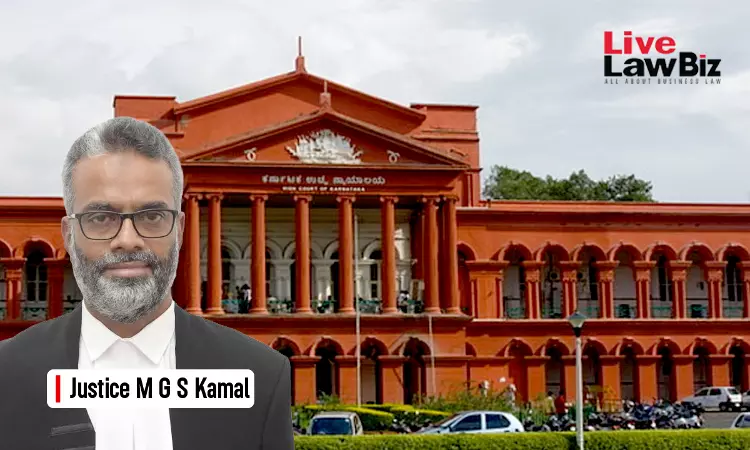
The Karnataka High Court has ruled that merely choosing a foreign seat of arbitration does not, by itself, prevent Indian courts from granting interim relief under Section 9 of the Arbitration and Conciliation Act, 1996.
It observed that excluding the jurisdiction of Indian courts requires an express agreement between the parties.
Justice M.G.S. Kamal observed, "Therefore, mere existence of an arbitration clause providing place of arbitration outside India itself cannot be construed as ''an agreement to the contrary''. In other words, parties are required to expressly agree and provide that provisions of Sections 9, 27 and Clause (b) of sub-Section(1) and sub-Section(3) of Section 37 of Part I of Act, 1996 are not applicable to the terms of the agreement"
The ruling came while the court partly allowed a Section 9 petition filed by Singapore-based technology company Aroha Labs Pte. Ltd. The petition was filed in support of a Singapore-seated arbitration.
The court restrained the company's former consultants and two entities allegedly controlled by one of them from using, copying, modifying, exploiting, operating, publishing, commercialising, licensing, transferring, assigning, disclosing, claiming rights over or otherwise dealing with five disputed software applications.
These applications are "Amore", "Astha 247: AI Spiritual App", "Creato", "Astro" and "Astro 247". The restraint will continue pending arbitration.
The court, however, declined to direct the immediate return of laptops, computers, source code and other company property at the interim stage.
The dispute arose out of master service agreements executed between May 2024 and November 2025. Under these agreements, Aroha Labs engaged consultants, including Prem Dharmani, to develop software applications and AI products.
According to Aroha Labs, it invested more than ₹2.2 crore in the projects. It also claimed the agreements assigned all intellectual property, including source code and trade secrets, exclusively to it.
The company alleged that Dharmani later proposed incorporating an Indian company to launch the applications. It claimed he assured Aroha Labs a 38% stake in the proposed company.
A term sheet recording the proposal was executed on September 7, 2024. Creato Club Private Limited was incorporated a little over two weeks later, with Dharmani holding 99.99% of its shares.
Aroha Labs alleged that Creato Club later claimed ownership of the applications and the underlying intellectual property instead of honouring the proposed shareholding arrangement. The company terminated the agreements on June 16, 2026, and invoked arbitration.
Before the high court, Aroha Labs relied on the proviso to Section 2(2) of the Arbitration Act and Clause 13.1.7 of the agreements, which allows either party to seek interim relief from "any court."
It argued that choosing Singapore as the arbitral seat under the SIAC Rules did not exclude the jurisdiction of Indian courts.
The former consultants and Creato Club opposed the petition. They argued that Singapore courts alone had supervisory jurisdiction because Singapore was the arbitral seat. They also contended that, as a non-signatory to the arbitration agreements, Creato Club could not be subjected to interim orders.
Rejecting these objections, the court observed that the 2015 amendment introducing the proviso to Section 2(2) was intended to preserve the power of Indian courts to grant interim protection in support of foreign-seated arbitrations. It held that this position would apply unless the parties had expressly agreed otherwise.
The court also examined whether interim relief could be granted against Creato Club despite it being a non-signatory. It observed that courts cannot adopt a rigid approach while deciding whether a non-signatory can be bound by an arbitration agreement. Referring to SC ruling in Cox and Kings Ltd, the court noted,
"Courts and the Tribunals, while considering the issue, whether or not non-signatory to be a party to the arbitration agreement, cannot take rigid stand but has to take a balance stand, considering the facts and circumstances of each case. It may adopt 'doctrine of group of companies' or 'alter ego' to pierce the corporate veil," the court observed.
On a prima facie assessment made for deciding the interim plea, the court found sufficient material to treat Creato Club as Dharmani's alter ego. It noted that he held 99.99% of the company's shares. It also found prima facie material indicating that the disputed applications had been developed on Aroha Labs' platform before Creato Club was incorporated.
The court accordingly granted an interim injunction restraining the former consultants and Creato Club from dealing with the disputed applications pending arbitration. It, however, refused to grant the mandatory relief directing the immediate handover of laptops, computers, storage devices, source code, and other company property.
For Petitioner (Aroha Labs Pte. Ltd.): Senior Advocate Nanda Kumar, with Advocate Mohammed Shameer.
For Respondents (Prem Dharmani & Ors.): Advocates Manu Kulkarni, Sumukh B. Ram and Chetan Tayal.