
Financial Pressure Alone Cannot Undo Insurance Settlement Without Proof Of Duress By Insurer: Delhi High Court
Shivani PS
16 March 2026 5:57 PM IST
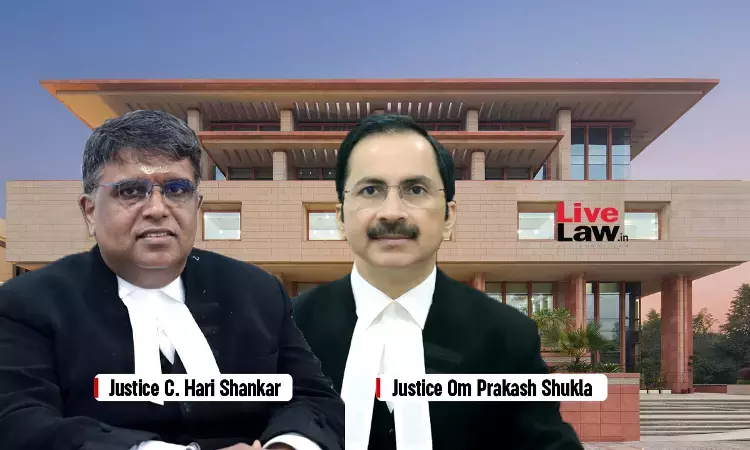
The Delhi High Court on Monday observed that a discharge voucher accepting an insurance settlement cannot be invalidated merely because the insured signed it under financial pressure, unless the insurer contributed to the alleged coercion, duress, or undue influence.
Refusing to reopen a fire-insurance compensation dispute between Supermint Exports Pvt Ltd and New India Assurance Company Ltd, the Court upheld an arbitral award rejecting the company's attempt to claim additional compensation after it had accepted Rs 12.18 crore as “full and final settlement."
The Division Bench of Justice C. Hari Shankar and Justice Om Prakash Shukla observed that :
“It has to be borne in mind that the decision to sign an unconditional no claim discharge voucher is ultimately of the signatory. The mere fact that the signatory may feel financial pressure, and therefore decide to sign the discharge voucher, would not ipso facto render the voucher unenforceable on the ground of fraud, coercion, undue influence, or even compulsion. Absent any contribution to the financial distress, even remote, by the opposite party, the compulsion and duress, if any, arises out of the claimant's own subjective decision, and the claimant cannot be permitted to take advantage thereof, to the prejudice of the opposite party.”
Supermint Exports Pvt Ltd, a manufacturer of mint and pine-based essential oils, had obtained an insurance policy from New India Assurance Company Ltd covering its factory building, machinery and stock for a total insured value of Rs 32,25,00,000.
On 13 February 2013, a fire broke out at the company's premises, damaging the building, plant, machinery and stock.
Supermint subsequently lodged an insurance claim of Rs 27,08,30,874.13.
A surveyor appointed by the insurer assessed the loss at Rs 12,18,21,908. The insurer offered settlement on that basis.
Supermint accepted the amount and executed two discharge vouchers dated March 30, 2014, and July 2, 2014, acknowledging receipt of Rs 12,18,21,908 as full and final settlement of the claim.
Despite accepting the payment, Supermint later invoked arbitration seeking the balance claim amount.
By an award dated December 28, 2019, the arbitral tribunal held that the company had voluntarily accepted the payment through discharge vouchers without any protest or reservation.
A nil award was passed, concluding that the claim stood discharged by accord and satisfaction, leaving no arbitrable dispute.
Supermint challenged the award under Section 34 of the Arbitration and Conciliation Act, 1996, but a single judge of the Delhi High Court dismissed the petition on 7 December 2021.
The company then filed an appeal before the Division Bench under Section 37.
Supermint Exports Pvt Ltd argued that the discharge vouchers were signed under financial distress and compulsion, alleging that the insurer insisted on full-and-final settlement documents before releasing the claim amount.
Conversely, New India Assurance Company Ltd contended that Supermint had voluntarily executed the discharge vouchers and accepted ₹12.18 crore as full and final settlement, leaving no surviving dispute for arbitration.
The Court noted that Supermint had received the survey report and did not object to the assessed loss before signing the discharge vouchers.
Internal records, including a board resolution, showed that the company consciously decided to accept the payment to address its financial difficulties.
The bench held that the company failed to prove any coercion or pressure by the insurer.
It clarified that unless the insurer itself contributed to the alleged economic duress, the settlement remained binding.
The Court relied on Supreme Court decisions on the doctrine of accord and satisfaction, reiterating that where a discharge voucher is executed voluntarily and without coercion, the settlement extinguishes further claims.
The Bench observed:
“The principle of accord and satisfaction, which is a hallowed principle of contract jurisprudence, cannot be consigned to oblivion.”
Finding no illegality or perversity in the arbitral award or the Single Judge's ruling, the Delhi High Court dismissed the appeal and upheld the nil arbitral award, holding that the insurance claim stood settled through accord and satisfaction.
For Appellant (Supermint Exports Pvt. Ltd.): Advocates Sudhir Nandrajog, Bhaskar Tiwari, Ramakant Shukla, Priscilla Kom
For Respondent (New India Assurance Company Ltd): Advocates Saurav Agrawal, Rajat Dasgupta, Sidhika Dwivedi, Anadi Mishra, Raadhika Chawla, Tushar Nair