
Exclusive Jurisdiction U/S 42 Of Arbitration Act Requires First Court To Be Competent: Madras High Court
Shivani PS
13 Oct 2026 4:15 PM IST
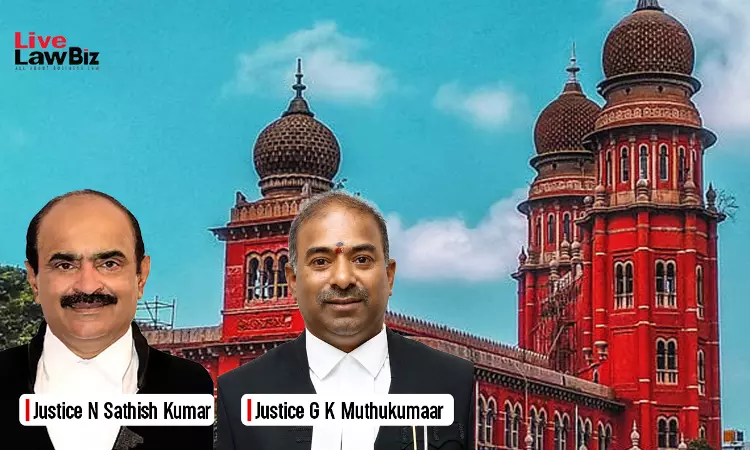
The Madras High Court on 12 October held that Section 42 of the Arbitration and Conciliation Act, 1996, grants exclusive jurisdiction to the court where an application is first filed only if that court has jurisdiction under the arbitration agreement.
A Division Bench comprising Justices N. Sathish Kumar and G.K. Muthukumaar allowed an appeal filed by an investor, subsequently represented by his legal heirs, against Sharekhan Limited. It set aside a Single Judge's order dismissing the investor's challenge to an arbitral award for lack of jurisdiction and remanded the matter for consideration on merits. The judges held:
“We also find that, in circumstances where two Courts simultaneously have jurisdiction under the arbitration agreement, then it is only in such circumstances that the Court where the arbitral proceedings were first initiated will have jurisdiction and not the other court if any proceedings are subsequently initiated therein.”
The dispute arose after A.V. Vijayakumar, a senior citizen and practising doctor from Thrissur, Kerala, opened a depository account with Sharekhan under an agreement dated 13 February 2006.
Vijayakumar alleged that Sharekhan sold his shares without his consent or authorised contract notes. Sharekhan denied the allegations, maintaining that Vijayakumar had authorised the transactions and received communications about them through email. Vijayakumar initiated arbitration, but the tribunal dismissed his claim.
On appeal, the National Stock Exchange's Panel of Appellate Arbitrators directed Sharekhan to pay him Rs. 12,50,053 with 18% interest from the date of the award until realisation.
Dissatisfied with the denial of compensation for 50% of his lost shares and costs, Vijayakumar challenged the award under Section 34 of the Arbitration and Conciliation Act, 1996, before the Madras High Court. Sharekhan had separately challenged the award before the Bombay High Court.
On 2 February 2021, a Single Judge dismissed Vijayakumar's challenge for lack of jurisdiction and directed him to approach the Bombay High Court.
Vijayakumar challenged this order under Section 37, arguing that the depository agreement, National Stock Exchange trading regulations and bye-laws conferred jurisdiction on the Madras High Court. Sharekhan countered that its earlier challenge before the Bombay High Court vested exclusive jurisdiction in that Court under Section 42.
The Division Bench examined whether Sharekhan's earlier filing could override the jurisdiction conferred by the parties' agreement. It found that Clause 22 of the depository agreement provided for the exclusive jurisdiction of Mumbai courts, subject to Clause 1.7.18, which incorporated the Exchange's bye-laws and regulations.
It noted that Regulation 5.3 required challenges to be filed before the competent court nearest to the regional centre where the appellate arbitration took place. Bye-law 17 linked jurisdiction to the investor's registered address. Since the appellate arbitration took place in Chennai, the regional centre nearest to Vijayakumar's address in Kerala, the Bench held that the Madras High Court had exclusive jurisdiction over the dispute.
Interpreting Section 42, the judges clarified that the provision does not confer jurisdiction on a court that otherwise lacks it merely because a party approached that court first.
They held that “therefore, if the proceedings are first initiated in a Court without jurisdiction as in this instant case, then, though this might be the Court where the Section 34 application was first filed, still under Section 42, the said Court would not be the jurisdictional Court.”
Further, the Bench stated that “the first Court where proceedings are first initiated should also be the Court on which jurisdiction is conferred under the arbitration agreement.”
It added that “if the first Court does not have jurisdiction conferred under the arbitration agreement then it will not be the Court mentioned in Section 42 even if the proceedings are first initiated therein.”Applying this principle, it held:
“However, this is not the factual situation in this instant case. Therefore, going by the said agreements (depository agreement, trading regulations and the bye-laws), we find that only this Court in Chennai has exclusive jurisdiction to entertain applications arising out of the arbitration agreement.”
Accordingly, the High Court rejected Sharekhan's contention that its earlier filing in Bombay barred Vijayakumar from pursuing his challenge in Chennai. It allowed the appeal, set aside the Single Judge's order dated 2 February 2021 and remanded the Section 34 challenge for consideration on merits, with both parties bearing their own costs.
Appearances for appellants (A.V. Vijayakumar & Ors.): Advocate M. Punnagai for Advocate Hari Radhakrishnan.
Appearances for respondent (Sharekhan Limited): Advocate Meera Gnanasekar.