
Delhi High Court Upholds Arbitral Award, Relies On Registered Lease Deed Over Oral Claim Of Joint Venture
Shivani PS
28 July 2026 1:00 PM IST
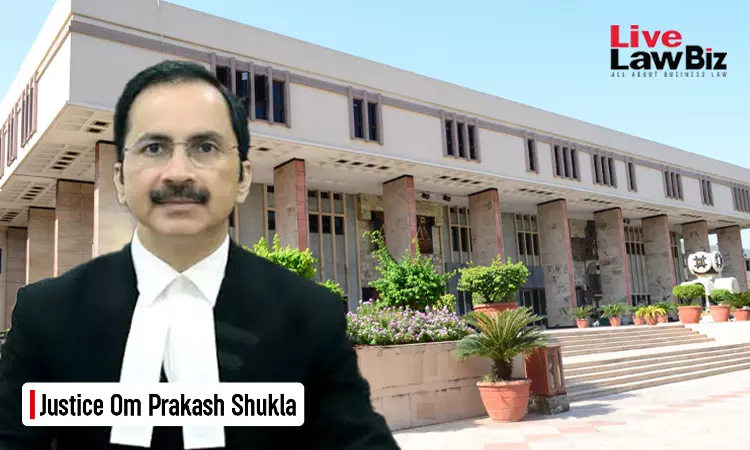
The Delhi High Court has recently upheld a partial arbitral award directing a hospital operator to hand over possession of leased premises. It held that an oral claim of a collaborative venture cannot override the clear terms of a registered lease deed when there is no written agreement to support it.
Justice Om Prakash Shukla observed that arbitral tribunals are not bound by the Indian Evidence Act. However, they can draw guidance from its underlying principles.
In this case, the parties had entered into a registered lease deed, but there was no written document supporting the company's claim that the arrangement was actually a collaborative venture. In those circumstances, the court held that the company's oral plea could not be accepted.
The court observed, "Keeping in view the applicability of the underlying principles of IEA, the contention of Mr. Rai that the relationship between the parties is actually collaborative, has to be excluded in view of Section 91 and 92 of IEA13 since there is no written document to demonstrate the collaborative nature and on the contrary, there is explicit documentary evidence of the contents of the lease deed, particularly Clause 10.4 of the deed along with the unambiguous admission of the Petitioner."
The ruling came while dismissing a petition filed by Getwell Healthcare Private Limited challenging a partial arbitral award directing it to hand over possession of the property to Dr. Santosh Sahi and the other owners.
The dispute arose from a registered lease deed executed in December 2015. The owners later terminated the lease and invoked arbitration. During the proceedings, they filed an application under Section 17 of the Arbitration and Conciliation Act read with Order XII Rule 6 of the Code of Civil Procedure, seeking possession of the property.
The arbitral tribunal allowed the application and directed Getwell Healthcare to hand over vacant and peaceful possession. It further held that the company would be liable to pay damages of ₹27 lakh per month if it failed to do so.
Senior Advocate K.K. Rai, appearing for Getwell, argued that the arbitrator had effectively granted final relief at an interim stage. He contended that the parties had intended to jointly develop and operate a hospital and had adopted the lease structure only for tax convenience. He also submitted that the company had invested around ₹65 crore in the project and that several issues remained to be decided in arbitration.
The owners argued that the relationship between the parties was governed entirely by the registered lease deed. They pointed out that Getwell Healthcare had repeatedly admitted the lease deed and its terms during the arbitral proceedings. They also highlighted the company's admission that there was no written document supporting the alleged collaborative arrangement.
Rejecting the challenge, the court held that Clause 10.4 of the lease deed expressly defined the parties' relationship as that of a lessor and lessee. It ruled out any partnership, joint venture, or joint undertaking. The court also noted that Getwell Healthcare had admitted there was no written document evidencing the alleged collaboration.
Although arbitral tribunals are not bound by the Code of Civil Procedure or the Indian Evidence Act, the court said they are free to draw from the fundamental principles underlying those statutes while assessing evidence.
The court also found it significant that Getwell Healthcare had not challenged the validity of the termination of the lease deed. In those circumstances, the lease stood revoked, rendering the company an illegal occupant. The court held that such occupation could not be allowed to continue merely because the arbitration proceedings were still pending.
The court further observed, "Section 19 of the Act empowers the Arbitral Tribunal to determine the admissibility and weight of any evidence. In the present case, the learned Arbitrator largely based his decision on the clear admission of the Petitioner and lack of the presence of a written document demonstrating a collaborative relationship between the parties."
Finding no patent illegality or any other ground that warrants this court's interference, the court dismissed the present plea.
For Petitioner (Getwell Healthcare Private Limited): Senior Advocate Mr. K.K. Rai, with Advocates Ms. Imtiyaz Hussain, Ms. Medha Tandon, Mr. Shubham Khare, Mr. Anshul Rai and Ms. S. Chatterjee.