
Delhi High Court Upholds ₹2.57 Crore Award Against AAI In Mangalore Airport Control Tower Construction Delay Case
Shivani PS
13 Feb 2026 7:52 PM IST
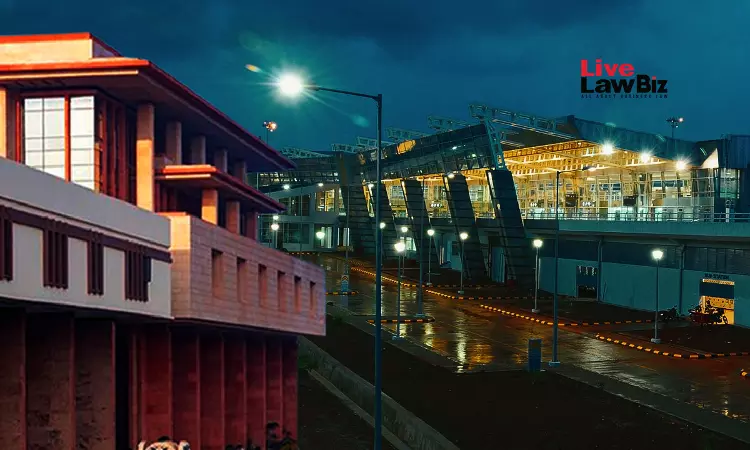
The Delhi High Court has recently dismissed a challenge by the Airports Authority of India (AAI) and upheld an arbitral award directing it to pay Rs. 2.57 Crore with interest and Rs 7 lakh as costs to URC Construction (P) Ltd.
The Court held that the 477-day delay in constructing a new control tower-cum-technical block at Mangalore International Airport was attributable to AAI.
The award grants interest at 10% per annum from September 4, 2017, till the date of the award, and further 10% from March 27, 2019, till actual payment.
Justice Neena Bansal Krishna held that the arbitrator's findings were based on a detailed analysis of the record and could not be interfered with under Section 34 of the Arbitration and Conciliation Act, 1996.
“The conclusion that the delay of 477 days was attributable to the Petitioner is based on a detailed analysis of the hindrance register, site constraints, and the conduct of the parties. This finding is neither perverse nor illegal,” the Court observed.
It added, “Once the breach on the part of the Petitioner was established, the Arbitrator was within his jurisdiction to award compensation.”
AAI had awarded the contract to URC Construction on April 12, 2012, at a cost of Rs. 18,90,88,243/-. The work was to be completed within 13 months from April 22, 2012. The stipulated completion date was May 31, 2013. The project was completed only on September 10, 2014. The delay was 477 days.
After completion, AAI's competent authority held that 142 days were justified and attributed 335 days to the contractor. It imposed liquidated damages of Rs. 58,55,625/-.
URC invoked arbitration. It contended that the delay was caused by AAI. It pointed to late drawings, revisions, changes in scope, substitution of items, rainfall, and site constraints.
By award dated March 26, 2019, the sole arbitrator granted Rs. 2,57,86,532 with interest and Rs. 7,00,000 as costs. AAI's application under Section 33 was disposed of on May 7, 2019. AAI then approached the High Court under Section 34.
The court refused to re-appreciate the evidence. It noted that the arbitrator had “painstakingly analyzed the Hindrance Register and the correspondence between the parties.”
It held that the arbitrator was not bound by AAI's internal assessment of delay. Once the delay was found attributable to AAI, the imposition of liquidated damages could not stand.
AAI argued that the arbitrator wrongly relied on Clause 10CC, which had been deleted from the contract. The Court rejected this contention. It drew a distinction between contractual price variation and damages arising from employer breach. It held that once AAI's breach was established, the contractor was entitled to damages under Section 73 of the Indian Contract Act, 1872.
The formula under Clause 10CC was used only as a yardstick to quantify damages. “The use of the Clause 10CC formula, being a standard provision in CPWD contracts, cannot be termed as arbitrary or patently illegal,” the Court held.
AAI also contended that the arbitrator violated natural justice by appointing an expert to verify calculations and relying on the report without furnishing it beforehand. The Court rejected the objection. It noted that AAI had been informed of the expert's appointment and did not object at that stage.
It held that a party cannot proceed without objection and later challenge the procedure after an adverse award. The Court clarified that the expert was appointed only to verify calculations and not to determine liability.
“The strict requirements regarding cross-examination are not automatically triggered in the same manner as they would be for a testimonial Expert,” it held. The court found no demonstrable prejudice.
Reiterating the narrow scope of interference under Section 34, the court held that the award was a plausible view based on the record.
“The Petitioner has failed to make out a case that the Impugned Award is patently illegal or shocks the conscience of the Court,” it observed. The petition was dismissed.
For the Petitioner (Airports Authority of India): Standing Counsel Mr. Digvijay Rai, Advocate Mr. Archit Mishra,Sr. Manager, Mr. Gagan Kochar and Ms. Kashish Singhal
For the Respondent (URC Construction (P) Ltd.): Advocates Mr. Vikas Mehta, Mr. Nishant Anshul, Mr. Bhaskar Nayak, and Mr. V. Ganesan