
Delhi High Court Rejects Pandrol Rahee's Extra Payment Claim, Affirms Fixed-Price Nature Of IRCON Contract
Shivani PS
20 May 2026 5:28 PM IST
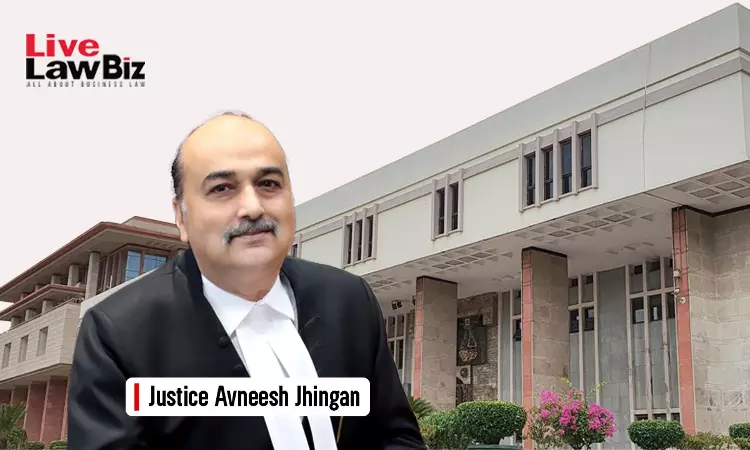
The Delhi High Court on 20 May upheld an arbitral award rejecting Pandrol Rahee Technologies Pvt. Ltd.'s claim for additional payment from IRCON International Ltd. for supplying extra components for ballastless track fastening systems, holding that the contract remained a fixed-price “set-based” agreement despite variations in quantity.
Justice Avneesh Jhingan observed that, “if the argument is taken to its logical end, it would mean that upon variation, the contract would change from a set-based to a component-based contract, which the parties never contemplated.”
The dispute arose from an IRCON tender dated 21 April 2015 for design, manufacture and supply of ballastless track fastening systems for the Mukundpur–Lajpat Nagar corridor of Delhi MRTS Phase-III.
Pandrol Rahee emerged as the successful bidder and was issued the Letter of Acceptance on 21 May 2015. The parties subsequently executed Contract CT-1A on 9 October 2015. Later, by a variation order dated 4 August 2016, the quantity of fastening sets was increased from 1,86,500 to 1,98,715 sets.
The company claimed that the revised quantities and curved track requirements compelled it to supply a 4-bolt fastening system instead of a 2-bolt system for certain curves above 500 metres radius, leading to additional procurement of components such as anchor bolts, bushes and springs and significantly increasing costs.
Arbitration was invoked on 23 August 2019, and a sole arbitrator appointed by the Court rejected all claims in an award dated 15 May 2023. Pandrol Rahee Technologies Pvt. Ltd. then approached the Delhi High Court under Section 34 of the Arbitration and Conciliation Act, 1996, challenging the award.
Before the High Court, Pandrol Rahee argued that Clause 27 mandated fresh rate negotiations for variations exceeding 25 per cent and contended that it was compelled to supply a costlier 4-bolt system for curved tracks.
IRCON, on the other hand, argued that the overall variation was only 6.55 per cent, the agreed rates continued to apply, and the contract barred extra claims arising from DMRC-approved design changes.
The High Court accepted IRCON's stand. It held that despite the Bill of Quantities (BOQ) separately indicating prices for imported and Indian components, transportation, taxes, and amounts payable in USD and INR, the contract remained a fixed-price agreement for supply of complete fastening sets, making the arbitrator's interpretation a plausible view.
It further held that Stipulation No. 6 of the Technical Specifications expressly barred Pandrol Rahee from claiming additional payment for changes in fastening design or bolt configuration approved by the Delhi Metro Rail Corporation (DMRC). The Bench said”
“The claim of the petitioner for payment of additional components over and above the agreed price of the sets is barred by Stipulation No. 6 of the TS.”
It also noted that Pandrol Rahee had commenced supplies even before obtaining DMRC's approval of the fastening design, contrary to contractual stipulations, and reiterated that under Section 34 of the Arbitration and Conciliation Act, courts cannot re-appreciate evidence or set aside an arbitral award merely because another interpretation of the contract is possible.
Accordingly, the High Court upheld the arbitral award and dismissed Pandrol Rahee's petition.
Appearances for petitioner (Pandrol Rahee Technologies Pvt. Ltd.): Advocates Naveen R. Nath, Nishant Das, Atul Kumar, Disha Gupta, Aatrayi Das, Sakshi Nand, Jyoti Jha and Aditya Rana.
Appearances for respondent (IRCON International Ltd.): Advocates Suman K. Doval, Ramesh Wangnoo and Lakshay Chaudhary.