
Delhi High Court Denies Interim Relief To Buyer As Developer's Claims Fail In Arbitration
Shivani PS
26 May 2026 4:20 PM IST
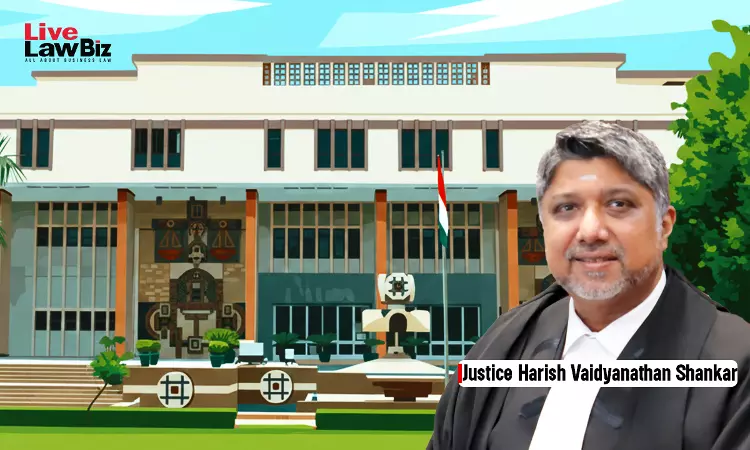
The Delhi High Court has refused interim protection to a purchaser seeking to restrain the creation of third-party rights and maintain status quo over the first floor of a Greater Kailash-I property, holding that the claim could not survive once the developer's claimed authority to create such rights stood rejected in arbitration
Justice Harish Vaidyanathan Shankar held that the buyer's claim was entirely derivative of the Collaboration Agreement executed between developer Aditya Bhutani and the property owner, under which Bhutani had claimed authority to deal with the property.
“The present Petition, in effect, seeks protection and enforcement of rights which are entirely derivative of the claims asserted by Respondent No. 1 under the Collaboration Agreement. Once those claims themselves have been negatived by a binding arbitral award presently operating in law, this Court cannot, in exercise of jurisdiction under Section 9 of the A&C Act, grant interim reliefs which would directly or indirectly defeat, dilute, or render ineffective the findings returned in the arbitral award dated 03.02.2026” the Court observed.
“In the aforesaid circumstances, once the very source of authority claimed by Respondent No. 1 to execute transactions or create rights in relation to the subject property has been rejected by the learned Arbitral Tribunal, there remains no legal basis for continuation of the present Petition insofar as it seeks interim protection founded upon such rights,” it added.
The dispute concerned property bearing No. E-135, Greater Kailash-I, New Delhi.
Bhutani had entered into a Collaboration Agreement dated January 6, 2023 with the property owner for redevelopment and reconstruction of the property.
On March 10, 2023, Bhanu Arora entered into an Agreement to Sell with Bhutani for the proposed first floor of the property.
Disputes between Bhutani and the property owner later went to arbitration, where the tribunal rejected Bhutani's claims, including his claim of authority to execute sale-related documents.
Arora then moved the High Court seeking status quo over the property and restraint on creation of third-party rights.
The property owner argued that no interim relief against her was maintainable in these proceedings since she had already been deleted from the array of parties in earlier proceedings for appointment of an arbitrator on the ground that she was not a signatory to the arbitration agreement between Arora and Bhutani.
Arora, on the other hand, argued that the Collaboration Agreement vested sufficient authority in Bhutani to deal with and transact in relation to the first floor of the property.
Reliance was also placed on an invocation notice dated May 4, 2025 and a clarificatory order dated February 6, 2026 stating that all rights and contentions, including issues relating to impleadment of non-signatories, remained open.
Rejecting these submissions, the Court held that the Agreement to Sell “derives its legitimacy, enforceability, and underlying legal foundation” from the Collaboration Agreement and that the rights asserted by Arora were “not independent or standalone in nature.”
The Court also held that no interim relief against the property owner was maintainable in these proceedings since she was neither a signatory to the arbitration agreement nor a party to the arbitral proceedings between Arora and Bhutani.
Accordingly, the court dismissed the petition while clarifying that Arora would remain free to pursue remedies against Bhutani before the arbitral tribunal already constituted between them.
For Petitioner (Bhanu Arora): Advocates Sachin Chopra, Astha Gupta.
For Respondent (Respondent No. 2): Advocates Shyamal Kumar, Apoorva Pal.