
Arbitration | Supreme Court Asks Law Commission To Examine Uniform Framework For Award Deposits In Appeals
Shivani PS
19 Sept 2026 11:54 AM IST
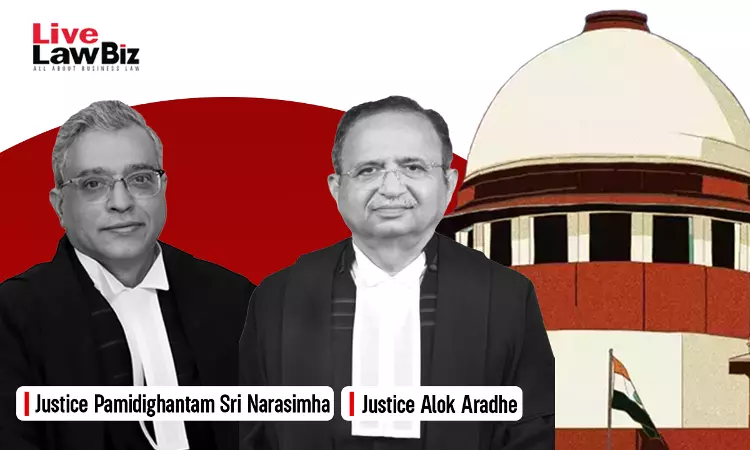
The Supreme Court has asked the Law Commission of India to examine the need for a uniform system governing money deposited with courts and tribunals during appeals.
The exercise will cover where such money should be kept, how it should earn interest, and how the deposit and interest should ultimately be adjusted between the parties.
The direction came while the top court held that National Seeds Corporation Ltd. remained liable to pay 12% interest on an arbitral award amount despite having deposited money in court. The money had been deposited as a condition for staying the award and was not freely available to National Agro Seed Corporation (India) for withdrawal.
A Bench of Justice Pamidighantam Sri Narasimha and Justice Alok Aradhe held that a deposit in court does not by itself stop interest from running. For interest liability to cease, the payment must comply with Order XXI Rule 1 of the Code of Civil Procedure, which lays down the modes of paying money under a decree.
The bench ruled, “A deposit of the amount in the court has to be made unconditionally and the same must be available to the decree-holder for withdrawal, in order to make the deposit in consonance with Order XXI Rule 1 of the Code.”
It further held, “If the deposit is not made in terms of Order XXI Rule 1 of the Code, the interest continues to run on the amount after the deposit.”
The dispute arose from a June 13, 2019 arbitral award directing National Seeds to pay about ₹1.46 crore to National Agro, along with 12% annual interest from August 26, 2017 until the date of the award. National Seeds challenged the award under Section 34 of the Arbitration and Conciliation Act, 1996, which allows a party to seek setting aside of an arbitral award on specified grounds.
The Delhi High Court stayed enforcement of the award on the condition that National Seeds deposit 50% of the principal amount. It deposited ₹73.20 lakh in November 2019.
After the Section 34 challenge was rejected, National Agro sought to withdraw the money. National Seeds opposed the withdrawal and later deposited another ₹1.53 crore after the executing court directed it to deposit the balance amount.
The Delhi High Court's executing court ultimately held that National Seeds had to pay 12% interest from June 13, 2019 until September 8, 2022, when the deposited amount was ordered to be released without conditions.
Before the top court, National Seeds argued that the deposit should have stopped interest on the amount deposited. National Agro argued that the money had never been freely available to it and that National Seeds had resisted its withdrawal.
The Supreme Court rejected National Seeds' contention.
It noted that the first deposit was made to secure a stay of the award and was not accompanied by the notice required under Order XXI Rule 1(2). National Seeds also resisted National Agro's attempts to withdraw the money after its challenge to the award had failed.
The court further noted that an order allowing National Agro to withdraw ₹1 crore was made subject to its furnishing title deeds as security. Since the money was not unconditionally available to National Agro, the deposit did not satisfy Order XXI Rule 1.
The bench therefore held that National Seeds' liability to pay interest had not ceased.
The court then examined the wider problem of how deposits made during appeals are handled. It observed that there is no statutory prescription or uniform rule governing such deposits.
Different courts and tribunals follow different approaches on the amount to be deposited, where the money should be invested, the interest it should earn, and how that interest should ultimately be adjusted.
The Supreme Court observed that disputes over such deposits arise frequently enough to require a clearer and more uniform approach. It said a consistent system was needed for determining how decretal amounts should be deposited during an appeal, how interest earned on those deposits should be accounted for and how the money and accrued interest should be adjusted when the dispute is finally settled.
The judgment noted that the absence of common standards affects both sides. An award-holder may be unable to use money awarded in its favour, while an award-debtor loses control of the money after depositing it. Different approaches across forums can also result in similarly placed parties being treated differently.
The bench asked the Law Commission to examine these issues and consider the systems followed in other countries. It also suggested that the Law Commission may consult the Reserve Bank of India, Ministry of Finance and the nodal Ministry of Law and Justice.
“We request the Law Commission of India to examine the issues which we have highlighted and, in the process, also consider the laws which other countries have enacted. It may be necessary for the Law Commission to consult the Reserve Bank of India, Ministry of Finance and also the Nodal Ministry of Law and Justice,” the bench observed.
The apex court accordingly upheld the Delhi High Court's order directing National Seeds to pay 12% annual interest from June 13, 2019, until September 8, 2022.
For Appellant (National Seeds Corporation Ltd.): Advocate Yashvardhan.
For Respondent (National Agro Seed Corporation (India)): Advocate Ashutosh Kumar.